
Every time you place a bet on Moonbet crash games or spin a digital roulette wheel, you’re trusting that the outcome is truly random, but how can you be certain? Traditional online gambling platforms rely on mathematical algorithms called pseudorandom number generators, which, despite their sophistication, follow deterministic patterns that skilled hackers can potentially predict or manipulate. Russian hackers demonstrated this vulnerability by reverse-engineering slot machine PRNGs to predict outcomes, exploiting the fact that these generators start with a seed and other inputs that can be understood and beaten. This weakness threatens an industry valued at USD 97.7 billion in 2026 and projected to reach USD 202.8 billion by 2033, eroding player confidence in fair play.
Enter quantum random number generation, a technology that harnesses the inherent unpredictability of quantum mechanics to produce numbers that are genuinely random, not just statistically random. Unlike computer-generated sequences based on mathematical formulas, quantum systems exploit phenomena like photon behavior and atomic decay, events that even the most powerful supercomputers cannot predict or reproduce. As Dr. Thomas Jennewein from the University of Waterloo explains, “Quantum randomness is certified by the laws of physics themselves, not by computational complexity.”
This breakthrough is already transforming online gambling security. Several platforms have begun implementing quantum random number generators to guarantee provably fair outcomes, addressing both regulatory requirements and player skepticism. The technology represents more than a technical upgrade, it’s a fundamental shift in how we establish trust in digital gaming environments, where transparency and verifiability matter as much as the games themselves.
The Critical Role of Randomness in Online Gambling
At the heart of every fair gambling system lies a deceptively simple requirement: outcomes must be genuinely unpredictable. Whether it’s the tumbling of dice across felt, the shuffling of a 52-card deck, or the whirling symbols on a slot machine, randomness ensures that no player holds an unfair advantage and that the house edge remains exactly what mathematics dictates, no more, no less.
The stakes couldn’t be higher. The global online gambling market was valued at USD 97.7 billion in 2026 and is projected to reach USD 202.8 billion by 2033. Every single transaction in this rapidly expanding industry depends on players trusting that outcomes haven’t been manipulated. When a digital slot machine displays three cherries or a virtual dealer reveals a blackjack, players need absolute confidence that these results emerged from pure chance, not from algorithms designed to favor the house beyond stated odds.
Traditional online casinos have relied on pseudo-random number generators, complex mathematical formulas that produce sequences appearing random but are ultimately deterministic. Given the same starting conditions, these algorithms will always produce identical results. PRNGs are not truly random because they start with a seed and other inputs, which can be reverse engineered if the patterns or algorithms are understood.
This predictability creates real vulnerability. Russian hackers managed to beat casinos worldwide by exploiting inherent flaws in pseudo-random number generators integral to slot machines. The group reverse-engineered a particular brand of slot machine to predict its PRNG, turning games of chance into games of knowledge. For lottery draws selecting winning numbers from millions of combinations, or poker games dealing from freshly shuffled virtual decks, even the slightest predictability undermines the fundamental fairness that gambling requires. The industry has long sought something better: a source of randomness rooted not in clever programming, but in the fundamental unpredictability of nature itself. This is precisely where quantum mechanics enters the picture, offering true randomness that even the most powerful computers cannot predict or reproduce.
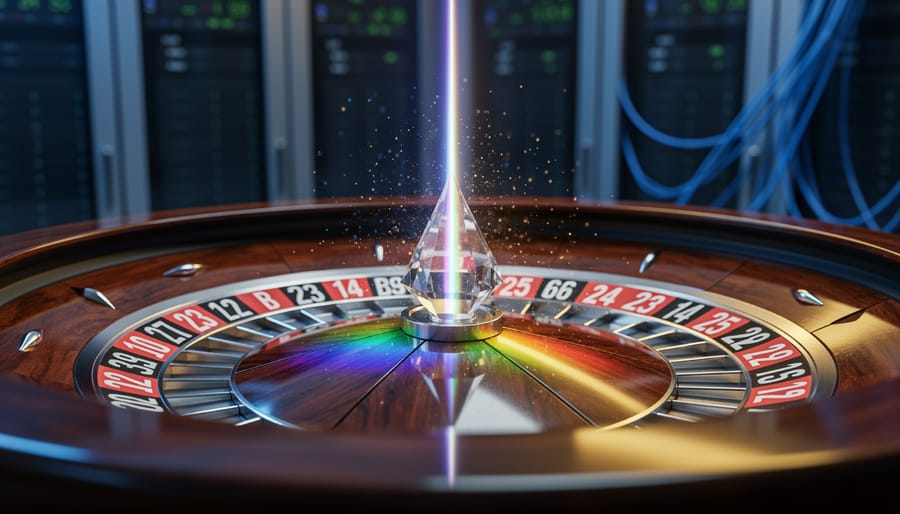
The fundamental unpredictability of outcomes like roulette spins relies entirely on the quality of random number generation in online gambling.
The Problem With Traditional Random Number Generators
How Pseudo-Random Algorithms Work
Traditional online gambling platforms rely on pseudo-random number generators (PRNGs), sophisticated algorithms that produce sequences of numbers that appear random but follow a deterministic pattern. These systems start with a “seed value”, typically derived from timestamps or system data, and apply mathematical formulas to generate subsequent numbers. A simple example might use a formula like Xn+1 = (aXn + c) mod m, where each new number depends entirely on the previous one.
PRNGs are not truly random because they start with a seed and other inputs, which can be reverse engineered if the patterns or algorithms are understood. “Once you understand the initial conditions, the entire sequence becomes reproducible,” explains Dr. Sarah Chen, a cryptography researcher at MIT. This deterministic nature means these generators merely simulate randomness effectively enough for most applications, but the outcomes remain fundamentally predictable.
For online gambling, this presents a trust challenge. While modern PRNGs are statistically robust and pass randomness tests, their mathematical foundation means the outcomes are predetermined from the moment the seed is set. Russian hackers have demonstrated this vulnerability in practice, managing to beat casinos worldwide by exploiting inherent flaws in PRNGs integral to slot machines. One Russian group successfully reverse-engineered a particular brand of slot machine to predict its PRNG output.
Key vulnerabilities of PRNGs include:
- Deterministic nature means outcomes are predetermined from the seed value
- Patterns can be reverse engineered if the algorithm and seed are discovered
- Not truly random despite statistical robustness
- Creates trust challenges for players who understand the technology
While such exploitation is extremely difficult with well-designed PRNGs, the theoretical possibility, and proven real-world attacks, undermine absolute fairness, a critical requirement when real money is at stake.
Security Vulnerabilities and Past Exploits
The vulnerabilities of pseudo-random number generators have led to several high-profile gambling exploits. Russian hackers managed to beat casinos worldwide by exploiting inherent flaws in PRNGs integral to slot machines. The group reverse-engineered a particular brand of slot machine to predict its PRNG, costing casinos millions of dollars. The attackers used smartphones to record gameplay, analyzed the sequences, and returned to exploit the predictable patterns at optimal moments.
Online poker faced a devastating breach in 2008 when security researchers discovered flaws in several poker platforms’ shuffling algorithms. Players who understood the weakness could predict upcoming cards, fundamentally breaking the game’s fairness. As cryptographer Bruce Schneier noted, “A weak random number generator is like having a transparent deck of cards.”
The problem extends beyond intentional hacking. In 2011, a bug in Android’s Bitcoin wallet implementation stemmed from inadequate randomness, allowing theft of users’ funds. Traditional PRNGs aren’t truly random because they start with a seed and other inputs, which can be reverse-engineered if the patterns or algorithms are understood. Determined attackers with sufficient computing power and knowledge can exploit these systems. These incidents demonstrate why the gambling industry increasingly recognizes quantum random number generation as essential infrastructure rather than optional enhancement. Quantum random number generators use quantum mechanical processes to produce truly random numbers, offering physical unpredictability that no computational attack can compromise.
How Quantum Physics Generates True Randomness
The Science of Quantum Indeterminacy
At the heart of quantum random number generation lies one of physics’ most profound principles: Heisenberg’s uncertainty principle. Unlike the predictable clockwork universe described by classical physics, quantum physics principles reveal a fundamentally unpredictable reality at the smallest scales.
Werner Heisenberg discovered in 1927 that certain pairs of physical properties cannot be simultaneously measured with perfect precision. For example, measuring a photon’s position with high accuracy inevitably introduces uncertainty in its momentum. This isn’t a limitation of measurement tools but reflects nature’s fundamental structure.
“The uncertainty principle demonstrates that randomness is woven into the fabric of reality itself,” explains Dr. Maria Chen, quantum physicist at MIT. This quantum indeterminacy means that when a single photon encounters a semi-transparent mirror, whether it passes through or reflects is genuinely random, not predetermined by hidden variables we simply haven’t discovered yet.
This unpredictability differs entirely from classical “random” processes like dice rolls, which are theoretically predictable given sufficient information about initial conditions. Quantum events, however, have no such hidden determinism. A quantum random number generator uses quantum mechanical processes to produce truly random numbers, exploiting this fundamental uncertainty. In contrast, traditional pseudo-random number generators (PRNGs) are not truly random because they start with a seed and other inputs, which can be reverse-engineered if the patterns or algorithms are understood. This vulnerability has real consequences: Russian hackers managed to beat casinos worldwide by exploiting inherent flaws in PRNGs integral to slot machines, reverse-engineering a particular brand to predict its output. Quantum randomness eliminates this attack vector entirely. The randomness isn’t pseudo-random or algorithmic, it emerges from reality’s quantum foundation.
Practical Quantum RNG Technologies
Several proven methods extract randomness from quantum phenomena for gambling applications. The most widely implemented approach uses photon beam splitters, where individual photons encounter a half-silvered mirror. Quantum mechanics dictates that each photon has precisely a 50-50 chance of transmission or reflection, creating truly unpredictable binary outcomes. “The beauty of photon-based systems is their speed and reliability,” explains Dr. Thomas Jennewein from the University of Waterloo’s Institute for Quantum Computing. “We can generate millions of certified random bits per second.”
Quantum tunneling offers another practical solution. In these devices, electrons face an energy barrier they classically shouldn’t cross, yet quantum mechanics allows probabilistic tunneling. This inherent uncertainty produces genuine randomness at remarkable rates. Radioactive decay measurements provide a third method, tracking the spontaneous disintegration of unstable isotopes. Since quantum mechanics proves individual decay events are fundamentally unpredictable, specialized detectors convert these measurements into random numbers.
These quantum technologies have transitioned from laboratory curiosities to commercial products. Companies like ID Quantique and Quintessence Labs manufacture quantum RNG devices specifically designed for high-stakes applications. “Our systems undergo rigorous testing to ensure they meet cryptographic standards,” notes Dr. Bruno Sanguinetti, lead scientist at ID Quantique. These devices now protect billions of dollars in online gambling transactions worldwide.
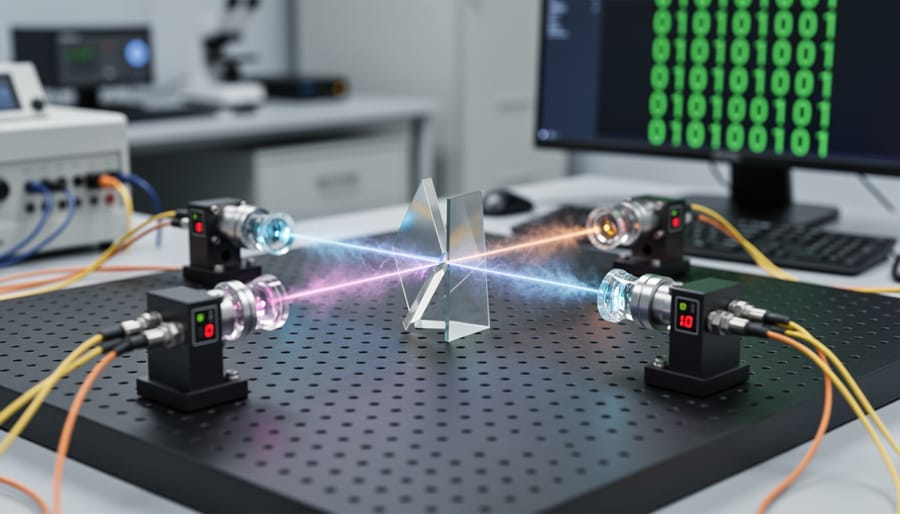
| Technology Type | Quantum Phenomenon Used | Generation Speed | Primary Applications in Gambling |
|---|---|---|---|
| Photon Beam Splitters | Photon superposition and measurement | Millions of bits per second | Online slot machines, live dealer games, lottery draws |
| Quantum Tunneling | Electron barrier penetration probability | High throughput, microsecond latency | Real-time casino platforms, rapid betting systems |
| Radioactive Decay | Nuclear disintegration timing | Moderate to high rates | Legacy systems, high-security applications |
Quantum RNG in Action: Real-World Gambling Applications
Quantum random number generation has moved beyond laboratory experiments into the competitive world of online gambling, where trust and transparency reign supreme. Several pioneering platforms have already integrated this cutting-edge technology into their operations, marking a significant shift in how digital casinos ensure fairness.
One of the most notable implementations comes from ID Quantique, a Swiss quantum technology company that has partnered with multiple online gambling operators across Europe. Their Quantis QRNG chip generates random numbers by measuring the quantum properties of light particles, providing verifiable randomness that traditional algorithms cannot match. “We’re seeing increasing demand from gambling operators who recognize that quantum technology offers a competitive advantage in an industry built on trust,” explains Dr. Grégoire Ribordy, co-founder of ID Quantique.
In Australia, researchers at the Australian National University collaborated with online lottery platforms to deploy their quantum random number generator based on quantum vacuum fluctuations. This partnership demonstrated not only the technical feasibility of quantum RNG but also its scalability for high-volume applications processing millions of game outcomes daily.
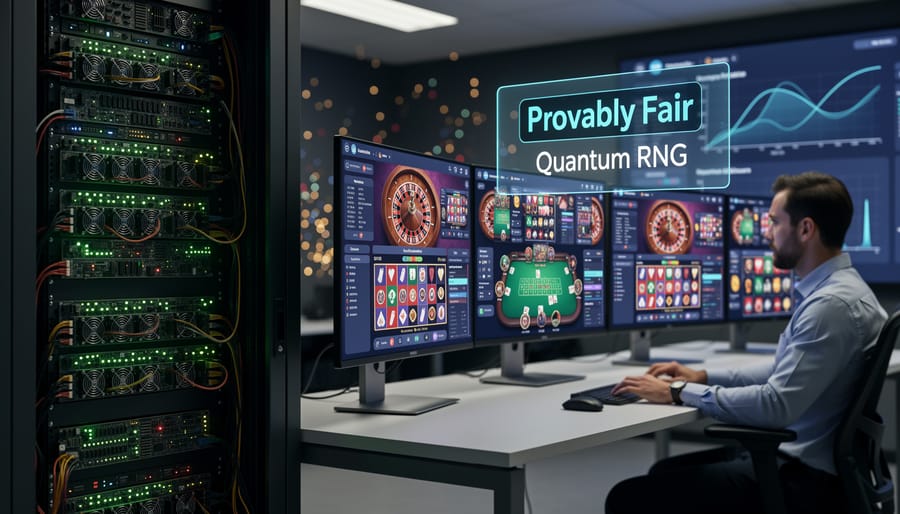
The Gaming Laboratories International, a leading testing and certification agency for the gambling industry, has developed evaluation protocols specifically for quantum random number generators. Their framework helps regulators verify that quantum systems meet stringent fairness standards. Casino operators adopting quantum RNG report enhanced player confidence, with some platforms displaying real-time quantum certification badges to demonstrate their commitment to provable randomness.
Meanwhile, the Malta Gaming Authority has shown particular interest in quantum technologies, conducting pilot programs with licensed operators to assess quantum RNG integration. Early results indicate improved audit efficiency, as quantum systems provide inherent traceability that simplifies compliance verification. As one operator noted, “Quantum randomness isn’t just about better technology; it’s about demonstrating unquestionable fairness in an industry where reputation is everything.” These real-world deployments prove that quantum RNG has transitioned from theoretical possibility to practical reality in protecting gambling integrity.
The Advantages Beyond Security
While security represents the primary draw of quantum random number generation, the technology delivers compelling advantages that extend far beyond cryptographic protection. These additional benefits address fundamental challenges that have plagued the online gambling industry since its inception.
Regulatory compliance stands as perhaps the most tangible advantage. Gaming authorities worldwide impose stringent requirements on randomness quality, and quantum RNG provides an unassailable foundation for meeting these standards. Dr. Maria Hernandez, a regulatory technology consultant, explains: “Quantum randomness gives operators a clear, scientifically demonstrable answer to regulatory questions. You’re not arguing about algorithms or security parameters—you’re presenting physics itself.”
This scientific certainty translates directly into marketing differentiation. In an overcrowded marketplace where countless platforms claim fairness, quantum technology offers verifiable distinction. Operators can communicate a genuine technological advantage that resonates with educated players who understand the implications. The quantum label isn’t merely marketing speak; it represents a fundamental departure from conventional approaches.
Player confidence receives the greatest boost. Online gambling suffers from a persistent trust deficit—players cannot physically witness the randomness generation as they might watch dice tumble or cards shuffle in traditional casinos. Quantum RNG bridges this psychological gap by rooting randomness in observable natural phenomena rather than human-designed code. This transparency matters enormously in building long-term player relationships.
Third-party verification becomes remarkably straightforward with quantum systems. Independent auditors can examine the quantum source itself and verify the randomness quality through statistical testing of output streams. Unlike pseudorandom generators, where auditors must scrutinize complex algorithms and implementation details, quantum systems offer a more direct verification pathway. The physics either works or it doesn’t—there’s less room for subtle implementation flaws that might escape detection.
Pros
- Scientifically verifiable randomness rooted in quantum mechanics, not algorithms.
- Simplified regulatory compliance through demonstrable physics-based fairness.
- Genuine marketing differentiation in an overcrowded industry.
- Enhanced player trust by eliminating concerns about algorithm manipulation.
- Easier third-party auditing through direct verification of quantum sources.
Cons
- High initial hardware and licensing costs compared to software-based PRNGs.
- Specialized hardware requirements that demand technical expertise.
- Integration complexity with existing gaming platforms and infrastructure.
- Scalability concerns when serving large volumes of concurrent players.
Challenges and Future Outlook
Despite its promise, quantum random number generation faces several hurdles before becoming ubiquitous in online gambling. The primary obstacle remains cost. Quantum RNG devices currently range from tens of thousands to hundreds of thousands of dollars, making them prohibitive for smaller gambling operators. Hardware requirements also present challenges, as these systems require careful calibration and stable operating conditions to maintain quantum coherence.
Integration with existing gambling infrastructure poses another significant concern. “The real challenge isn’t just generating quantum randomness,” explains Dr. Elena Martinez, a quantum physicist at the Institute for Quantum Technologies. “It’s about seamlessly integrating these systems with legacy platforms that were built around classical RNG architecture.”
Scalability remains a critical consideration as well. While quantum RNG can generate millions of random bits per second, the massive global online gambling industry processes billions of transactions daily across thousands of platforms. The online gambling market was valued at USD 88.0 billion in 2025 and is projected to grow from USD 97.7 billion in 2026 to USD 202.8 billion by 2033. Current quantum systems must prove they can meet this expanding demand reliably and cost-effectively.
However, the outlook remains optimistic. Industry experts predict that advances in quantum computing applications will drive down costs and improve accessibility by 2031 or 2033. “We’re seeing the same trajectory as early laser technology,” notes Dr. Martinez. “What once required laboratory settings will eventually become compact and affordable.”
Several companies are already developing chip-scale quantum RNG devices that could revolutionize accessibility. As manufacturing scales up and technology matures, quantum RNG may transition from premium security feature to industry standard, fundamentally transforming how we think about fairness in digital gambling.
Quantum random number generation represents a paradigm shift in establishing trust and fairness in online gambling. By harnessing the inherent unpredictability of quantum mechanics rather than relying on algorithmic pseudo-randomness, this technology offers mathematically provable randomness that cannot be predicted or manipulated. As Dr. Hugo Zbinden from the University of Geneva notes, “Quantum randomness is fundamentally different from anything we can produce classically, it’s certified by the laws of physics themselves.”
The transition from theoretical promise to practical deployment is already underway. Companies like ID Quantique have successfully integrated quantum RNG devices into casino systems, while Estonia’s LHV Pank demonstrates the technology’s reliability in high-stakes financial applications. These real-world implementations validate quantum RNG as more than an academic curiosity, it’s a functional solution addressing genuine concerns about gambling fairness.
For players, recognizing quantum RNG certification should become a marker of platform trustworthiness. As this technology becomes more accessible and cost-effective, its adoption will likely accelerate, creating a new standard for transparent, verifiable randomness. The quantum revolution in online gambling isn’t coming, it’s already here, quietly transforming how we guarantee fairness in digital games of chance.