

Climate change affects the biosphere by altering temperature regimes, precipitation patterns, and atmospheric composition in ways that disrupt ecosystems, shift species distributions, and threaten biodiversity. At the same time, the biosphere serves as Earth’s most important natural buffer against warming, with forests, oceans, and soil systems absorbing roughly half of human-generated carbon emissions each year.
This two-way relationship sits at the heart of our planetary future. Rising temperatures are already pushing species toward the poles, bleaching coral reefs, and intensifying wildfires that reshape entire landscapes. Yet the same living systems under threat hold remarkable potential to slow warming if we protect and restore them strategically.
Understanding these dynamics matters now more than ever. By 2026, climate impacts on ecosystems have accelerated beyond many earlier projections, while solutions involving nature-based carbon capture have moved from theoretical promise to practical implementation. The biosphere doesn’t respond to warming as a passive victim. It fights back through carbon sequestration, provides critical cooling through water cycling, and adapts through evolutionary responses that unfold across generations.
This article explores both sides of the climate-biosphere connection. We’ll examine the mechanisms through which warming disrupts living systems, from cellular stress responses to continent-scale migrations. Then we’ll investigate how biological processes can help reverse the trend, including the role of low-carbon energy transitions that reduce pressure on natural systems. The science reveals challenges, certainly, but also pathways forward grounded in ecology’s fundamental resilience.
What the Biosphere Means in Climate Science
The biosphere encompasses every place on Earth where life exists, from deep-ocean vents to high-altitude clouds, forming an interconnected web of living organisms and their environments. In climate science, this global biological layer is not just a passive backdrop, it is an active player that shapes atmospheric composition, regulates temperature, and determines how much carbon dioxide remains in the air versus being locked away in living tissue and soils.
Think of the biosphere as having three overlapping zones: terrestrial ecosystems on land (forests, grasslands, tundra), marine environments in oceans and freshwater, and the atmospheric realm where microbes drift and birds migrate. These zones are not separate; they exchange energy, water, and chemical elements constantly. A coastal mangrove forest, for instance, connects terrestrial plant growth with marine nutrient cycles while influencing local humidity and temperature patterns.
Understanding a few core concepts helps clarify the biosphere’s climate role:
- Biosphere
- The global sum of all living organisms and the ecosystems they create, extending from deep ocean floors to several kilometres into the atmosphere.
- Ecosystem services
- Benefits that ecosystems provide to humans and the planet, including climate regulation, water purification, and nutrient cycling.
- Carbon sink
- Any natural system that absorbs and stores more carbon dioxide from the atmosphere than it releases, such as forests, oceans, and soils.
- Primary productivity
- The rate at which plants and other photosynthetic organisms convert sunlight and CO2 into biomass, forming the foundation of all food webs.
- Trophic levels
- Hierarchical positions in a food chain, from primary producers (plants) through herbivores to carnivores, each transferring energy and carbon through the system.
The biosphere-atmosphere carbon exchange represents one of Earth’s most consequential processes. Through photosynthesis, plants pull roughly 120 billion tonnes of carbon from the atmosphere annually, converting it into leaves, wood, roots, and eventually soil organic matter. Respiration by plants, animals, and decomposers returns much of this carbon to the air, creating a dynamic balance. When this balance tips, whether from deforestation removing carbon sinks or warming soils releasing stored carbon, the atmosphere accumulates more CO2, amplifying climate change. This two-way flow makes the biosphere both vulnerable to climate disruption and essential to any solution.
How Climate Change Disrupts Living Systems
Temperature Shifts and Species Distribution
Warming temperatures fundamentally reshape where and when organisms live. As regional climates shift, many species move toward cooler areas, poleward in latitude or upward in elevation, tracking the temperature zones they evolved to tolerate. Arctic species like polar bears and ice-dependent seals face shrinking habitats as sea ice retreats, while temperate species push northward into formerly frigid zones. A 2024 study from the University of Helsinki documented boreal forest species colonizing tundra at unprecedented rates, fundamentally altering ecosystem composition.
These range shifts create mismatches in ecological timing called phenological disruption. Spring arrives earlier in temperate regions, triggering earlier leaf-out and flowering, but not all species respond uniformly. Migratory birds may arrive to find peak insect abundance has already passed, reducing breeding success. Marine ecosystems show similar patterns, warmer waters off New England have pushed cod northward while southern species like black sea bass move in, disrupting established fisheries and food webs.
Tropical species face a different challenge: already living near their thermal limits, many have nowhere cooler to go. Research from the Smithsonian Tropical Research Institute shows that even modest warming forces montane cloud forest species upslope until they run out of mountain. Species trapped in lowland tropical forests experience heat stress that reduces growth and survival, particularly during compound extremes of heat and drought. The result is not just individual species loss but wholesale restructuring of communities that evolved together over millennia.
Ocean Acidification and Marine Ecosystems

The ocean absorbs roughly a quarter of the carbon dioxide we emit, acting as a massive climate buffer. But this comes at a cost. When CO2 dissolves in seawater, it forms carbonic acid, lowering the ocean’s pH and making it harder for marine organisms to build and maintain calcium carbonate shells and skeletons. Since pre-industrial times, ocean acidity has increased by about 30%, a pace unprecedented in the geological record.
Coral reefs face the sharpest threat. Acidification slows coral growth rates and weakens existing structures, leaving reefs vulnerable to storms and disease. When combined with warming waters that trigger bleaching events, the compounding stress pushes entire reef systems toward collapse. Dr. Emily Darling of the Wildlife Conservation Society notes that “we’re seeing cascading effects ripple through marine food webs as foundation species like corals disappear, displacing fish communities and destabilizing ecosystems that billions of people depend on for food and coastal protection.”
Shellfish populations tell a similar story. Oyster larvae struggle to form shells in acidified water, leading to massive die-offs in commercial hatcheries along the U.S. West Coast. Pteropods, tiny swimming snails that form a crucial link in the Arctic food chain, show shell dissolution in waters that have already crossed critical pH thresholds. These losses reverberate upward, affecting salmon, seabirds, and marine mammals that depend on shellfish as prey. The disruption extends beyond individual species, fundamentally altering how energy and nutrients flow through marine ecosystems.
Extreme Weather and Ecosystem Resilience
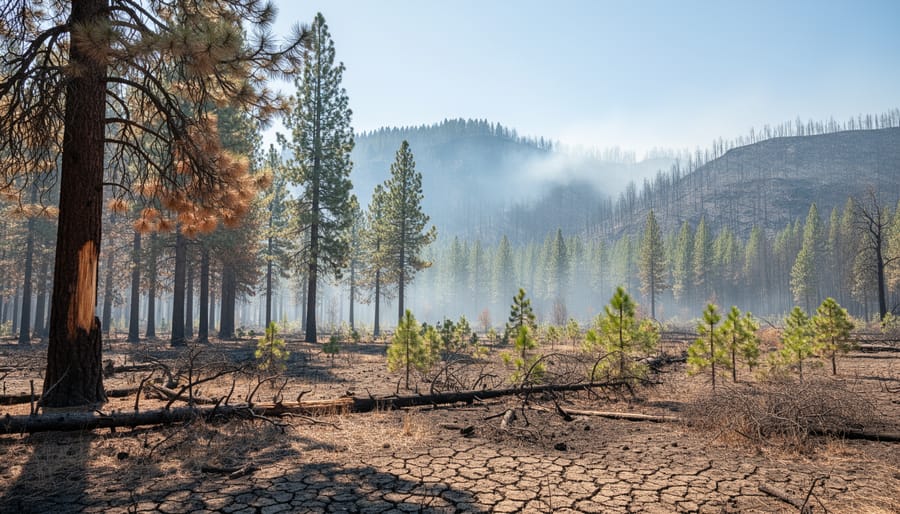
Climate extremes strike ecosystems with devastating force and increasing frequency. Prolonged droughts shrivel vegetation, kill trees en masse, and trigger cascading failures through food webs as plants, herbivores, and predators alike struggle for survival. California’s 2012-2016 drought killed over 147 million trees in the Sierra Nevada, fundamentally altering forest structure and creating tinderbox conditions that fueled subsequent megafires.
Floods reshape landscapes overnight, washing away topsoil built over centuries and drowning organisms unable to escape. Coastal storm surges inundate wetlands with saltwater, poisoning freshwater-dependent species. Wildfires, now burning hotter, larger, and more frequently, don’t just consume biomass; they transform soil chemistry, eliminate seed banks, and convert carbon-storing forests into carbon sources for years afterward.
Each extreme event chips away at biodiversity. Species already stressed by gradual warming face sudden shocks that exceed their adaptive capacity. Local extinctions follow, simplifying ecosystems and severing the intricate relationships between pollinators, seed dispersers, predators, and prey.
The compounding problem is resilience erosion. Ecosystems need recovery time between disturbances to rebuild biomass, restore nutrient cycles, and replenish populations. When droughts stack upon fires, or floods arrive before storm-damaged forests regenerate, systems lose their bounce-back ability. This degraded state means fewer ecosystem services, diminished water filtration, reduced pollination, collapsed fisheries, precisely when human communities need nature’s support most during climate disruption.
Feedback Loops That Amplify Change
Climate change doesn’t just push the biosphere in one direction, it triggers self-reinforcing cycles that accelerate warming far beyond the initial impact of human emissions. These positive feedback loops occur when changes in living systems amplify rather than buffer climate shifts, creating a dangerous spiral that makes future warming harder to prevent.
The biosphere contains several major feedback mechanisms that intensify climate change:
- Permafrost thaw releases methane and CO2 from previously frozen organic matter, adding greenhouse gases that cause more warming and more thaw
- Forest dieback from drought and heat stress converts carbon sinks into carbon sources as dead trees decompose and wildfires increase
- Arctic sea ice loss exposes dark ocean water that absorbs more solar radiation than reflective ice, accelerating regional warming
- Tropical forest degradation reduces rainfall through decreased evapotranspiration, causing further drought stress and tree mortality
- Peatland drainage and burning releases centuries of stored carbon while eliminating future sequestration capacity
The permafrost feedback illustrates why these loops matter so urgently. Arctic soils hold roughly twice as much carbon as the entire atmosphere, locked in frozen ground that’s remained stable for millennia. As temperatures rise, this permafrost thaws and microbes begin decomposing the organic matter, releasing methane, a greenhouse gas 28 times more potent than CO2 over a century. University of Alaska researchers found that thermokarst lakes, formed by thawing permafrost, can emit ten times more methane than previously estimated. Each degree of warming unlocks more carbon, which drives additional warming, which thaws more permafrost.
Forest feedbacks operate through multiple pathways simultaneously. When drought weakens trees, they become vulnerable to beetle infestations that kill vast areas of forest. Dead trees stop absorbing CO2 and eventually release their stored carbon through decomposition or wildfire. Meanwhile, the loss of forest cover reduces moisture recycling, trees pump water vapor into the atmosphere through their leaves, which forms clouds and generates rainfall. Fewer trees mean less rain, which stresses remaining forests further.
What makes these feedbacks particularly concerning is their potential to create tipping points where the biosphere shifts from climate ally to climate amplifier, regardless of future emission reductions.
The Biosphere’s Natural Climate Solutions
Forests as Carbon Warehouses
Forests function as Earth’s largest terrestrial carbon sinks, pulling CO2 from the atmosphere through photosynthesis and locking it away in wood, roots, and soil for decades or centuries. Trees convert atmospheric carbon into cellulose and lignin, the structural materials of trunks, branches, and root systems, while forest soils accumulate additional carbon from decomposing leaves and organic matter. This dual storage mechanism makes forests irreplaceable climate regulators.
Not all forests sequester carbon at the same rate. Tropical rainforests, despite covering just seven percent of land surface, store roughly 250 billion tons of carbon in their biomass and soils. Their year-round growing seasons and dense vegetation make them carbon-capture powerhouses. Temperate forests in mid-latitudes grow more slowly but store carbon reliably across centuries, with mature hardwood stands accumulating 150-200 tons per hectare. Boreal forests, the vast coniferous belts across Canada, Russia, and Scandinavia, sequester carbon more gradually due to cold climates limiting growth, yet their extensive peatlands hold massive carbon reserves accumulated over millennia.
Recent research from Yale University has quantified forest restoration’s mitigation potential at 205 gigatons of carbon, roughly 20 years of current global emissions. Scientists at ETH Zurich mapped 900 million hectares of land suitable for reforestation without competing with agriculture, demonstrating that natural regrowth could capture two-thirds of human-made carbon emissions if we protect and expand forest cover.
The critical variable is time. Young forests absorb carbon rapidly during their first 50 years, but old-growth forests continue storing carbon while providing irreplaceable biodiversity habitat. Protecting existing forests prevents immediate carbon release, while strategic reforestation builds future sequestration capacity.
Oceans and Blue Carbon Ecosystems
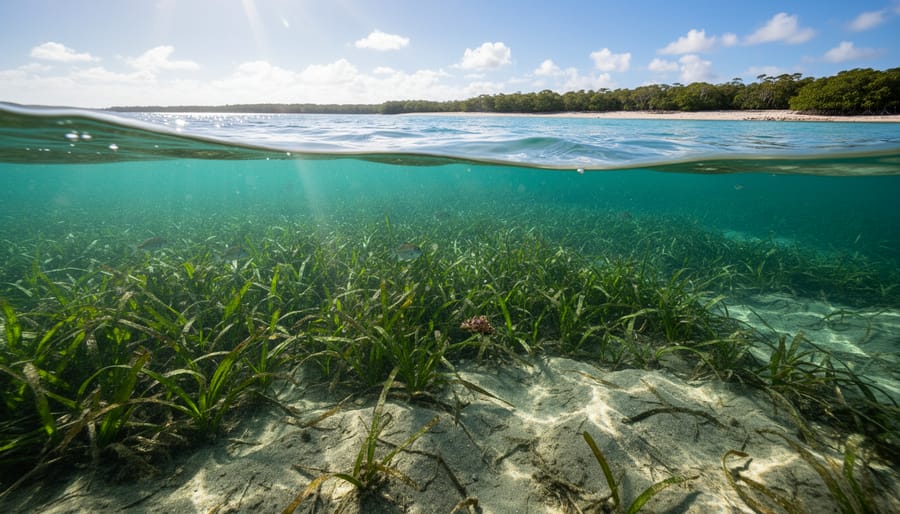
Oceans absorb roughly a quarter of the carbon dioxide humans release into the atmosphere each year, and much of that sequestration happens through living coastal and marine ecosystems. “Blue carbon” refers to carbon captured by these ocean and coastal environments, particularly mangroves, seagrass meadows, and salt marshes, which store carbon in their biomass and, crucially, in the sediments beneath them.
What makes these systems exceptional is their storage efficiency. While they cover less than 2% of the ocean floor, coastal blue carbon ecosystems sequester carbon at rates up to 40 times higher per area than terrestrial forests. Mangroves, for instance, trap organic matter in their tangled root systems, where waterlogged, oxygen-poor sediments slow decomposition dramatically. Carbon gets locked away for centuries or even millennia in these underwater soils.
Seagrass meadows perform a similar function, capturing carbon through photosynthesis while their dense root networks stabilize sediment. A single hectare of seagrass can store twice as much carbon as a terrestrial forest of equivalent size. Salt marshes add another layer, with their thick vegetation and regular tidal flooding creating ideal conditions for long-term carbon burial.
In the open ocean, microscopic phytoplankton drive the “biological carbon pump.” These organisms photosynthesize at the surface, and when they die, they sink, transporting carbon to the deep sea where it remains sequestered for centuries. Marine scientists estimate phytoplankton contribute to removing billions of tons of atmospheric carbon annually, making them fundamental to ocean-based climate regulation despite their invisibility to the naked eye.
Soil Systems and Regenerative Agriculture
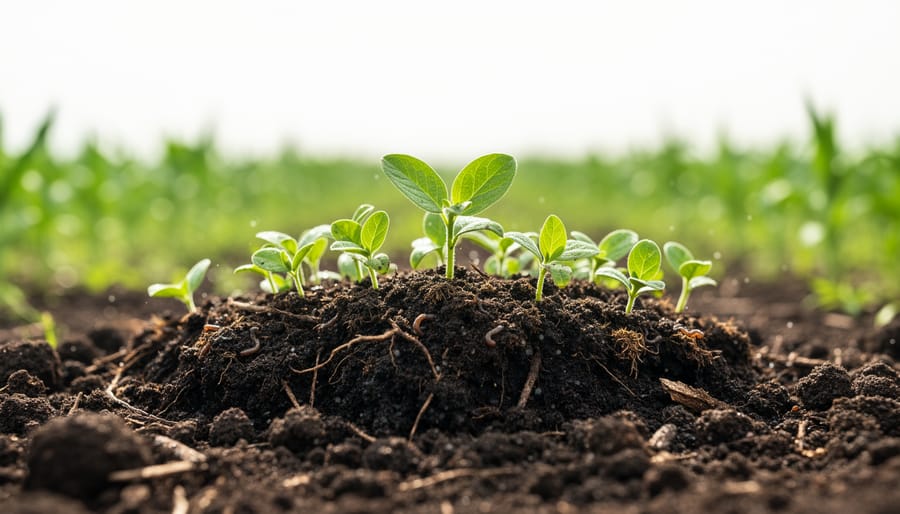
Soil holds more carbon than the atmosphere and all plant life combined, roughly 2,500 gigatons in the top three meters alone. When microorganisms break down plant roots and residues, they create stable organic compounds that can lock away carbon for centuries. Healthy soils rich in organic matter function as massive carbon reservoirs, but conventional agriculture has reversed this process. Intensive tilling, monoculture cropping, and synthetic fertilizer dependence have depleted soil carbon stocks by 50 to 70 percent across many agricultural regions, effectively turning farmland from a carbon sink into a source.
Regenerative agriculture aims to reverse that trend by rebuilding soil health through practices that mimic natural ecosystems. Cover cropping keeps living roots in the soil year-round, feeding microbial communities that sequester carbon. Crop rotation introduces diversity that prevents nutrient depletion and pest buildup. No-till farming eliminates plowing, which otherwise exposes buried organic matter to oxygen and releases stored carbon as CO2. By leaving soil structure intact, no-till methods preserve fungal networks that move carbon deep underground where it stabilizes.
The potential scale matters. Converting even 15 percent of global cropland to regenerative methods could sequester an estimated 3 gigatons of CO2 annually, equivalent to taking 650 million cars off the road. Gabe Brown, a Montana rancher who pioneered regenerative practices on his farm, increased soil organic matter from 1.7 to 5.3 percent over two decades while eliminating synthetic inputs entirely. His results demonstrate that sustainable farming can enhance carbon storage while maintaining productivity, though widespread adoption requires economic incentives and technical support for farmers making the transition.
Real-World Applications of Biosphere-Based Mitigation
Around the world, scientists and policymakers are moving biosphere-based climate solutions from theory into practice. These initiatives demonstrate measurable carbon reductions while delivering co-benefits like biodiversity protection and community resilience.
China’s Grain for Green Program, launched in 1999 and expanded significantly through 2026, has converted over 32 million hectares of marginal farmland back to forest and grassland. Researchers at Beijing Forestry University estimate the program has sequestered approximately 450 million tons of carbon while reducing soil erosion across the Loess Plateau. The scale proves that reforestation can work even in densely populated regions when properly incentivized.
Costa Rica’s Payment for Ecosystem Services program compensates landowners for maintaining forest cover, reversing decades of deforestation. The country doubled its forest coverage from 26% in 1983 to over 52% by 2025. Dr. Patricia Madrigal, who studies the program’s climate impact, notes that “the economic model shifted conservation from a cost to an investment, creating a sustainable mechanism that doesn’t rely solely on government funding.”
- The Great Green Wall initiative across Africa’s Sahel region aims to restore 100 million hectares of degraded land by 2030, with countries like Senegal already restoring 18 million hectares
- Indonesia’s mangrove restoration projects have replanted over 600,000 hectares since 2020, protecting coastlines while sequestering an estimated 3 million tons of CO2 annually
- Scotland’s Peatland Action programme has restored 28,000 hectares of degraded peatlands, preventing 900,000 tons of carbon emissions per year
- The Loess Plateau rehabilitation in China transformed 35,000 square kilometers of eroded land into productive ecosystems, sequestering 90 million tons of carbon
Australia’s carbon farming initiative allows landowners to earn credits through regenerative practices and native vegetation management. Over 500 projects covering 48 million hectares are now registered, with verified carbon storage reaching 170 million tons. The market-based approach demonstrates how economic incentives can scale biosphere solutions rapidly without massive public expenditure.
Measuring the Biosphere’s Climate Impact
Measuring the biosphere’s role in climate regulation requires sophisticated tools that span scales from local plots to the entire planet. Satellite remote sensing has revolutionized this field, with instruments like NASA’s MODIS and ESA’s Sentinel satellites continuously tracking vegetation greenness, forest cover, and land-use changes across every ecosystem on Earth. These orbital platforms measure how much sunlight plants absorb for photosynthesis, providing estimates of net primary productivity, essentially how much carbon the biosphere pulls from the atmosphere each year through plant growth.
On the ground, flux towers stand as sentries in forests, grasslands, and croplands worldwide, measuring the exchange of carbon dioxide between ecosystems and the atmosphere in real time. These instrumented towers use eddy covariance sensors to quantify both carbon uptake during photosynthesis and release through ecosystem respiration, capturing the biosphere’s breathing pattern throughout day and night, across seasons. Researchers combine this high-frequency data with periodic biomass surveys, physical measurements of tree trunks, root systems, and soil carbon, to validate satellite observations and build comprehensive carbon budgets.
Yet climate scientists acknowledge significant measurement challenges. Tropical forests remain difficult to monitor due to persistent cloud cover, while soil carbon stocks vary enormously over short distances, requiring intensive sampling. Ocean productivity measurements struggle with the vastness of marine systems and seasonal phytoplankton blooms. Emerging technologies like laser-based lidar and hyperspectral imaging promise finer detail, but scientists emphasize that understanding the biosphere’s full climate impact demands integrating multiple measurement approaches rather than relying on any single technology.
Challenges and Future Outlook
Despite their immense potential, biosphere-based solutions face sobering constraints that limit what nature alone can achieve for curbing climate change. Deforestation continues at alarming rates in critical regions, tropical forests that took centuries to develop can be cleared in days, releasing stored carbon and eliminating future sequestration capacity. Land-use change for agriculture, urban expansion, and infrastructure fragments habitats and reduces ecosystem resilience just when we need it most. The biosphere itself grows increasingly vulnerable as climate extremes intensify: heatwaves kill forests, droughts turn grasslands to dust, and wildfires release decades of sequestered carbon in hours. When ecosystems flip from carbon sinks to sources, they accelerate rather than buffer warming.
Can the biosphere alone reverse climate change?
No. While the biosphere provides crucial carbon sequestration and climate regulation, it cannot offset current emission levels without dramatic reductions in fossil fuel use and complementary technological solutions.
What happens if ecosystems become net carbon sources?
Degraded or stressed ecosystems can release more carbon than they absorb, creating positive feedback loops that accelerate warming. This shift has already begun in some tropical forests and peatlands experiencing drought and fire.
How do we protect biosphere solutions long-term?
Success requires integrated strategies: protecting existing ecosystems through policy and enforcement, restoring degraded lands, reducing emissions to prevent runaway climate impacts, and funding ongoing monitoring to ensure natural systems remain healthy and functional.
Yet researchers emphasize grounds for optimism. Emerging work on assisted migration helps species adapt to shifting conditions, while advances in ecosystem monitoring allow real-time assessment of biosphere health. Hybrid approaches combining nature-based solutions with direct air capture and renewable energy show promise for comprehensive climate action. Scientists increasingly advocate for integrated frameworks that protect existing ecosystems, restore degraded ones, and reduce emissions simultaneously, recognizing that the biosphere’s climate role depends on our commitment to safeguarding it while pursuing every available mitigation pathway.
The relationship between climate change and the biosphere runs both ways, creating a dynamic that defines our planet’s future. Climate change poses severe threats to living systems, shifting species distributions, acidifying oceans, and triggering feedback loops that amplify warming. Yet these same ecosystems hold extraordinary power to pull carbon from the atmosphere, regulate temperatures, and buffer against climate extremes.
This dual nature makes ecosystem protection and restoration not just an environmental priority but a climate imperative. Every forest we preserve, wetland we restore, and agricultural system we regenerate strengthens the biosphere’s capacity to fight back against the very changes threatening it. The urgency is real: we can’t afford to lose more carbon-storing ecosystems while simultaneously trying to reduce emissions.
The hopeful news, based on what climate scientists say is that nature-based solutions are gaining serious traction. Researchers worldwide are developing better methods to measure ecosystem carbon storage, identify restoration priorities, and scale up interventions that work. New satellite technologies track forest regrowth in real-time. Universities partner with Indigenous communities to combine traditional knowledge with modern conservation. Regenerative agriculture spreads across continents.
The biosphere has been regulating Earth’s climate for billions of years. With informed protection and strategic restoration, it can remain our most powerful ally in the climate challenge ahead.