
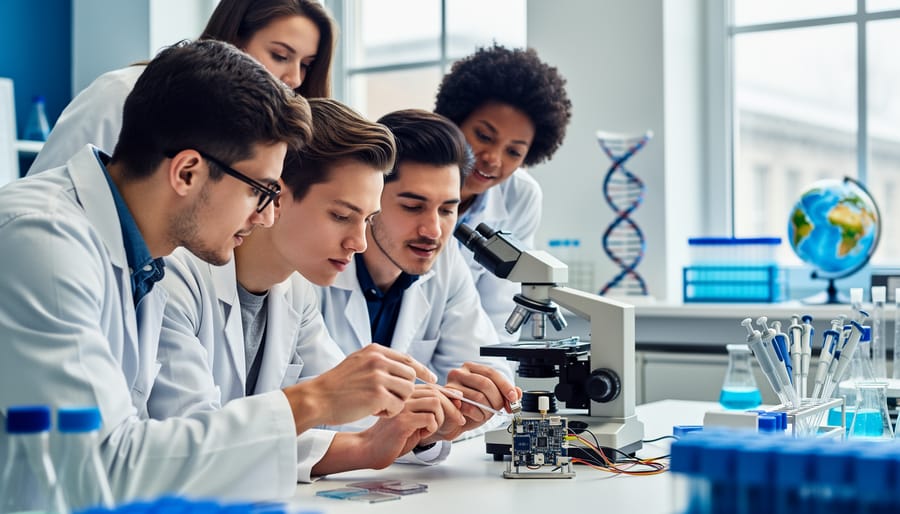
When a pharmaceutical company ignored insights from diverse research teams in 2006, they nearly missed a critical discovery: a diabetes medication worked differently across ethnic populations. That oversight could have endangered millions of patients. The near-miss highlights why diversity, equity, and inclusion in higher education isn’t simply about fairness. It’s about producing better science, solving harder problems, and preparing researchers who can see what homogeneous teams miss.
The evidence is compelling. Research institutions with diverse faculty and student bodies consistently produce more innovative solutions and higher-impact publications. A 2014 study published in the Proceedings of the National Academy of Sciences found that ethnically diverse teams demonstrated superior problem-solving abilities compared to homogeneous groups, even when the homogeneous teams appeared more skilled on paper. The mechanism is straightforward: different backgrounds bring different questions, methodologies, and perspectives to research challenges.
Consider climate change solutions where researchers from island nations and coastal communities bring urgency and insight that landlocked scientists might overlook. Or artificial intelligence development, where diverse teams are better equipped to identify and mitigate algorithmic bias that could perpetuate discrimination in healthcare, criminal justice, and employment systems.
Dr. Jennifer Eberhardt, a Stanford psychologist studying bias, notes that “diversity in research teams isn’t just additive, it’s multiplicative. Different perspectives collide and create entirely new approaches to problems.”
The practical implications extend beyond laboratories. Students educated in diverse environments develop stronger critical thinking skills and cultural competence, making them more effective collaborators in an interconnected world. They learn to question assumptions, challenge groupthink, and approach problems from multiple angles. These aren’t abstract benefits. They translate directly into better research outcomes, more comprehensive solutions, and innovations that serve broader populations rather than narrow segments of society.
The Innovation Gap: What Homogeneous Research Teams Miss
When earth scientists mapped geological formations across remote regions, they initially overlooked critical patterns. The research teams, drawn primarily from similar educational backgrounds and geographic locations, consistently missed indigenous land-use indicators that could have revealed crucial information about soil stability and environmental change. It wasn’t until teams incorporated researchers with different cultural perspectives and field experiences that these blind spots became apparent.
The problem extends far beyond earth sciences. In physics laboratories, homogeneous research teams have historically focused on questions that reflected their shared experiences while neglecting others of equal scientific merit. A striking example emerged in materials science research, where teams examining thermal properties of building materials had concentrated solely on conditions typical of temperate climates. Researchers from tropical regions later identified significant gaps in understanding material behavior under high-humidity, high-temperature conditions, opening entirely new avenues for sustainable construction research.
We discovered that our most significant breakthrough came not from more sophisticated equipment, but from a postdoctoral researcher who questioned our fundamental assumptions about data collection based on her work in a completely different environmental context.
These oversights aren’t simply about representation. They reflect genuine gaps in scientific inquiry that compromise research quality and limit practical applications. Consider seismology, where diversity of scientific thought has proven essential. Teams studying earthquake prediction patterns found that incorporating researchers familiar with different regional geological conditions identified novel correlations that single-perspective teams had dismissed as statistical noise.
The benefits of interdisciplinary research approaches multiply when teams also bring diverse personal and professional backgrounds. Particle physics collaborations have documented how researchers trained in different national scientific traditions approach problem-solving differently. Some prioritize theoretical elegance, others experimental verification, and still others computational modeling. This variation in methodological approach has accelerated discovery timelines.
Research directors report tangible outcomes: diverse teams identify more potential experimental confounds, propose alternative explanations for unexpected results, and recognize broader applications for their findings. They don’t just produce different research. They produce better science.
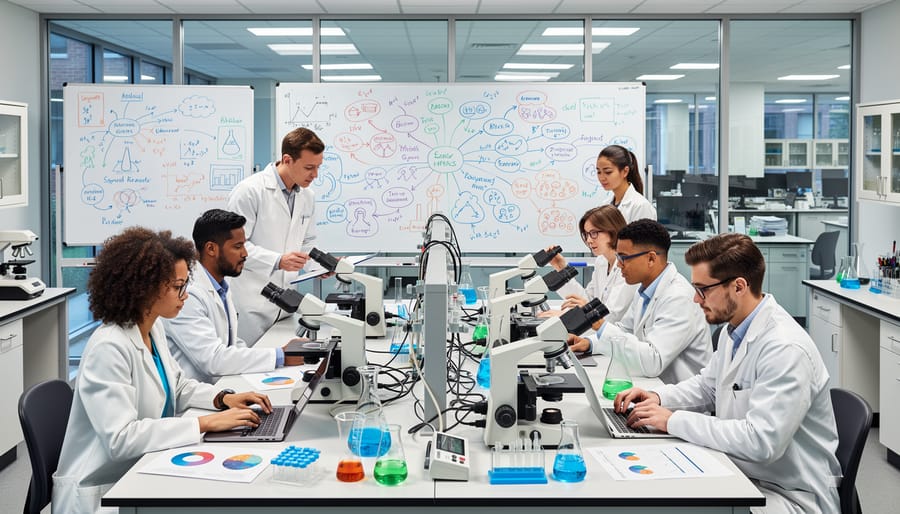
How Diverse Perspectives Accelerate Scientific Breakthroughs
Cognitive Diversity and Problem-Solving
When researchers from varied backgrounds tackle the same problem, they bring fundamentally different mental frameworks to the table. A computational biologist trained in India approaches protein folding challenges differently than one educated in Germany or Brazil, not because one approach is superior, but because educational systems, research traditions, and even language structures shape how we conceptualize problems. This cognitive variation proves invaluable in scientific research, where breakthroughs often emerge from unexpected angles.
Dr. Katherine Phillips, a social scientist at Columbia University who studies organizational diversity, found that diverse teams generate more innovative solutions because they “process information more carefully and are more likely to reexamine facts.” The discomfort of working with people who think differently forces us to sharpen our arguments and consider alternative explanations we might otherwise dismiss.
Consider the development of pulse oximetry, a medical device that measures blood oxygen levels. Early designs worked reliably on lighter skin but produced inaccurate readings for darker skin tones. This critical flaw persisted for decades partly because research teams lacked the diversity to recognize and address it during development. Had engineers and clinicians from different racial backgrounds been involved from the start, this oversight might have been caught before millions of devices reached hospitals.
Cultural experiences also influence experimental design. Researchers who have navigated multiple cultural contexts often excel at identifying confounding variables or considering how findings might transfer across populations. A study examining vaccine hesitancy benefits enormously when team members understand diverse community perspectives firsthand, rather than treating demographic variations as mere data points.
The real advantage comes from collision. When someone trained in traditional hypothesis-driven research collaborates with colleagues who favor exploratory data analysis, or when experimental physicists work alongside theoretical modelers, the friction generates creative sparks. Different thinking styles prevent groupthink and challenge comfortable assumptions that can blind even brilliant scientists to novel possibilities.
Expanding Research Questions and Applications
Researchers from underrepresented communities frequently bring attention to problems that have been sitting in plain sight yet remained largely ignored by traditional academic circles. Their lived experiences guide them toward questions that affect millions but have been sidelined in mainstream research agendas.
Dr. Jayajit Chakraborty, an environmental justice researcher, notes: “Communities of color have been telling us about air quality disparities for decades. It took researchers from those communities entering academia to make it a priority in environmental science.”
This pattern repeats across disciplines. Cities in the Global South, home to billions experiencing rapid urbanization and acute climate impacts, remain underrepresented in climate research compared to their counterparts in wealthier nations. Scientists from these regions bring essential perspectives on adaptation strategies that work in resource-constrained environments, producing innovations with global applications.
Diverse research teams have expanded inquiry into critical areas including:
- Heat-resilient building materials using locally available resources in tropical climates
- Low-cost water purification systems designed for communities without reliable electricity infrastructure
- Agricultural techniques combining indigenous knowledge with climate modeling to improve food security
- Accessible technology interfaces accounting for varying literacy levels and language diversity
The technology sector shows similar patterns. Researchers who understand the challenges faced by disabled communities have driven breakthroughs in assistive technologies that later found widespread commercial applications. Voice recognition software, originally developed for accessibility, now powers billions of smartphones. Curb cuts designed for wheelchairs benefit parents with strollers, travelers with luggage, and delivery workers alike.
These aren’t peripheral contributions. They represent fundamental shifts in how we frame research questions and measure impact. When researchers ask “who benefits?” and “who gets left behind?”, they produce solutions with broader applicability and greater real-world relevance.
Cross-Cultural Collaboration and Global Challenges
Today’s most pressing challenges don’t respect borders. Climate change, pandemic response, food security, and renewable energy innovation require solutions that draw from knowledge systems across the globe. Universities with strong DEI commitments naturally position themselves to address these complex problems by bringing together researchers who understand different environmental contexts, cultural practices, and regional needs.
Consider solar technology development. A research team that includes scientists from tropical regions, arctic communities, and desert environments brings invaluable perspectives on how photovoltaic systems perform under radically different conditions. Dr. Amara Okonkwo, a materials scientist at MIT, explains: “When our lab included researchers from Nigeria, Norway, and New Mexico, we discovered design flaws we’d never have caught otherwise. Each person understood how their home environment would stress the technology differently.”
This geographical and cultural diversity becomes particularly crucial when deploying solutions globally. A renewable energy system designed solely by researchers in temperate climates might fail catastrophically in monsoon regions. Agricultural innovations developed without input from Indigenous knowledge holders often overlook sustainable practices refined over centuries.
Universities that actively recruit international students and faculty, support diverse research collaborations, and value non-Western knowledge systems create richer intellectual ecosystems. These institutions produce graduates who can work effectively across cultures and research that actually translates to real-world impact in diverse settings. The result is science that serves humanity broadly, not just specific populations.

Training Tomorrow’s Scientists: DEI’s Educational Impact
The classroom experience shapes future scientists long before they enter a laboratory. DEI initiatives fundamentally transform how students learn to think, collaborate, and approach complex problems. Research from the University of Washington shows that undergraduate students in diverse learning groups develop stronger critical thinking skills and consider more variables when analyzing scientific problems. These aren’t soft skills peripheral to science. They’re core competencies that determine research quality.
Dr. Maria Gomez, a neuroscience professor at Stanford University, puts it plainly: “When my students work on projects in diverse teams, they challenge each other’s assumptions in ways homogeneous groups simply don’t. That friction produces better science.” Her observation aligns with data showing that students from different backgrounds bring distinct problem-solving approaches rooted in varied educational experiences and cultural perspectives.
The benefits extend beyond group work. Inclusive teaching practices, a cornerstone of educational DEI efforts, improve learning outcomes for all students. When professors incorporate diverse examples and acknowledge different learning styles, average test scores rise across demographics. A study at North Carolina State University found that students in courses using inclusive teaching methods showed 12% higher retention rates in STEM majors compared to traditional approaches.
These improvements matter for collaborative scientific research where tomorrow’s scientists will spend most of their careers. Modern research problems rarely yield to solo efforts. Climate change, drug development, and artificial intelligence all require teams that can bridge disciplines and perspectives. Students who learn alongside peers from different backgrounds develop communication skills that transcend cultural and professional boundaries.
The preparation goes deeper than teamwork mechanics. Exposure to diverse viewpoints during education builds epistemic humility, the recognition that one’s own perspective has limits. This quality proves essential for scientists who must evaluate conflicting evidence, consider alternative hypotheses, and revise theories based on new data.
Universities implementing comprehensive DEI programs also report unexpected benefits. At Georgia Tech, mentorship programs pairing students across demographic lines increased research publication rates among undergraduates by 23%. Students gained access to broader professional networks while learning to navigate different communication styles and expectations.
The global scientific community demands these competencies. Research increasingly happens across international borders, with teams spanning continents and cultures. A graduate trained only among similar peers enters this environment at a disadvantage, lacking the cultural fluency that facilitates productive collaboration. Educational DEI initiatives function as professional preparation, equipping students with skills the modern research enterprise requires.
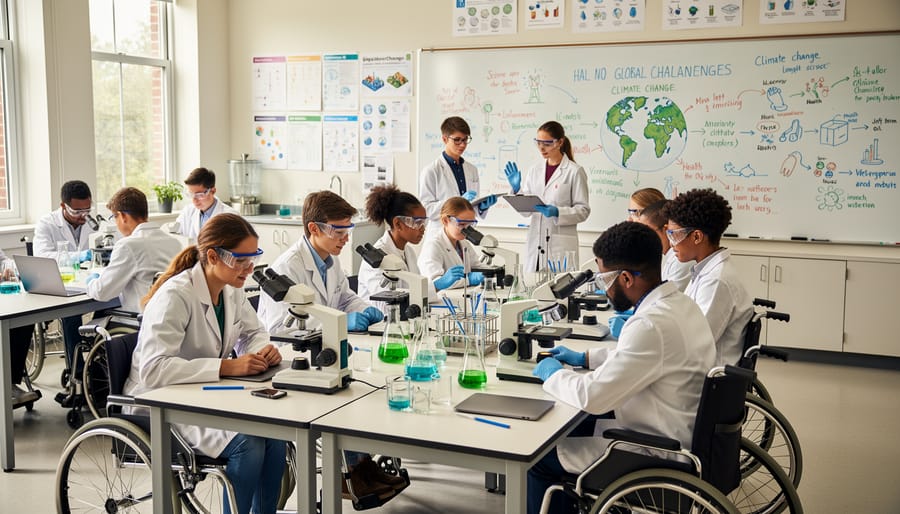
Real-World Results: Universities Leading Through Inclusion
The evidence isn’t just theoretical. Several institutions have documented how their DEI initiatives directly enhanced university research contributions across critical scientific domains.
At the University of California, Berkeley, the establishment of targeted fellowships for underrepresented minority students in atmospheric sciences led to breakthrough research in climate modeling. Dr. Maria Santos, who joined through this program, developed novel algorithms that improved precipitation forecasting accuracy by 23% in tropical regions. “My background growing up in coastal Guatemala gave me insights into weather patterns that others might overlook,” Santos explains. “That lived experience became part of my scientific toolkit.”
Stanford’s women-in-physics initiative produced similar results. By creating mentorship networks and addressing systemic barriers, the program increased female representation in the physics department by 40% between 2015 and 2022. This shift coincided with pioneering work in quantum computing applications, including research that accelerated quantum error correction protocols.
| University | DEI Initiative | Research Area | Measurable Outcome |
|---|---|---|---|
| UC Berkeley | Minority STEM Fellowships | Atmospheric Sciences | 23% improvement in tropical precipitation models |
| Stanford | Women in Physics Program | Quantum Computing | Advanced error correction protocols |
| MIT | First-Generation Scholar Initiative | Materials Science | Patents for sustainable battery technology |
| University of Washington | Indigenous Knowledge Integration | Marine Biology | New ocean acidification indicators |
The pattern continues across disciplines. MIT’s First-Generation Scholar Initiative brought students from non-traditional academic backgrounds into materials science laboratories, resulting in three patents for sustainable battery technology. These innovations drew from unexpected problem-solving approaches that researchers attributed to diverse educational pathways.
The University of Washington integrated Indigenous knowledge systems into their marine biology program, partnering with local tribes. This collaboration identified previously undocumented ocean acidification indicators along the Pacific coast, advancing both scientific understanding and conservation efforts.
What makes these examples particularly compelling is their measurability. These aren’t abstract claims about culture or climate. They represent concrete advances in scientific knowledge, directly traceable to deliberate inclusion efforts that expanded who participates in research and what perspectives they bring to complex problems.
The evidence is clear. Diversity, equity, and inclusion transform how universities approach the hardest problems facing humanity. This goes beyond ethics or campus culture. The most innovative research emerges when different perspectives collide, when assumptions get challenged, and when scientists from varied backgrounds bring their lived experiences to bear on complex questions.
As Dr. Paula Hammond, chemical engineer and former chair of MIT’s faculty, observes: “Diverse teams don’t just feel right, they produce better science. The questions we ask, the experiments we design, and the solutions we imagine are all shaped by who’s in the room.”
Climate change won’t be solved by homogeneous teams missing critical variables. Medical breakthroughs demand researchers who understand health disparities across populations. Artificial intelligence systems require developers who recognize bias in algorithms. These challenges are too intricate, too multifaceted for narrow perspectives.
The universities making genuine progress understand that inclusive research environments accelerate discovery. They’re not checking boxes. They’re building the intellectual infrastructure needed for meaningful contributions to science and technology. Every time a promising student from an underrepresented background enters a lab, every time a research question gets reframed through a different cultural lens, we move closer to answers that actually work for everyone.
The future of higher education depends on this recognition. Universities can either maintain comfortable traditions while falling behind on innovation, or they can embrace the scientific reality that diverse teams produce superior outcomes. The choice shapes what discoveries we make and whose problems we solve.