
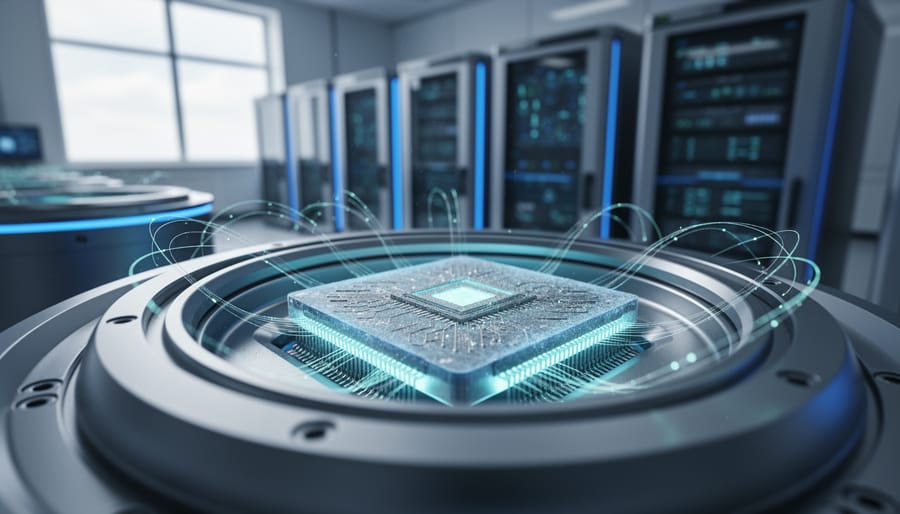
As of 2023, approximately 50 to 100 quantum computers were operational worldwide, though pinning down an exact number requires understanding what qualifies as a true quantum computer. These machines ranged from experimental prototypes with fewer than 10 qubits to IBM’s 433-qubit Osprey processor and Atom Computing’s 1,180-qubit neutral atom system, representing a dramatic acceleration from just a handful of machines five years earlier.
The question of how many quantum computers existed in 2023 isn’t as straightforward as counting laptops in an office. The quantum computing landscape that year included everything from cloud-accessible systems offered by tech giants like IBM, Google, and Amazon to specialized research machines locked away in university laboratories. Some systems operated at near absolute zero using superconducting circuits, while others trapped individual atoms with lasers or manipulated photons through optical circuits.
What made 2023 particularly significant was the shift from pure research instruments to increasingly capable platforms. “We’re moving beyond proof-of-concept demonstrations to systems that can tackle real computational problems,” noted researchers tracking the field’s progress that year. Major corporations, national laboratories, and startups across North America, Europe, and Asia operated these machines, with cloud access democratizing availability even as physical ownership remained concentrated among well-funded institutions.
Understanding the 2023 quantum computer count matters because it marked an inflection point. These weren’t merely larger versions of earlier prototypes but represented diverse technological approaches competing to achieve quantum advantage. The machines varied wildly in qubit count, coherence times, error rates, and accessibility, making the raw number less important than the ecosystem’s growing maturity and the expanding range of organizations gaining hands-on experience with quantum hardware.
Defining What Counts as a Quantum Computer
Counting quantum computers sounds straightforward until you ask: what actually qualifies as one? The challenge isn’t just bureaucratic, it strikes at the heart of defining quantum computing itself.
At its core, a quantum computer manipulates quantum bits (qubits) to perform calculations that exploit superposition and entanglement. But implementation varies wildly. Superconducting qubits, the approach favored by IBM and Google, use tiny circuits cooled to near absolute zero. Trapped ion systems, like those from IonQ and Honeywell, confine individual atoms with electromagnetic fields. Photonic quantum computers encode information in light particles. Neutral atom systems trap clouds of atoms in optical lattices. Each technology harnesses the power of qubits differently, making direct comparisons tricky.
The debate sharpens when we consider quantum annealers. D-Wave has built machines with thousands of qubits, but these specialized systems solve optimization problems through quantum annealing rather than universal gate-based computation. Should they count? Some researchers argue annealers aren’t “real” quantum computers because they can’t run arbitrary quantum algorithms. Others contend they’re quantum devices solving genuine problems, what else matters?
Then there’s the prototype problem. Universities worldwide operate small experimental quantum systems with just a handful of qubits. Are these computers or research apparatus? A two-qubit testbed advancing coherence techniques contributes to the field, but calling it a quantum computer feels generous when commercial systems now boast 50 to 400 qubits.
This leads to the threshold question: how many qubits make a quantum computer? There’s no consensus. Some draw the line at quantum advantage, the point where a quantum system outperforms classical computers at a specific task. Google claimed this milestone in 2019 with 53 qubits. Others argue for quantum error correction as the minimum bar, requiring hundreds or thousands of physical qubits per logical qubit.
Geographic and access considerations complicate matters further. Should we count only operational machines or include systems under construction? Only cloud-accessible devices or also private research systems? The answer shapes the total dramatically, turning a simple census into a definitional maze.
The Quantum Computer Census: 2023 Numbers
Commercial and Cloud-Accessible Systems
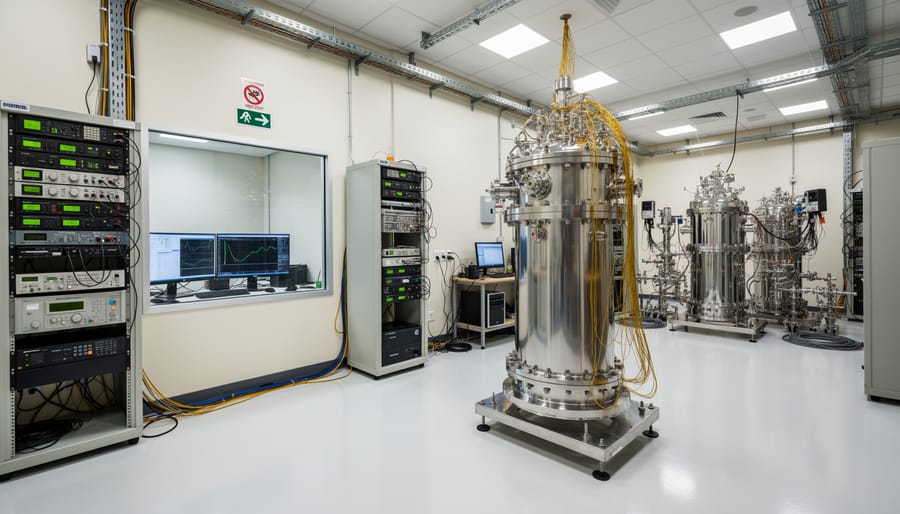
By 2023, cloud-based quantum computing had matured into a practical reality, with major tech companies operating fleets of machines accessible to researchers, developers, and businesses worldwide. IBM led the pack with more than 20 operational quantum computers available through IBM Quantum, ranging from 5-qubit educational systems to their flagship 433-qubit Osprey processor. Their quantum network served over 450,000 registered users across 2,500 organizations.
Google maintained several quantum processors accessible through Google Quantum AI, including iterations of their Sycamore architecture. While Google operated fewer publicly accessible systems than IBM, their machines featured competitive qubit counts and gate fidelities optimized for specific research applications.
Amazon Braket distinguished itself not by building quantum computers but by aggregating access to multiple hardware providers. Through this platform, users could run circuits on systems from IonQ (ion trap processors with up to 32 qubits), Rigetti (superconducting processors), D-Wave (quantum annealers with thousands of qubits), and Oxford Quantum Circuits. This approach gave researchers unprecedented flexibility to test algorithms across different quantum architectures.
Microsoft Azure Quantum followed a similar aggregator model, partnering with IonQ, Quantinuum, and Rigetti to offer diverse hardware options alongside their own quantum development tools.
Collectively, these cloud platforms made approximately 30-40 distinct quantum processors accessible to the public in 2023, a dramatic increase from just a handful five years earlier.
Private Research and Government Systems
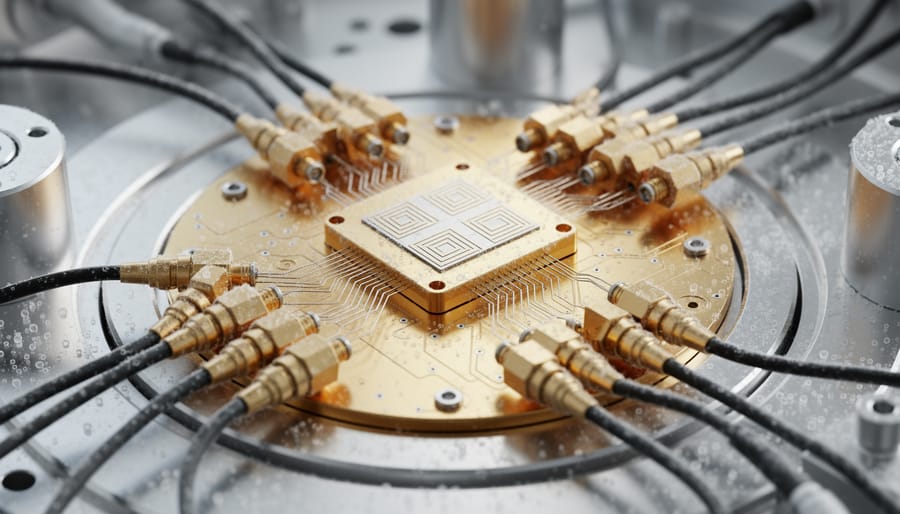
Beyond the quantum computers accessible through commercial cloud platforms, a substantial, though harder to quantify, number of systems operate within government laboratories, universities, and corporate research facilities worldwide. These machines rarely appear in public databases, making any census inherently incomplete.
In the United States, institutions like Oak Ridge National Laboratory, Los Alamos National Laboratory, and Sandia National Laboratories house specialized quantum systems for national security research and fundamental physics experiments. Many of these installations focus on quantum networking, cryptography applications, and advanced materials simulation rather than general-purpose computing. The exact specifications and even existence of some government-funded quantum computers remain classified, particularly those exploring post-quantum cryptography solutions.
European research centers tell a similar story. The Fraunhofer Institute in Germany, various facilities within France’s CEA research organization, and the UK’s National Quantum Computing Centre operate quantum systems that support collaborative research projects but lack public access interfaces. These installations often serve as testbeds for novel quantum architectures before commercial deployment.
China presents the murkiest picture. The country has invested heavily in quantum technology through institutions like the University of Science and Technology of China and the Chinese Academy of Sciences. Reports suggest dozens of quantum computing systems operating across research campuses, but comprehensive data remains scarce. The Jiuzhang photonic quantum computer and Zuchongzhi superconducting systems represent publicly acknowledged achievements, yet industry analysts believe numerous additional machines exist within private laboratories.
Conservative estimates suggest at least 50-75 quantum computers operated in non-public research settings throughout 2023, though the true number could easily exceed 100 when counting smaller-scale experimental systems and quantum annealers not disclosed in academic publications.

Leading Organizations and Their Quantum Fleets
By 2023, a handful of organizations had moved well beyond building one-off prototypes, assembling networks of quantum computers that positioned them as the technology’s infrastructure providers.
IBM stood out with the most extensive quantum network. The company operated more than 20 quantum computers accessible through its IBM Quantum platform, ranging from modest five-qubit educational systems to flagship processors exceeding 100 qubits. This fleet approach allowed IBM to serve thousands of users simultaneously, from academic researchers testing algorithms to enterprise clients exploring commercial applications. Their strategy emphasized building diverse systems rather than betting everything on a single architecture, providing testing grounds for different qubit counts and configurations.
Google took a different approach with fewer but more experimental systems. Following its 2019 quantum supremacy claim with the Sycamore processor, Google maintained a smaller collection of superconducting quantum computers, focusing on pushing performance boundaries rather than maximizing access. The company’s systems remained primarily dedicated to internal research, though partnerships with select academic institutions provided limited external access.
IonQ pioneered commercialization of trapped-ion quantum computers, operating multiple systems available through cloud platforms including Amazon Braket and Microsoft Azure Quantum. With systems ranging from 11 to 32 qubits, IonQ emphasized quality over quantity, promoting their superior gate fidelities and longer coherence times compared to superconducting alternatives. Their machines powered diverse applications in quantum in research across chemistry simulations and optimization problems.
Rigetti Computing operated several superconducting quantum computers, combining cloud access through partners with on-premises installations for government and enterprise clients. Their Aspen-series processors evolved through multiple generations, with the company pursuing hybrid classical-quantum architectures that integrated quantum processing units directly into data centers.
China emerged as a major force with multiple quantum computing efforts distributed across research institutions. The University of Science and Technology of China deployed several systems including both superconducting and photonic quantum computers, while government-backed initiatives in Beijing and Shanghai built additional machines, though exact numbers remained difficult to verify due to limited public disclosure.
Europe’s quantum ecosystem distributed across national efforts rather than concentrating in single companies. Germany’s Fraunhofer Institute, France’s national quantum plan, and the Netherlands’ QuTech all operated experimental systems, while startups like Finland’s IQM and France’s Pasqal contributed photonic and neutral-atom machines. The European Union’s Quantum Flagship program coordinated these efforts, targeting a quantum computing infrastructure spanning the continent.
Next-Generation Systems: What Makes Them Different
The quantum computers operating in 2023 represent a significant leap beyond the proof-of-concept devices that dominated headlines a few years earlier. While early systems demonstrated quantum principles, next-generation quantum machines arriving around this period cross a critical threshold from laboratory curiosities to machines capable of tackling real computational challenges. Understanding what separates these advanced systems from their predecessors clarifies why organizations are racing to build more of them.
The distinction isn’t just about scale, though that matters enormously. Several technical advancements converge to define these newer machines:
- Qubit counts exceeding 100, with IBM reaching 433 qubits in its Osprey processor and systems approaching 1,000 qubits on development roadmaps
- Coherence times extended from microseconds to milliseconds, giving quantum states longer to complete calculations before decohering
- Two-qubit gate fidelities above 99%, reducing error rates that plagued earlier operations
- Modular architectures that allow expansion by connecting quantum processing units rather than building monolithic chips
- Dynamic circuit capabilities enabling mid-computation measurements and conditional operations
These improvements compound. A system with 400 qubits but poor coherence accomplishes less than one with 100 high-quality qubits that maintain quantum states long enough to execute complex algorithms. IBM’s Condor processor, for instance, prioritized qubit quality and connectivity patterns over simply maximizing count, recognizing that useful computation requires reliable control over quantum states.
Error correction represents perhaps the most crucial advance distinguishing 2023-era machines. While full fault-tolerant quantum computing remains years away, intermediate error mitigation techniques deployed in these systems reduce noise sufficiently to produce meaningful results. Google’s experiments with surface codes and IBM’s error suppression methods demonstrate progress toward building logical qubits from multiple physical qubits, a necessary step before quantum computers can run extended calculations without collapsing.
The modular approach adopted by several manufacturers fundamentally changes the growth equation. Instead of each quantum computer being a one-off prototype, companies now build families of systems sharing core architectures. This standardization accelerates deployment, making it economically viable to operate multiple machines simultaneously and offer varied access tiers to different users, directly driving the expanding count of available quantum computers worldwide.

Real-World Applications Driving Expansion
The quantum computer census grew in 2023 not through academic curiosity alone, but because organizations discovered genuine competitive advantages in specific applications. Drug discovery led this practical push, with pharmaceutical companies partnering with quantum providers to simulate molecular interactions that overwhelm classical computers. Researchers at several institutions used quantum systems to model protein folding dynamics, work that feeds into broader quantum medicine initiatives targeting personalized treatments and faster clinical trial design.
Materials science applications proved equally compelling in 2023. Battery manufacturers accessed quantum computers to explore new electrolyte compositions, while chemical companies modeled catalysts for carbon capture processes. These simulations required the quantum advantage in handling correlated electron systems, problems where traditional supercomputers struggle regardless of processing power.
Optimization problems drove corporate adoption across logistics, finance, and supply chain management. Airlines tested quantum algorithms for fleet routing, while financial institutions explored portfolio optimization that could process thousands of variables simultaneously. The integration of quantum and AI workflows accelerated this trend, with hybrid classical-quantum systems tackling machine learning training challenges.
Cryptography research represented another growth driver, though often conducted privately. Organizations with long-term security concerns began testing quantum-resistant encryption schemes while simultaneously exploring quantum key distribution networks. Several governments expanded their quantum fleets specifically for cryptanalysis research and post-quantum cryptography development.
What distinguished 2023 was the shift from proof-of-concept demos to sustained research programs. Companies weren’t just trying quantum computing once; they maintained ongoing access to multiple systems, testing different hardware types against their specific problems. This persistent engagement, rather than breakthrough results, explained why the quantum computer count climbed as providers built capacity to meet genuine demand rather than speculative interest.
The Growth Trajectory: From 2023 Onward
Looking back from today’s vantage point, 2023 marked an inflection point rather than a destination in quantum computing’s expansion. Industry projections from that year suggested the global installed base would triple between 2023 and 2026, driven by several converging factors. IBM announced plans to deploy utility-scale systems exceeding 1,000 qubits by 2024, while Amazon committed to expanding its Braket network with additional partner hardware. Google outlined a roadmap toward error-corrected systems, and Chinese institutions signaled investments in dozens of new quantum facilities.
Government initiatives accelerated this trajectory significantly. The U.S. National Quantum Initiative earmarked billions for new quantum infrastructure, the European Quantum Flagship program funded regional quantum hubs, and countries from Japan to South Korea unveiled national quantum strategies with explicit hardware deployment targets. These weren’t abstract ambitions, they translated into procurement orders, facility construction, and research collaborations that would materialize as functioning systems.
The fundamental business model evolved alongside hardware improvements. Quantum-as-a-service platforms transformed the question from ownership to access. A researcher in 2024 could tap into a dozen different quantum architectures through cloud interfaces without caring whether the physical count stood at 200 or 300 machines worldwide. This shift rendered simple census efforts less meaningful; what mattered was aggregate computational capacity and the diversity of available quantum approaches.
Tracking this landscape requires monitoring multiple indicators: new system announcements from manufacturers, additions to cloud platforms, published qubit roadmaps, and research papers reporting experiments on previously undocumented hardware. The International Data Corporation and quantum-focused analysts like Quantum Computing Report maintain running tallies, though precise global counts remain elusive given proprietary systems and classified government installations.
The question of how many quantum computers existed in 2023, somewhere between 50 and 100 operational systems, depending on definitions, tells only part of the story. What mattered more was the shift happening beneath that number: machines were getting dramatically more capable, error rates were dropping, and access was expanding from exclusive research labs to cloud platforms anyone could experiment with.
By 2023, quantum computing had moved past the “look what we built” phase into genuine utility testing. Companies were running real optimization problems, researchers were simulating molecular interactions that classical computers couldn’t handle, and the infrastructure for a quantum-enabled future was taking shape. The systems themselves were maturing fast, what took a room-sized dilution refrigerator in 2020 was becoming more standardized, and qubit counts were climbing from dozens into the hundreds.
Looking forward from 2026, that 2023 landscape was a pivot point. The democratization that began then has accelerated. More organizations now build quantum expertise without owning hardware, students learn on real machines through cloud access, and hybrid classical-quantum workflows are becoming standard practice in specific industries.
When tracking quantum computing’s evolution, watch three indicators: error correction breakthroughs that enable longer calculations, the emergence of quantum networks connecting multiple processors, and commercial applications that deliver measurable ROI. The raw count of machines will keep growing, but these milestones will determine whether quantum computing fulfills its transformative potential or remains a specialized tool for narrow problems.