
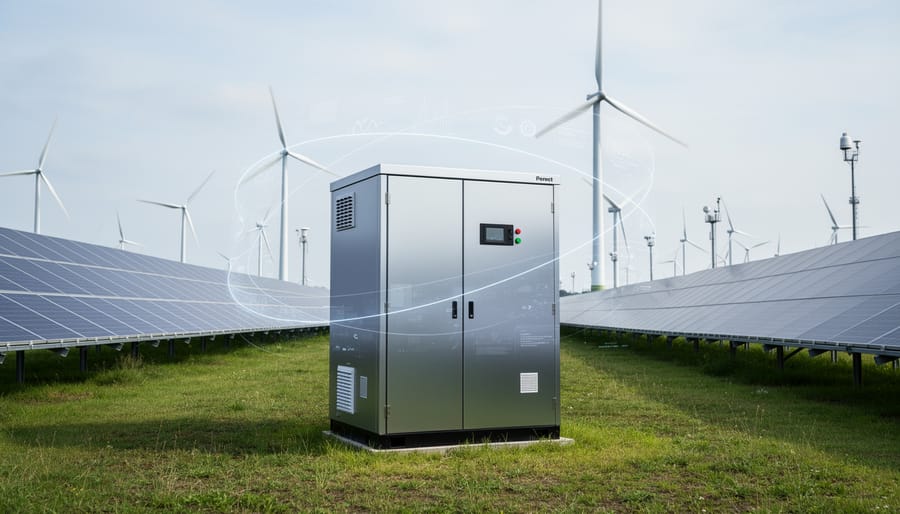
AI in renewable energy refers to the application of machine learning algorithms, neural networks, and predictive analytics to optimize the generation, distribution, and storage of power from solar, wind, hydro, and other clean sources. The technology addresses one of renewable energy’s most persistent challenges: intermittency and unpredictability.
Why does this matter now? Renewable installations worldwide generated over 30% of global electricity in 2025, but their variable nature creates grid instability and efficiency losses. Traditional forecasting methods struggle to predict cloud cover affecting solar arrays or sudden wind pattern shifts. Artificial intelligence changes that equation entirely.
Modern AI systems analyze weather satellites, ground sensors, and historical generation data to forecast renewable output with remarkable precision. Some wind farms now predict power production 48 hours ahead with accuracy above 95%, allowing grid operators to balance supply and demand without relying on fossil fuel backup plants. The technology also optimizes maintenance schedules by detecting equipment degradation before failures occur, cutting downtime by up to 40% in documented installations.
Beyond forecasting, AI manages complex energy storage decisions. Battery systems equipped with machine learning algorithms determine optimal charge and discharge cycles based on electricity prices, demand patterns, and weather forecasts. Dr. Sarah Chen, leading AI research at the National Renewable Energy Laboratory, notes that “intelligent storage management can increase the economic value of battery installations by 20 to 35 percent compared to rule-based systems.”
This article explains how these AI systems function, examines the main application categories across different renewable sources, and provides concrete examples of deployment. You’ll understand both the technical mechanisms and the practical impact on our transition to clean energy.
What AI in Renewable Energy Means
AI in renewable energy refers to the application of computational intelligence, specifically machine learning algorithms, neural networks, and predictive analytics, to make renewable energy systems smarter and more efficient. At its core, this technology enables energy infrastructure to learn from data, recognize patterns, and make informed decisions without constant human intervention. Think of it as giving renewable energy systems a digital brain that can process vast amounts of information and respond to changing conditions in real time.
The integration works by feeding data, from weather satellites, grid sensors, energy meters, and equipment monitors, into AI models that identify relationships and trends humans might miss. These models then generate forecasts about energy production, anticipate equipment failures, or optimize when to store versus distribute power. A solar farm AI might analyze cloud cover patterns alongside historical production data to predict output for the next six hours. A wind energy system could adjust turbine blade angles based on predicted wind speeds and directions.
What distinguishes AI from traditional automation is its ability to improve through experience. Instead of following rigid, pre-programmed rules, machine learning systems refine their predictions and decisions as they process more data. A neural network managing battery storage learns the subtle patterns of local energy consumption, getting better at deciding when to charge and discharge as seasons and usage habits change.
This computational intelligence addresses renewable energy’s core technical challenges: the intermittent nature of solar and wind power, the complexity of matching supply with fluctuating demand, and the massive scale of modern energy grids. By processing information faster and more comprehensively than human operators, AI helps renewable sources become reliable, cost-effective alternatives to fossil fuels.
How AI Powers Renewable Energy Systems
Data Collection and Integration
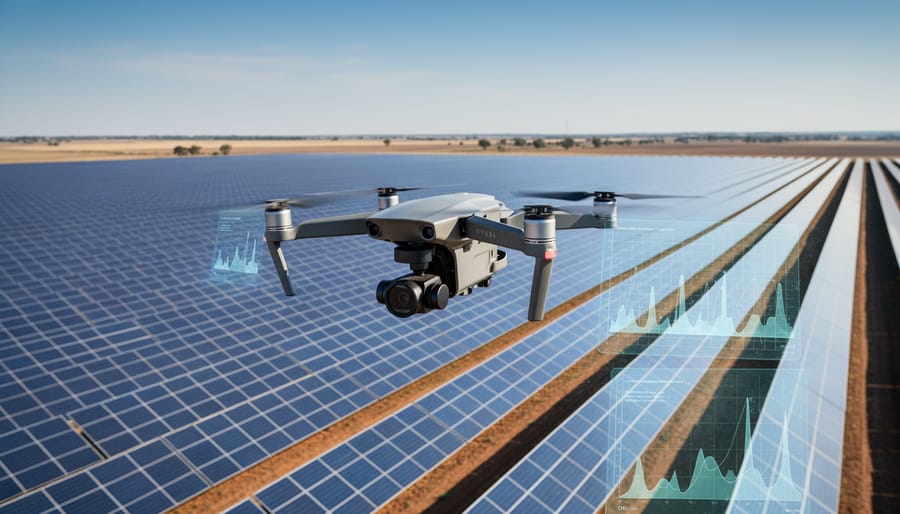
AI systems in renewable energy begin their work by drawing from an unprecedented web of data sources operating across multiple scales and timeframes. Weather stations positioned throughout energy production regions transmit real-time readings of wind speed, temperature, humidity, and barometric pressure at intervals measured in seconds or minutes. Satellite systems contribute high-resolution imagery capturing cloud formations, atmospheric conditions, and solar irradiance patterns across entire continents. Ground-based sensors embedded in solar panels, wind turbines, and battery systems continuously monitor equipment performance, voltage fluctuations, and energy output. Smart grid infrastructure adds another dimension, feeding in consumption patterns, load demands, and distribution network status from thousands or millions of connection points.
The integration challenge lies not just in volume but in variety. These data streams arrive in different formats, sampling rates, and measurement units. Machine learning systems apply preprocessing algorithms to standardize this information, filtering out noise and sensor errors while identifying correlations that matter for energy predictions. The process mirrors broader techniques in AI and environmental data analysis, where disparate inputs merge into coherent models that reveal patterns invisible to human observation alone.
Machine Learning Algorithms at Work
Neural networks form the computational backbone of AI in renewable energy, mimicking the human brain’s interconnected structure to process complex energy data. These algorithms excel at identifying non-linear relationships between variables like wind speed, temperature, humidity, and energy output, patterns too intricate for traditional statistical methods.
Deep learning models, a subset of neural networks with multiple processing layers, analyze years of historical data alongside real-time sensor readings to build predictive models. A recurrent neural network, for instance, can learn seasonal energy generation patterns and forecast solar output days in advance by recognizing how cloud cover, sun angle, and atmospheric conditions interact.
“The beauty of these algorithms is their ability to improve continuously,” explains Dr. Sarah Chen, computational energy researcher at Stanford University. “Each prediction cycle refines the model’s understanding, making tomorrow’s forecast more accurate than today’s.”
Predictive models employ supervised learning, training on labeled datasets where outcomes are known, to develop forecasting capabilities. The algorithms identify which input features most strongly influence energy production, then weight those factors appropriately when generating predictions for new scenarios.
Real-Time Decision Making
Once trained algorithms are deployed, they continuously monitor streaming data from sensors, weather forecasts, grid demand signals, and market prices to make rapid operational decisions. In a solar-plus-storage facility, for example, the AI might decide within milliseconds whether to route incoming energy to the grid, divert it to battery storage, or curtail production based on current pricing and predicted evening demand. These systems run optimization loops hundreds of times per second, far faster than human operators could respond.
Reinforcement learning has proven especially effective for these dynamic environments. The algorithms learn optimal control strategies through trial and error in simulation, then apply those strategies to real equipment. Real-time optimization using RL allows wind farms to adjust turbine angles as gusts shift direction, or enables microgrids to balance multiple distributed energy sources without human intervention. The speed and adaptability of these AI controllers are what turn intermittent renewable sources into reliable, responsive grid assets.
Types of AI Applications in Renewable Energy
Forecasting and Prediction Systems
Forecasting systems built on artificial intelligence represent one of the most transformative applications in renewable energy, addressing the fundamental challenge of intermittency. These systems analyze massive datasets, satellite imagery, atmospheric pressure readings, historical weather patterns, and real-time sensor feeds, to predict when and how much energy a facility will generate hours or even days ahead.
In solar installations, AI algorithms track cloud formations, atmospheric moisture levels, and seasonal sun angles to forecast panel output with increasing precision. Some large-scale solar farms now achieve prediction accuracy within 5% for next-day generation forecasts, allowing grid operators to plan backup capacity more efficiently. Wind energy benefits similarly from machine learning wind forecasting which combines LIDAR measurements, turbulence models, and offshore weather data to anticipate wind speeds at turbine height, critical for both output estimation and structural safety decisions.
Beyond generation forecasting, AI tackles the demand side. Neural networks trained on consumption patterns, factoring in temperature fluctuations, time of day, and even local events, predict when electricity demand will spike, enabling utilities to store surplus renewable energy during low-demand periods and release it precisely when needed. This dual capability transforms renewables from unpredictable sources into manageable components of a stable energy grid.
Optimization and Control Systems
AI optimization and control systems continuously adjust renewable energy operations to extract maximum efficiency from every kilowatt generated. These systems monitor hundreds of variables simultaneously, from turbine blade angles and solar panel orientations to battery charge cycles and grid load patterns, making thousands of micro-adjustments per hour that human operators couldn’t manage manually.
In energy generation, AI algorithms dynamically reconfigure solar arrays to track optimal sun angles while predicting cloud cover minutes in advance, pre-adjusting output to maintain grid stability. Wind farms employ AI controllers that coordinate turbine operations across entire installations, reducing wake interference and increasing collective output by up to 12%.
Storage allocation presents particularly complex challenges that AI handles with remarkable precision. Systems analyze real-time electricity prices, weather forecasts, and consumption patterns to determine optimal charging and discharging schedules for battery arrays. California’s grid operators use AI control systems that orchestrate thousands of distributed battery installations, storing excess solar power during midday peaks and releasing it during evening demand surges. These intelligent systems have reduced curtailment, wasted renewable energy, by over 30% in some regions while simultaneously lowering costs for consumers through strategic market participation.
Monitoring and Maintenance AI
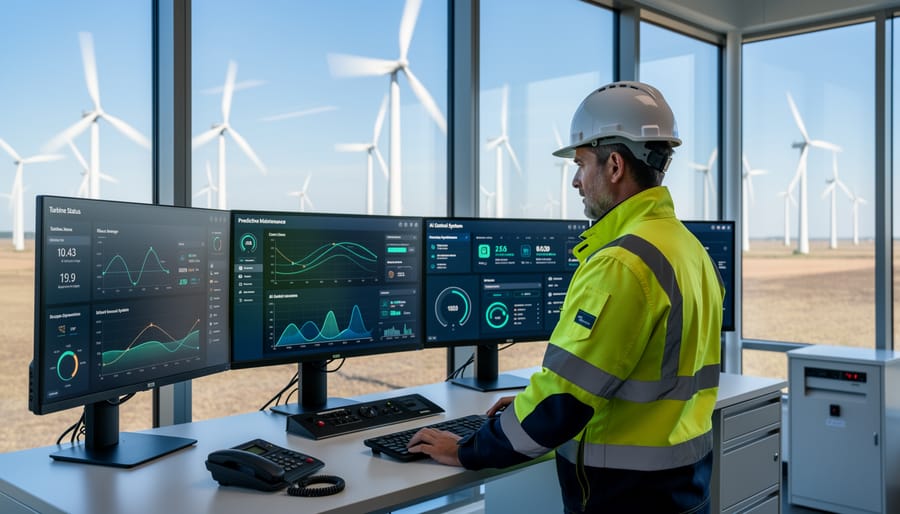
Predictive maintenance AI transforms how renewable energy facilities prevent equipment failures. Machine learning algorithms continuously analyze sensor data from wind turbines and solar panels, monitoring vibration patterns, temperature fluctuations, acoustic signatures, and performance metrics, to identify subtle anomalies that signal impending component degradation. These systems detect bearing wear in turbine gearboxes, micro-cracks in solar cells, and electrical faults weeks or months before they cause failures.
The financial impact is substantial. Wind farms using AI-driven maintenance reduce unexpected downtime by up to 30% and extend equipment lifespan by predicting optimal service intervals rather than following rigid schedules. Solar installations employ computer vision algorithms that scan arrays for hot spots, soiling patterns, and panel defects far more efficiently than manual inspections. This proactive approach cuts maintenance costs while maximizing energy generation, as technicians can address issues during planned maintenance windows instead of responding to costly emergency breakdowns.
Resource Assessment and Site Selection
AI transforms resource assessment by processing decades of satellite imagery, topographic maps, and climate records to pinpoint ideal sites for renewable installations. Machine learning models analyze millions of data points, solar irradiance levels, wind patterns at different altitudes, proximity to transmission infrastructure, land use constraints, and seasonal weather variations, identifying locations that humans might overlook. These systems can evaluate entire regions in hours, ranking potential sites by expected energy output, construction feasibility, and environmental impact. For solar farms, AI assesses shading patterns, dust accumulation risks, and optimal panel angles. Wind projects benefit from algorithms that model turbulence effects and wake patterns across terrain. This computational approach reduces costly site surveys and improves project returns by ensuring installations are built where natural resources are most abundant and consistent.
How AI Is Used Across the Renewable Energy Sector
AI in Solar Energy
Solar farms use AI to squeeze every watt from their panels through real-time adjustments that human operators could never match. At the University of California, San Diego, researchers developed neural networks that predict cloud movements up to fifteen minutes ahead with 85% accuracy, allowing battery systems to compensate before output drops. “We’re essentially giving solar installations short-term vision,” explains Dr. Maria Chen, lead AI researcher at UCSD’s renewable energy lab. “The system learns local weather patterns and adjusts energy distribution before the clouds even arrive.”
Panel positioning represents another major application. AI algorithms continuously calculate optimal tilt angles throughout the day, accounting for seasonal sun paths, atmospheric conditions, and even dust accumulation on surfaces. In Arizona’s Copper Crossing Solar Farm, machine learning models increased annual energy capture by 12% compared to fixed-angle installations by making micro-adjustments every twenty minutes.
Output forecasting has become remarkably precise. Google’s DeepMind project partnered with wind farms initially, but the same approach now helps solar facilities predict generation 36 hours in advance. These forecasts let grid operators schedule conventional power plants more efficiently, reducing fossil fuel backup and cutting costs by millions annually across large installations.
AI in Wind Energy
Wind farms face unique challenges that AI addresses with remarkable precision. Modern machine learning systems analyze atmospheric data from multiple sources, including weather satellites, ocean buoys, and ground sensors, to predict wind patterns hours or days in advance. These forecasts allow operators to adjust turbine angles and prepare grid infrastructure for incoming generation capacity, minimizing waste when winds exceed storage capabilities.
Turbine control represents another breakthrough application. AI algorithms continuously monitor blade pitch, rotation speed, and yaw position across entire wind farms, making micro-adjustments thousands of times per hour. “Our neural networks learn the optimal performance envelope for each turbine individually,” explains Dr. Maria Chen, wind energy researcher at Stanford’s Atmosphere/Energy Program. “Two turbines standing fifty meters apart can have completely different AI-tuned configurations based on local wind flow patterns.”
Predictive maintenance systems scan vibration sensors, temperature readings, and acoustic signatures to detect bearing wear, gearbox degradation, or blade damage before catastrophic failure occurs. Offshore installations particularly benefit, AI can schedule repairs during calm weather windows, avoiding expensive emergency helicopter visits. North Sea operators report maintenance cost reductions exceeding thirty percent since deploying these monitoring systems.
AI in Energy Storage and Grid Management
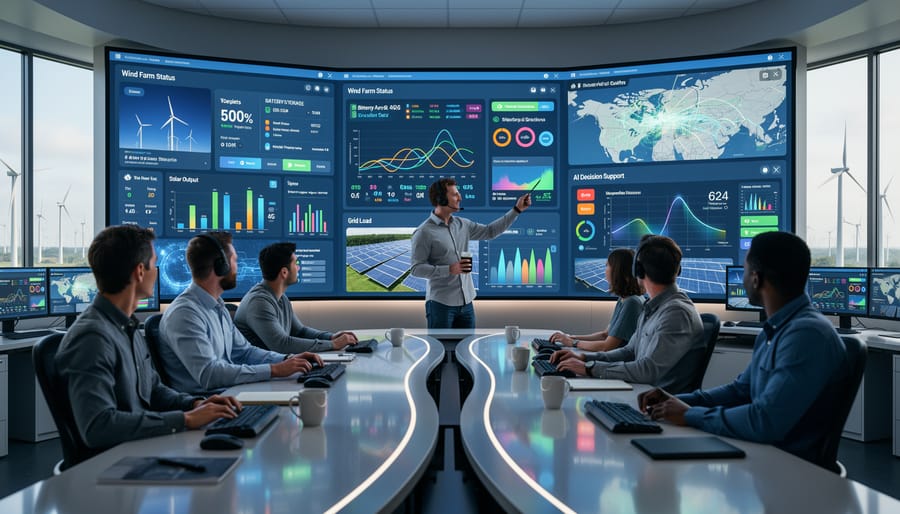
AI tackles one of renewable energy’s toughest challenges: storing power when the sun shines and wind blows, then releasing it when demand peaks. Machine learning algorithms predict consumption patterns by analyzing historical usage data, weather forecasts, and real-time grid conditions. These systems decide precisely when to charge batteries during periods of excess generation and when to discharge stored energy to meet demand spikes.
At Germany’s Next Kraftwerke virtual power plant, AI coordinates over 10,000 distributed energy resources, balancing supply across wind farms, solar arrays, and battery systems. The algorithms continuously optimize charge-discharge cycles to extend battery lifespan while maintaining grid stability. During a sudden cloud cover event, the system can redirect stored energy within milliseconds, preventing voltage fluctuations that would otherwise destabilize the network.
Demand response programs use AI to shift energy-intensive operations to off-peak hours automatically. Industrial facilities receive pricing signals from AI systems that forecast grid stress, allowing them to adjust manufacturing schedules without human intervention. Pacific Northwest National Laboratory reports that AI-managed grid balancing reduced curtailment of renewable energy by 23 percent in pilot projects, meaning less clean energy wasted when generation exceeds immediate demand.
AI in Emerging Renewable Technologies
AI is expanding beyond solar and wind into less conventional renewable sources where optimization challenges are particularly complex. In tidal energy, machine learning models analyze ocean current patterns, lunar cycles, and coastal topography to predict power output with increasing accuracy. Researchers at marine energy institutes use neural networks to optimize turbine placement in tidal streams, maximizing energy capture while minimizing environmental impact on marine ecosystems.
Geothermal systems benefit from AI-driven subsurface mapping that processes seismic data and thermal gradient measurements to identify viable drilling sites. Predictive algorithms monitor underground heat exchange systems, adjusting fluid flow rates to prevent equipment degradation and maintain optimal temperatures. This reduces exploration costs and extends system lifespan.
Hybrid installations combining multiple renewable sources present coordination challenges that AI handles effectively. Smart algorithms balance inputs from solar panels, wind turbines, and battery storage in real time, routing power based on instantaneous availability and demand. University research groups are developing reinforcement learning systems that teach these hybrid plants to self-optimize over time, learning from seasonal patterns and grid requirements to maximize overall efficiency.
Common Questions About AI in Renewable Energy
Professionals and students considering careers at the intersection of AI and sustainability frequently raise practical concerns about the technology’s real-world performance and accessibility. How accurate are AI forecasts? Does the technology deliver measurable cost benefits? What barriers remain? These questions reflect a healthy skepticism about emerging technologies and deserve direct answers grounded in current deployments.
How accurate are AI energy forecasts?
Modern AI systems achieve forecast accuracy of 85-95% for day-ahead solar and wind predictions, significantly outperforming traditional statistical models. Accuracy varies by location, data quality, and forecast horizon, with short-term predictions generally more reliable than week-ahead forecasts.
Is AI making renewable energy more affordable?
Yes, by reducing operational costs through predictive maintenance, optimizing energy storage, and improving grid integration. Utilities report 10-30% reductions in maintenance costs and 5-15% improvements in overall system efficiency when deploying AI-driven management systems.
What are the main limitations of AI in renewable energy?
Current limitations include dependency on high-quality data, difficulty predicting extreme weather events, computational costs for complex models, and the need for human oversight in critical decisions. AI performs best as a decision-support tool rather than a fully autonomous operator.
What skills are needed to work in this field?
Professionals typically need backgrounds in data science, electrical engineering, or environmental science combined with programming skills in Python or R. Many researchers also recommend domain expertise in energy systems alongside machine learning fundamentals, and those exploring opportunities can find detailed career pathways in our green career guide.
Looking ahead, researchers anticipate significant advances in edge computing for faster on-site processing, improved algorithms for handling weather extremes, and better integration between AI systems managing different energy sources. The technology continues maturing rapidly as more deployment data becomes available and computational techniques advance, creating new possibilities for grid resilience and renewable energy penetration rates that seemed impossible just five years ago.
AI has moved from experimental novelty to practical necessity in renewable energy systems, delivering measurable improvements that were impossible just a decade ago. The technology now forecasts solar and wind output with 90% accuracy up to 48 hours ahead, cuts maintenance costs by predicting equipment failures weeks before they occur, and balances grid loads in milliseconds, keeping renewable energy flowing even when weather conditions shift unexpectedly. These aren’t theoretical gains. Operators report 15-20% efficiency increases at wind farms using AI-optimized turbine controls, while solar installations with intelligent tracking systems capture 25% more energy than static panels.
The real transformation happens at scale. As renewable capacity expands globally, AI provides the intelligence layer that makes intermittent energy sources reliable enough to replace fossil fuels. Machine learning models coordinate thousands of distributed energy resources simultaneously, something human operators couldn’t manage, turning fragmented solar rooftops and wind farms into cohesive virtual power plants.
Research continues to push boundaries, with universities developing algorithms that integrate weather modeling, energy demand prediction, and storage optimization into unified systems. “We’re teaching AI to think like an energy system rather than optimizing individual components,” explains Dr. Sarah Chen from MIT’s Energy Initiative. “That holistic approach will be essential as renewables become our primary energy source.”
The convergence of AI and climate action accelerates with each deployment, making clean energy not just environmentally necessary but economically superior.