
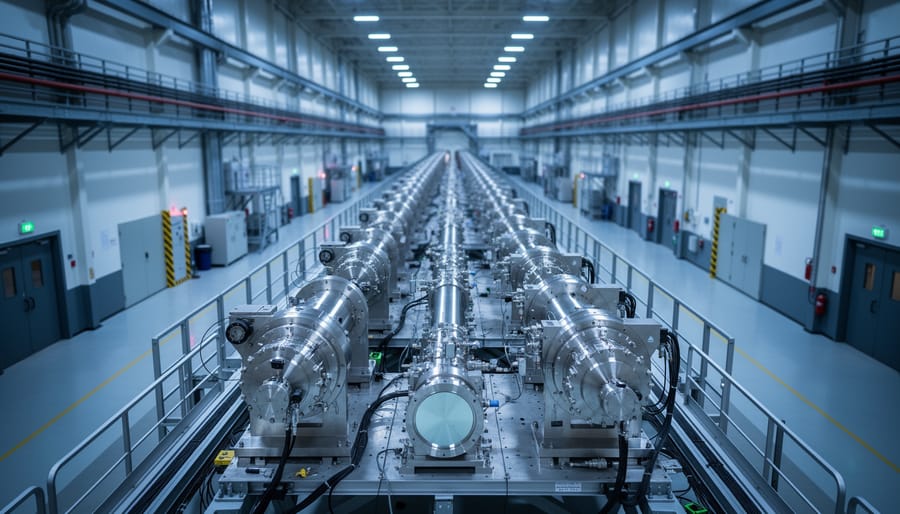
Gravitational waves are ripples in the fabric of spacetime itself, generated when massive objects like black holes or neutron stars spiral together and merge. The Laser Interferometer Gravitational-Wave Observatory, or LIGO, detects these distortions using twin facilities in Louisiana and Washington that measure changes in distance smaller than a proton’s width. Since the first detection in 2015, LIGO and its partner observatories have transformed astrophysics from a discipline that could only see the universe to one that can also hear it.
Understanding how LIGO works requires grasping just how faint these cosmic signals are. When a gravitational wave passes through Earth, it stretches and compresses space by an almost incomprehensibly small amount. LIGO’s L-shaped detectors use laser beams traveling down four-kilometer arms to measure these tiny shifts. When the arms’ lengths change by even a fraction of an atomic diameter, the interference pattern of the recombined laser beams reveals the gravitational wave’s signature.
The science has accelerated dramatically. The O4a catalog, released in August 2025, documented events from the fourth observing run’s first phase, while the O4b catalog from May 2026 added detections from the continuation of that run. These releases have confirmed that LIGO can now routinely observe colliding black holes, merging neutron stars, and hybrid events that combine both. The diversity of detected mergers, from rapidly spinning black hole pairs to events like GW250114 (identified in September 2025 as the highest signal-to-noise ratio detection to date), demonstrates the growing precision of the instruments.
This article explains what gravitational waves reveal about the universe, how LIGO’s detection technology turns abstract physics into better science the different types of cosmic collisions researchers observe, and why these discoveries matter for fields from fundamental physics to cosmology.
What Gravitational Waves Are
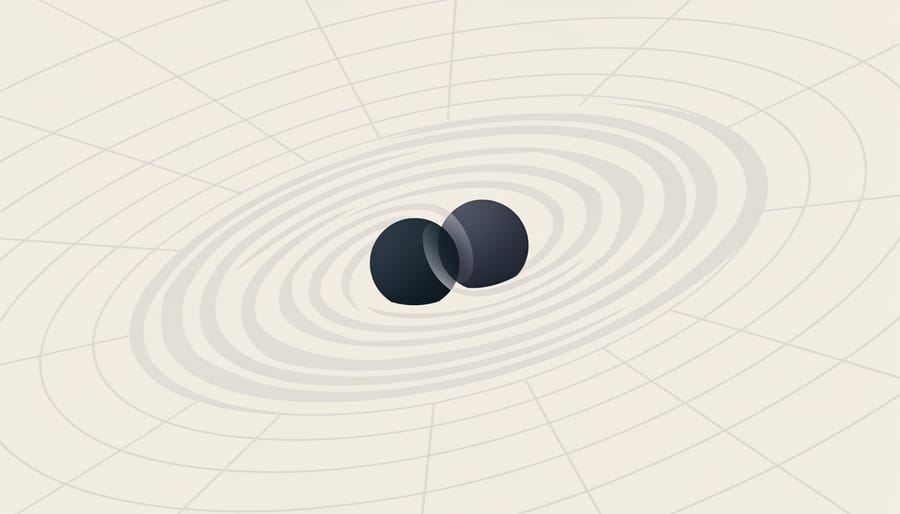
Gravitational waves are ripples in the fabric of spacetime itself, traveling outward from some of the most violent events in the universe. When massive objects accelerate through space, such as two black holes spiraling toward each other, they create distortions that propagate at the speed of light, stretching and squeezing everything in their path by infinitesimal amounts. Einstein predicted spacetime ripples in his 1915 general theory of relativity, describing gravity not as a force but as the curvature of spacetime caused by mass and energy.
For a century, these waves remained purely theoretical. Einstein himself doubted we’d ever detect them because the distortions they cause are extraordinarily small, far less than the width of a proton even from cataclysmic cosmic collisions. Yet the prediction was clear: any time massive objects undergo violent acceleration, they should radiate energy in the form of gravitational waves, carrying information about their source across the cosmos.
- Spacetime
- The four-dimensional fabric of the universe combining the three dimensions of space with time, which can be warped by mass and energy.
- Gravitational Waves
- Ripples in spacetime caused by accelerating massive objects, traveling at the speed of light and stretching and compressing space as they pass.
- Black Hole Merger
- The collision and coalescence of two black holes, releasing enormous energy as gravitational waves during their final spiral and merger.
- Neutron Star
- The collapsed core of a massive star, packing more than the sun’s mass into a sphere about 20 kilometers across, one of the densest objects in the universe.
- Binary System
- Two astronomical objects orbiting their common center of mass, which can eventually spiral inward and merge if they lose energy to gravitational radiation.
The cosmic events powerful enough to produce detectable gravitational waves involve the most extreme objects in nature. Binary black hole mergers occur when two black holes, locked in orbit, gradually lose energy and spiral inward until they collide. Binary neutron star mergers produce both gravitational waves and electromagnetic signals, including gamma-ray bursts and optical light. Mixed systems, where a black hole consumes a neutron star, offer a third category. Each type leaves a distinctive signature in the gravitational wave signal, allowing scientists to identify the source and extract detailed information about mass, spin, and distance.
How LIGO Detects Gravitational Waves
The Interferometer Design
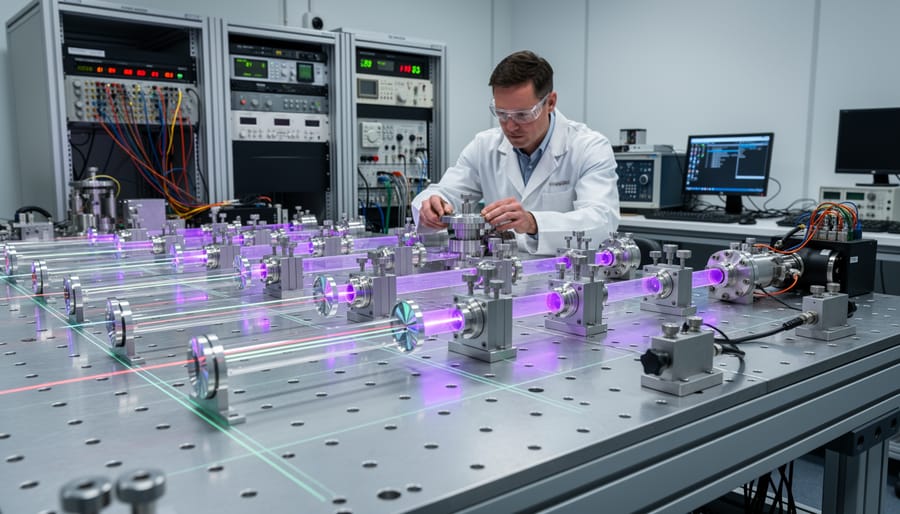
Each LIGO observatory houses an enormous L-shaped interferometer with two perpendicular 4-kilometer LIGO arms extending from a central corner station. Inside these arms, the environment must be pristine: massive vacuum chambers, each 1.2 meters in diameter, maintain a pressure one trillionth that of Earth’s atmosphere. This ultra-high vacuum prevents air molecules from scattering the laser light, which would introduce noise and mask the tiny signals from gravitational waves.
At the corner station, a high-power infrared laser generates a beam that travels to a beam splitter, which divides the light equally and sends it down both arms. At the end of each arm sits a precisely positioned mirror that reflects the laser light back toward the beam splitter. When no gravitational wave is present, the two beams return perfectly out of phase and cancel each other through destructive interference, producing darkness at the detector.
When a gravitational wave passes through, it compresses spacetime in one direction while stretching it in the perpendicular direction. This causes one arm to lengthen by a fraction of the width of a proton while the other shortens by the same amount. The returning laser beams no longer cancel perfectly, and light reaches the photodetector. The system must measure these changes with astonishing precision: detecting a shift of one ten-thousandth the diameter of a proton across four kilometers.
The Global Detector Network
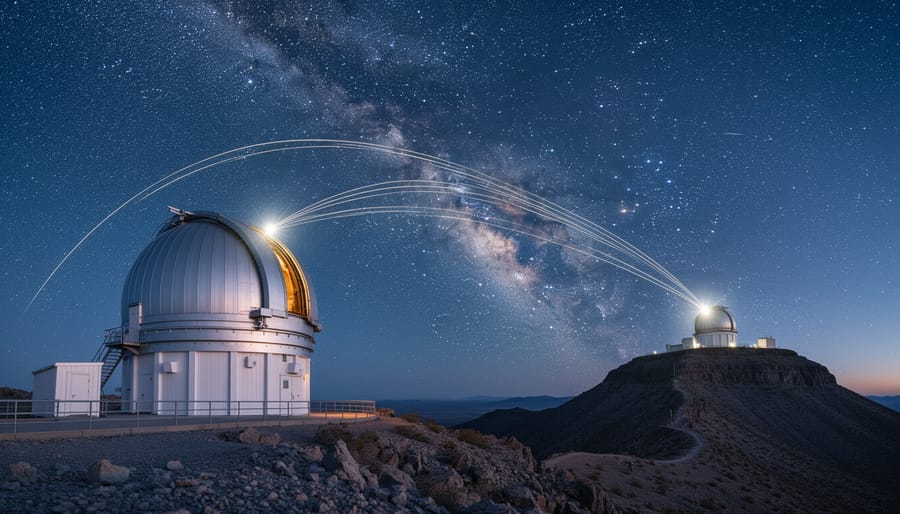
When a gravitational wave passes through Earth, the signal arrives at each detector at a slightly different time. LIGO operates two observatories, one in Hanford, Washington, and another in Livingston, Louisiana, separated by about 3,000 kilometers. This separation is deliberate. By comparing the precise timing of when a signal reaches each facility, scientists can determine the direction the wave came from, much like how your brain uses the tiny timing difference between your ears to locate a sound.
The network extends beyond LIGO’s two detectors. Virgo, located near Pisa, Italy, joined the search in 2017, and KAGRA in Japan began collaborative research observations in 2020. Each additional observatory improves the network’s ability to pinpoint a source’s location in the sky. With three or more detectors catching the same event, researchers can triangulate the origin to a much smaller patch of sky, sometimes narrowing it down from hundreds to just tens of square degrees.
Multiple detectors also serve a critical quality-control function. Local disturbances, like seismic activity or equipment vibrations, might create false signals at a single site. When two or more geographically distant observatories register the same gravitational wave signature within milliseconds, scientists can confidently rule out local interference and confirm the signal is astrophysical in origin. This redundancy has proven essential as the catalog has grown through successive observing runs, with the O4a Catalog released in August 2025 and the O4b Catalog released in May 2026 adding to the verified collection of cosmic events.
Types of Gravitational Wave Events
LIGO has captured signals from three main categories of cosmic collisions, each offering a unique window into extreme physics. Binary black hole mergers are the most common detections and reveal how these invisible giants spiral together and coalesce. Binary neutron star mergers are rarer but far more revealing, producing not only gravitational waves but also light across the electromagnetic spectrum. The hybrid category, black hole-neutron star mergers, sits between these two extremes and helps scientists test models of how matter behaves near black holes.
- Binary black hole mergers produce the strongest gravitational wave signals and let researchers measure black hole masses, spins, and test general relativity in extreme gravity
- Binary neutron star mergers generate both gravitational waves and electromagnetic radiation, enabling multi-messenger astronomy and revealing the origin of heavy elements like gold and platinum
- Black hole-neutron star mergers offer insights into tidal disruption and the physics of neutron star matter under extreme conditions
Each event type leaves a distinct signature in the data. Black hole mergers create clean, high-amplitude signals as two objects without surfaces collide. Neutron star mergers produce more complex waveforms with tidal effects visible in the final moments before merger, providing clues about the equation of state governing ultra-dense matter. The famous event GW170817, a neutron star merger detected in August 2017, launched the era of multi-messenger astronomy when dozens of telescopes observed the accompanying light show.
Researchers now scrutinize each detection for what it reveals about mass distributions, spin orientations, and cosmic evolution. GW230814, the loudest event in the GWTC-4.0 catalog released in August 2025, showcases how high signal-to-noise detections improve parameter estimates. The O4b Catalog released in May 2026 continues expanding this cosmic census, with every new merger refining our understanding of how compact objects form, evolve, and populate the universe.
The Growing Catalog of Detections
Since LIGO’s first confirmed detection in September 2015, the observatory has built an expanding catalog of gravitational wave events that grows with each observing run. These runs are scheduled periods when the detectors operate continuously, searching for signals from cosmic collisions across the universe.
The collaboration releases its findings through numbered catalogs. In August 2025, LIGO published the O4a Catalog, officially designated GWTC-4.0, which compiled events detected during the first phase of the fourth observing run along with confirmations from earlier periods. Among its discoveries, GW230814 stands out as the loudest event in GWTC-4.0, producing an exceptionally clear signal. Just weeks later, researchers announced GW250114, which holds the distinction of being the highest signal-to-noise ratio event detected to date, marking a full decade since gravitational wave astronomy began.
The most recent release came in May 2026 with the O4b Catalog, designated GWTC-5.0. GWTC-5.0 corresponds to O4b and includes events from the second phase of the fourth observing run. This catalog added notable detections such as GW241011 and GW241110, which revealed rapidly spinning, unequal mass black holes colliding in distant regions of space. Later observations like GW240925 and GW250207 helped demonstrate new astrophysical calibration techniques that improve detector accuracy.
Researchers access the complete historical record through two primary resources. The Gravitational Wave Open Science Center maintains the full catalog of all confirmed detections, providing detailed data for each event. For the most recent discoveries, the GraceDB LVK Public Alerts website offers an updated list of candidate events as they’re identified, often before full analysis confirms their astrophysical origin.
Each catalog release represents months of meticulous analysis, transforming raw detector data into verified cosmic events that reveal the universe’s most violent processes.
What Scientists Learn from Gravitational Waves
Gravitational wave astronomy has opened entirely new ways to study the universe, revealing phenomena that remain invisible to traditional telescopes. Each detection adds concrete data to fields ranging from fundamental physics to cosmology.
Testing Einstein’s predictions stands among the most significant applications. General relativity predicts precisely how gravitational waves should behave as they travel through spacetime, and LIGO’s observations have confirmed these century-old equations with remarkable accuracy. The waves arrive exactly as Einstein described, even from collisions billions of light-years away.
Black hole populations across cosmic history now come into focus through these detections. Before LIGO, astronomers had identified only a few dozen black holes through indirect methods. The growing catalog reveals black holes of unexpected masses, challenging formation theories and showing that these objects are far more common and diverse than models suggested. The data traces how black hole populations have evolved since the early universe.
Multi-messenger astronomy represents perhaps the most transformative application. When LIGO and Virgo detected gravitational waves from colliding neutron stars in 2017, telescopes worldwide turned to observe the same event in visible light, X-rays, and gamma rays. This coordination solved longstanding mysteries about where heavy elements like gold and platinum form, while demonstrating that combining gravitational wave data with electromagnetic observations multiplies the scientific return from each event.
The measurements also constrain cosmic expansion rates. By analyzing how gravitational waves stretch as they travel, combined with identifying their source locations, scientists derive independent estimates of the Hubble constant, addressing tensions between different measurement methods.
Neutron star matter, compressed to densities found nowhere else in the universe, yields its properties through these observations. The way neutron stars deform during mergers reveals the exotic physics governing matter under extreme conditions, much as fields like quantum computing probe quantum mechanics at technological frontiers. Dr. Nergis Mavalvala of MIT notes that gravitational waves are “revolutionizing science by giving us access to the most violent and energetic events in the universe, things we could never study any other way.”
Common Questions About LIGO and Gravitational Waves
What are gravitational waves?
Gravitational waves are ripples in spacetime caused by accelerating massive objects, such as merging black holes or neutron stars. Einstein predicted their existence in 1915, and they travel at the speed of light, carrying information about cosmic events across the universe.
How does LIGO detect gravitational waves?
LIGO uses laser interferometry with two 4-kilometer-long arms arranged in an L-shape. When a gravitational wave passes through, it causes one arm to lengthen while the other shortens by distances smaller than a proton, and the interference pattern of the laser beams reveals this tiny distortion.
What is GWTC-5.0?
GWTC-5.0 is the O4b Catalog released in May 2026, containing gravitational wave events detected during the O4b observing run and earlier runs. This catalog represents the latest verified public release of detection data from the LIGO-Virgo-KAGRA collaboration.
What are the latest gravitational wave detections?
Notable recent detections include GW250114, which holds the highest signal-to-noise ratio to date, and GW230814, the loudest event in the GWTC-4.0 catalog. The current full catalog of all events is available on the GWOSC website, and the most recent public alerts can be found on the GraceDB LVK Public Alerts website.
These questions reflect the most common inquiries from those encountering gravitational wave astronomy for the first time. The field continues to expand our understanding with each new detection, turning what was once purely theoretical physics into an observational science that reveals the universe’s most violent events.
LIGO’s detection of gravitational waves stands as one of the defining scientific achievements of the 21st century. What began with a single confirmed observation in 2015 has evolved into a systematic survey of the universe’s most violent events, transforming gravitational wave astronomy from theoretical possibility into observational reality. The expanding catalog of detections demonstrates the maturation of this field: from the O4a Catalog released in August 2025 to the O4b Catalog in May 2026, researchers continue to capture signals from cosmic collisions billions of light-years away, each one adding new data points to our understanding of black holes, neutron stars, and the fundamental nature of spacetime itself.
The technology that makes these discoveries possible has proven remarkably robust. LIGO’s interferometers, working in concert with Virgo and KAGRA, now routinely detect distortions in spacetime smaller than a fraction of a proton’s width. Events like GW250114, with the highest signal-to-noise ratio recorded to date, show how sensitive these instruments have become. Each new detection refines our models of stellar evolution, tests Einstein’s equations under extreme conditions, and provides independent measurements of cosmic expansion.
The future promises even greater sensitivity as detector upgrades continue and new observatories join the global network. For now, scientists have access to a growing archive of verified cosmic events, all documented and available for analysis, each one a window into phenomena that were purely theoretical just over a decade ago.