
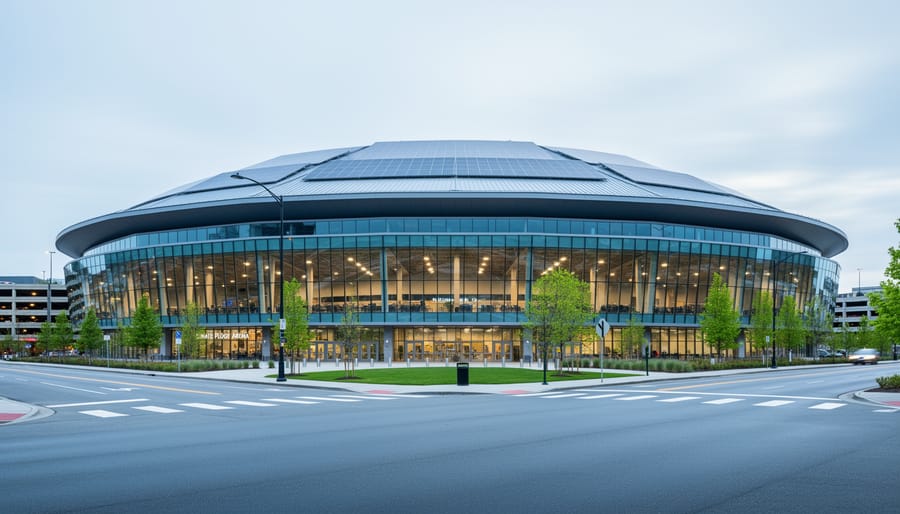
Climate Pledge Arena is the world’s first net-zero carbon certified sports and entertainment venue, located in Seattle and designed to eliminate all fossil fuel use while operating entirely on renewable energy. This landmark facility proves that large-scale entertainment venues can meet ambitious climate goals without sacrificing functionality or fan experience.
The arena’s transformation represents a critical test case for sustainable infrastructure. Converting an existing structure originally built in 1962 into a zero-carbon facility required eliminating natural gas connections and implementing comprehensive renewable energy systems. These changes demonstrate how legacy buildings can be reimagined for a climate-conscious future rather than torn down and rebuilt.
The venue received Zero Carbon Certification from the International Living Future Institute, meeting rigorous standards that go beyond typical green building practices. According to Jason F. McLennan, the arena achieved this by getting rid of all fossil fuels entirely, creating a blueprint other venues worldwide are now studying.
Seattle’s approach combines onsite solar generation with strategic renewable energy partnerships. The facility features solar panels covering the 36,000-square-foot atrium roof and additional arrays on the adjacent parking structure. Amazon supports remaining energy needs through offsite utility-scale solar and wind farms, ensuring 100 percent renewable power even during peak events.
The complete removal of underground natural gas infrastructure prevents 780 metric tons of carbon dioxide emissions annually, equivalent to taking hundreds of cars off the road. This article examines how Climate Pledge Arena’s innovative systems work together, what components make zero-carbon operation possible, and how this model applies to broader climate solutions.
What Climate Pledge Arena Means for Carbon-Neutral Buildings
Climate Pledge Arena earned Zero Carbon Certification from the International Living Future Institute by eliminating all direct fossil fuel emissions and powering operations entirely through renewable sources. This certification represents the highest standard for carbon-neutral buildings, requiring facilities to demonstrate zero operational carbon emissions through a combination of energy efficiency, low-carbon energy generation, and verified renewable energy procurement.
- Net-zero carbon
- A building that produces zero net carbon dioxide emissions annually by eliminating fossil fuel use and matching 100 percent of its energy consumption with renewable sources.
- Zero Carbon Certification
- Third-party verification from the International Living Future Institute confirming that a building operates without contributing greenhouse gas emissions to the atmosphere.
- Renewable energy portfolio
- The combined mix of clean energy sources, such as solar, wind, and hydroelectric power, that supply a facility’s electricity needs without burning fossil fuels.
- Carbon offset
- Compensation for unavoidable emissions by supporting projects that remove or prevent equivalent amounts of carbon dioxide elsewhere, though Climate Pledge Arena eliminates rather than offsets its operational emissions.
The arena’s achievement connects directly to climate change studies examining the built environment’s role in global emissions. Buildings account for nearly 40 percent of worldwide carbon output, making the decarbonization of large public facilities a critical pathway for meeting climate targets. Climate Pledge Arena demonstrates that entertainment venues can operate at massive scale without contributing to atmospheric carbon buildup, challenging the assumption that certain building types must rely on fossil fuels.
How Climate Pledge Arena Achieves Zero Carbon Operations
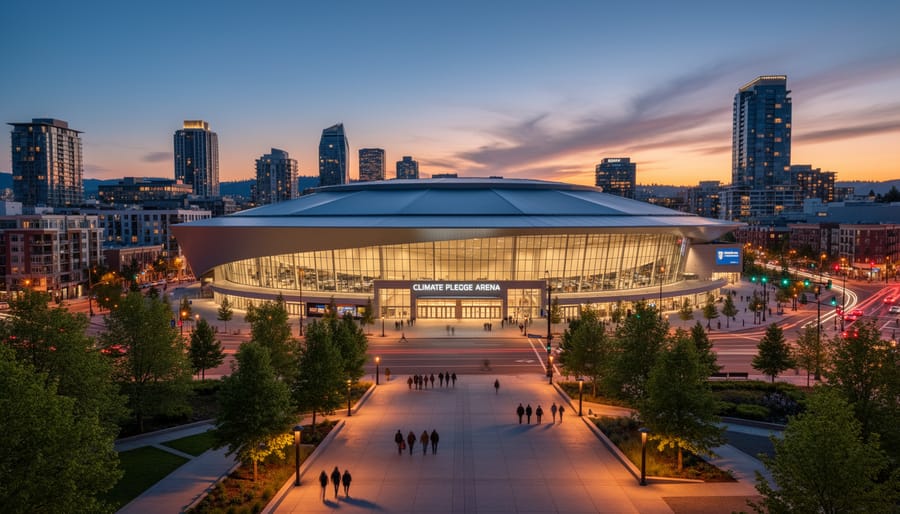
Eliminating Fossil Fuels from Arena Operations
The most fundamental step in eliminating carbon emissions from Climate Pledge Arena was converting the facility from natural gas to all-electric systems. This underground infrastructure overhaul required removing existing natural gas lines and rebuilding the mechanical systems to run entirely on electricity. The conversion prevents 780 metric tons of carbon dioxide emissions annually, removing a direct source of fossil fuel combustion that conventional arenas depend on for heating, water systems, and kitchen operations.
Traditional sports and entertainment venues rely heavily on natural gas for space heating during cold months, hot water production for locker rooms and concessions, and commercial kitchen equipment. By replacing these gas-fired systems with electric alternatives, the arena eliminated onsite fossil fuel burning. The mechanical redesign included installing electric heat pumps, electric water heaters, and commercial-grade electric cooking equipment throughout the facility.
Jason F. McLennan, who worked on the project, emphasized the significance of this approach, noting that the venue got rid of all fossil fuels as part of becoming a zero-carbon arena. This stands in contrast to many sustainability projects that reduce fossil fuel consumption but maintain gas connections as backup systems or for specific applications.
The all-electric strategy works because the electricity powering these systems comes from renewable sources rather than fossil fuel power plants, creating a complete break from carbon-emitting energy. Without renewable electricity backing the conversion, switching from gas to electric would simply shift emissions from the building to the power grid.
Onsite Renewable Energy Generation
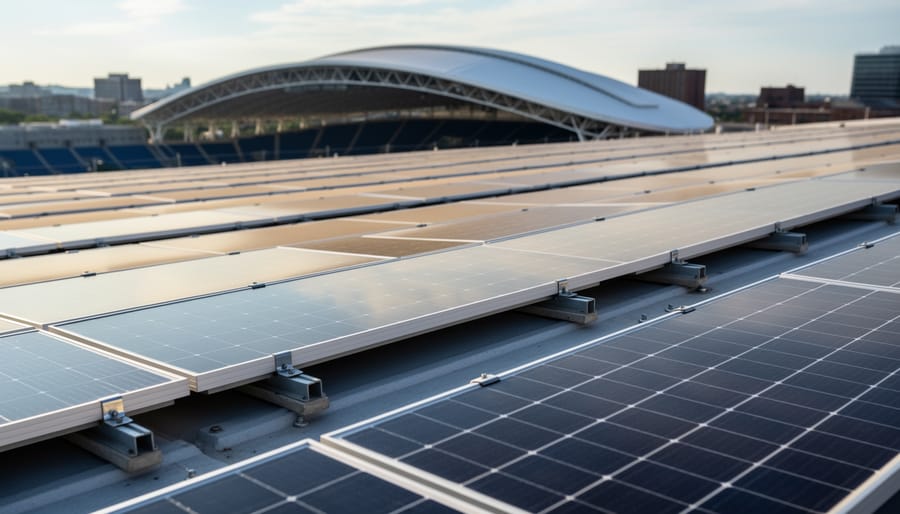
Climate Pledge Arena generates electricity onsite through two strategically placed solar installations that serve as visible demonstrations of renewable energy sources in action. The primary array sits atop the venue’s distinctive 36,000-square-foot atrium roof, where photovoltaic panels capture sunlight streaming through the transparent covering. A second installation occupies the roof of the adjacent 1st Avenue parking structure, expanding the arena’s capacity to convert solar radiation into usable power.
These rooftop systems form the foundation of the facility’s energy portfolio, contributing directly to daily operations without drawing from the regional grid. The atrium installation serves a dual purpose: it maintains natural lighting for the historic building while harvesting energy from the same sunlight, reducing the load on artificial lighting systems below. Together, these arrays represent the arena’s self-generated power capacity.
However, onsite solar alone cannot meet the full electrical demand of a venue that hosts concerts, hockey games, and basketball events year-round. The panels produce a meaningful portion of the building’s needs, but the remaining gap requires additional energy procurement, which Amazon addresses through offsite renewable projects tied to the venue’s operations.
Offsite Renewable Energy Partnerships
While the solar installations on Climate Pledge Arena’s roof and parking structure generate meaningful power, they can’t meet the full energy demands of a major sports and entertainment venue. Amazon stepped in to close this gap by committing to procure enough offsite renewable energy to match the arena’s total consumption. This involves contracting with utility-scale solar and wind farm projects that feed clean electricity into the regional grid. When the arena draws power, an equivalent amount of renewable energy enters the grid system through these partnerships.
This arrangement represents a practical solution to the space constraints inherent in urban venues. You can’t fit enough solar panels on a single building to power 18,100 seats, massive refrigeration systems for an NHL ice surface, concert lighting rigs, and year-round event operations. Instead, the offsite renewable strategy leverages the carrying capacity of larger generating facilities located where land and wind or solar resources are abundant. The renewable energy credits and power purchase agreements ensure that for every megawatt-hour the arena consumes, a megawatt-hour of clean energy displaces fossil fuel generation somewhere on the shared grid, maintaining the net-zero carbon balance that defines the facility’s operations.
Components of a Zero-Carbon Arena System

Climate Pledge Arena achieves net-zero carbon status through a carefully integrated system of technologies and operational protocols that eliminate direct fossil fuel use and offset remaining emissions. Understanding how low-carbon energy works helps explain how these components interconnect to create a closed-loop zero-carbon system. The arena’s approach demonstrates that carbon neutrality requires more than just renewable energy procurement, it demands fundamental changes to building systems, materials selection, and daily operations.
The venue’s zero-carbon system relies on several interdependent components:
- All-electric HVAC systems that replaced conventional natural gas heating equipment throughout the 740,000-square-foot facility
- Dual solar arrays on the atrium roof and parking structure generating onsite renewable electricity
- Electric Zambonis and equipment that eliminated emissions from ice resurfacing operations
- Low-global-warming-potential refrigerants in ice-making systems that reduce greenhouse gas impact by 90% compared to traditional options
- Renewable energy credits and power purchase agreements securing offsite wind and solar generation to cover demand beyond onsite capacity
- Real-time energy monitoring systems tracking consumption and emissions across all building operations
The operational protocols matter as much as the hardware. Staff training ensures that all systems run at peak efficiency, while the monitoring infrastructure identifies energy waste before it accumulates. Material choices extended beyond energy systems, the arena incorporated reclaimed rainwater for ice-making and building systems, reducing both energy for water treatment and the carbon footprint of municipal water delivery.
This layered approach addresses what climate change studies identify as the three scopes of emissions: direct onsite combustion, purchased electricity, and indirect supply chain impacts. By systematically eliminating or offsetting emissions across all three categories, Climate Pledge Arena created a replicable framework that other venues can adapt to their specific contexts and constraints.
Real-World Applications and the Future of Climate-Conscious Venues
Scaling Zero-Carbon Technology to Other Venues
Climate Pledge Arena’s retrofit demonstrates that existing buildings can incorporate many zero-carbon strategies without complete reconstruction. The all-electric conversion represents the most transferable element, older arenas and stadiums can eliminate natural gas systems by upgrading heating, cooling, and food service equipment to electric alternatives. Onsite solar installations work best for facilities with large roof areas and favorable sunlight exposure, making them viable for many venues across different climates.
New construction projects face fewer constraints. Designers can integrate renewable energy systems, efficient building envelopes, and smart energy management from the ground up, typically at lower cost than retrofitting. Zero-carbon design becomes simpler when architects don’t navigate around existing mechanical systems or structural limitations.
The primary economic barrier remains upfront capital investment. Converting mechanical systems and installing renewable energy infrastructure costs significantly more than maintaining fossil fuel equipment, even when long-term operational savings offset initial expenses. Technical challenges vary by location, buildings in regions with carbon-intensive electric grids require larger renewable energy purchases to achieve zero emissions, while those in areas with clean electricity face simpler pathways.
Building age and design create additional hurdles. Historic venues with preservation requirements or facilities lacking adequate roof space for solar panels need creative solutions like offsite renewable partnerships or community solar agreements to reach carbon neutrality.
Impact on Climate Change Research and Policy
Climate Pledge Arena functions as a living laboratory for decarbonization research, providing measurable performance data that informs climate change studies worldwide. The venue’s real-time energy consumption, carbon offset verification, and operational efficiency metrics contribute to a growing body of evidence demonstrating that large-scale entertainment facilities can eliminate emissions without compromising functionality. This documented proof-of-concept addresses a critical gap in climate mitigation research, showing that the built environment sector, responsible for nearly 40% of global emissions, can achieve net-zero operations through existing technologies rather than waiting for future innovations.
The arena’s Zero Carbon Certification from the International Living Future Institute establishes a replicable framework that influences building codes and industry standards beyond sports venues. Municipal governments and commercial developers now reference Climate Pledge Arena’s approach when drafting sustainability requirements for new construction and major renovations. The venue demonstrates that eliminating fossil fuel infrastructure and transitioning to renewable energy at scale is technically feasible and economically viable, providing policymakers with empirical evidence to support stricter emissions regulations for large public buildings.
Common Questions About Zero-Carbon Arenas
What makes Climate Pledge Arena zero-carbon?
The arena eliminates all fossil fuel use by operating as an all-electric facility and powers itself with 100 percent renewable energy from both onsite solar panels and offsite wind and solar farms secured by Amazon. This combination prevents 780 metric tons of CO2 emissions annually from what would otherwise be natural gas consumption.
What does 100 percent renewable energy mean for a venue this size?
It means every kilowatt-hour consumed during events, operations, and maintenance comes from solar or wind sources rather than fossil fuel power plants. The arena generates some power onsite through solar panels on its 36,000-square-foot atrium roof and parking structure, while utility-scale renewable farms cover the remaining demand.
Can existing arenas convert to zero-carbon operations?
Converting older facilities requires replacing gas-powered heating, cooling, and kitchen equipment with electric alternatives and securing renewable energy contracts. The infrastructure changes can be substantial, Climate Pledge Arena’s renovation included underground work to remove natural gas lines entirely, but the technical pathway exists for venues willing to invest in the transition.
Who verifies zero-carbon certification?
Climate Pledge Arena received its Zero Carbon Certification from the International Living Future Institute, an independent organization that evaluates building performance against rigorous sustainability standards. This third-party verification ensures the venue meets defined criteria rather than self-reporting its environmental claims.
The certification process matters because it establishes accountability. Without independent verification, the term “zero-carbon” risks becoming marketing language rather than measurable achievement. Climate Pledge Arena’s willingness to submit to external review sets a precedent for transparency that other venues can follow, creating standardized benchmarks for what carbon neutrality actually requires in practice.