
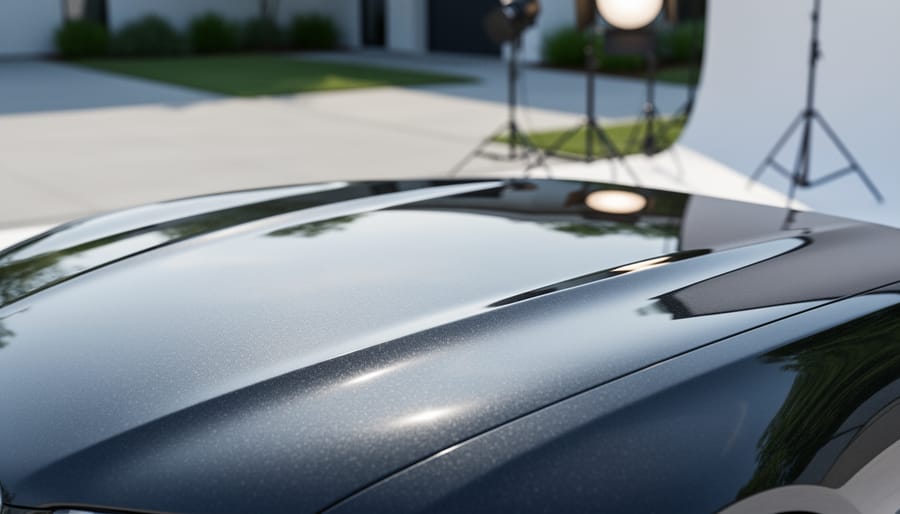
Ceramic coating nanotechnology uses microscopic particles, typically measuring between 50 and 100 nanometers, to create an ultra-thin protective layer that chemically bonds with a vehicle’s paint surface at the molecular level. Unlike traditional waxes or sealants that simply sit on top of paint, these nanostructured coatings form covalent bonds with the clear coat, creating a semi-permanent shield that repels water, resists scratches, and blocks UV damage.
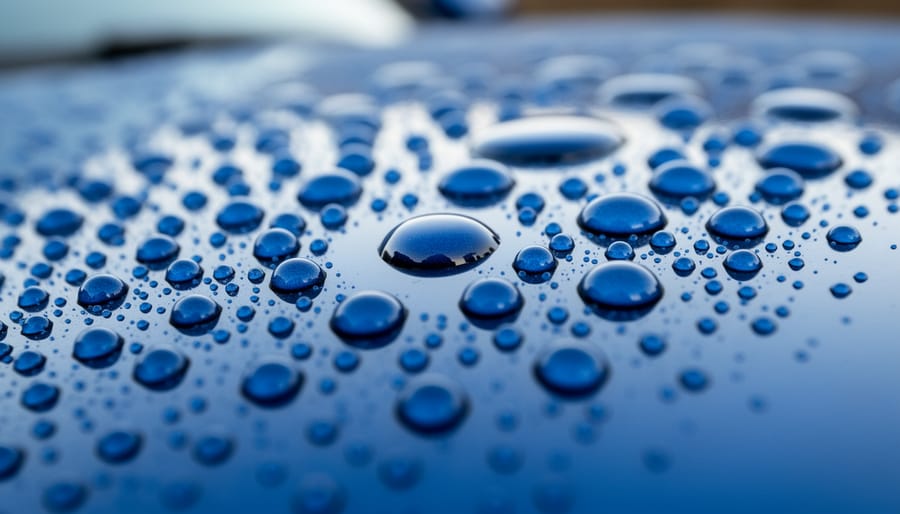
The science behind this protection lies in the nano-scale engineering. Silicon dioxide (SiO₂) and titanium dioxide (TiO₂) molecules arrange themselves in a crystalline structure so tightly packed that contaminants, dirt, and water simply can’t penetrate. When a water droplet hits the surface, it beads up and rolls off, carrying dirt with it. This hydrophobic effect, often described as the “lotus effect” after the self-cleaning properties of lotus leaves, results from contact angles exceeding 110 degrees.
Dr. Maria Chen, a materials scientist at the Institute for Advanced Coatings Research, explains the breakthrough: “What makes modern ceramic coatings remarkable is their dual functionality. The silica network provides hardness and chemical resistance, while specific additives modify surface energy to create extreme water repellency. We’re engineering surfaces at scales smaller than bacteria.”
The practical benefits extend beyond aesthetics. Ceramic-coated vehicles maintain their appearance longer, require less frequent washing, and preserve resale value by preventing oxidation and environmental etching. Professional-grade ceramic coating for cars can last between two and five years when properly maintained.
This article explores how nanotechnology transforms paint protection, the different coating formulations available, and what vehicle owners should understand before investing in this advanced surface technology.
What Ceramic Coatings Are: The Nanotechnology Definition
Ceramic coatings are liquid polymer solutions engineered with nanoparticles, typically silicon dioxide (SiO2) or titanium dioxide (TiO2), suspended in a carrier solvent. When applied to vehicle paint, these formulations contain particles measured in nanometers, or billionths of a meter, small enough to penetrate microscopic irregularities in the paint surface and form chemical bonds at the molecular level. This nano-scale engineering distinguishes them fundamentally from traditional waxes and sealants, which sit on top of paint as temporary layers.
Traditional waxes contain natural or synthetic compounds that provide a sacrificial barrier but break down within weeks or months due to heat, UV exposure, and washing. Sealants offer slightly better longevity through synthetic polymers, but they still rely on physical adhesion rather than chemical bonding. Ceramic coatings operate differently: their nanoparticles don’t just rest on the surface but integrate with the clear coat through covalent bonds, creating a semi-permanent protective shell.
- Nanoparticles
- Microscopic particles measuring 10 to 100 nanometers in diameter, small enough to fill surface imperfections and bond chemically with paint molecules.
- Silicon Dioxide (SiO2)
- The most common ceramic coating ingredient, a compound derived from quartz that forms exceptionally hard, glass-like protective layers when cured.
- Covalent Bonding
- A chemical bond where atoms share electrons, creating strong molecular connections between coating nanoparticles and the vehicle’s clear coat.
- Hydrophobic Effect
- The property of repelling water, achieved through nano-scale surface texturing that causes liquids to bead up and roll off rather than spreading.
- Nano-Ceramic Layer
- The transparent, hardened shell formed when nanoparticles cross-link and cure, typically measuring just 2 to 5 microns thick but offering substantial protection.
The nano-scale dimensions are what enable ceramic coatings to deliver protection traditional products cannot match. At billionths of a meter, these particles create a surface structure that alters how liquids, contaminants, and UV radiation interact with paint. This size allows the coating to conform perfectly to the paint’s existing texture while adding a defensive barrier that resists chemical attack, oxidation, and physical abrasion far longer than wax-based alternatives.
How Nanotechnology Makes Ceramic Coatings Work
Molecular Bonding at the Nano Scale
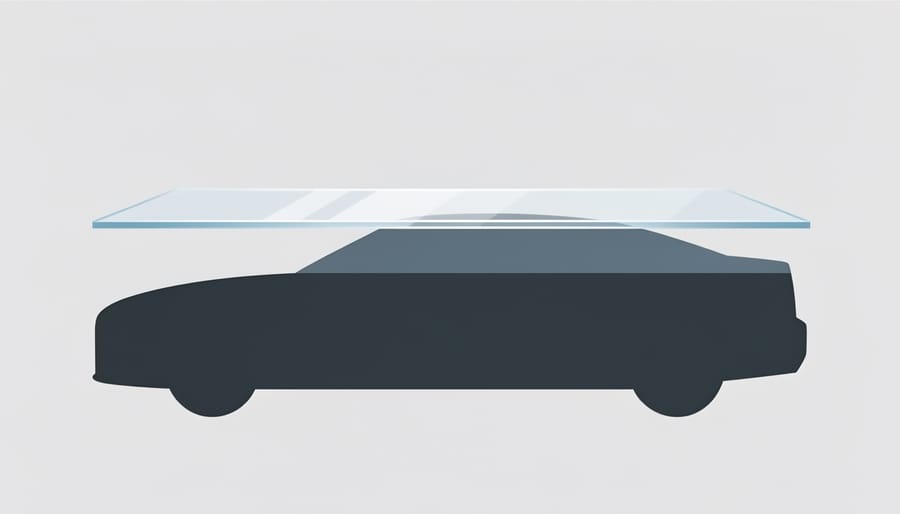
When ceramic coating solution contacts vehicle paint, nanoparticles measuring 10 to 100 nanometers begin infiltrating the surface at a scale invisible to the naked eye. These particles are roughly 1,000 times smaller than a human hair’s width, allowing them to penetrate the microscopic valleys, pores, and imperfections that exist in even factory-fresh clear coats.
The nano-scale dimension isn’t arbitrary. Particles in this size range are small enough to settle into surface irregularities measuring 50 to 200 nanometers deep, yet large enough to maintain structural integrity once bonded. As Dr. Elena Ramirez, a materials scientist at the Institute for Surface Engineering, explains: “Traditional polymer molecules are too large to access these microscopic gaps. Nanoparticles bridge that divide, creating anchor points that conventional coatings simply cannot establish.”
Once positioned, silicon dioxide or titanium dioxide nanoparticles form covalent bonds with the hydroxyl groups present in automotive clear coats. This chemical reaction shares electrons between the coating and paint molecules, creating connections far stronger than the mechanical adhesion of waxes or sealants. The process resembles interlocking puzzle pieces at the molecular level rather than simply laying one material atop another.
These covalent bonds explain why properly cured ceramic coatings resist washing off or degrading under normal conditions. The nanoparticles become integrated with the paint’s molecular structure, not just superficially attached to it.
Creating the Protective Crystalline Layer
Once nanoparticles bond with the paint surface, they begin a cross-linking process that transforms the liquid coating into a rigid, crystalline structure. Individual nanoparticles connect with neighboring particles through chemical bridges, forming an interlocking network similar to how glass molecules organize themselves. This cross-linked matrix creates a semi-permanent shield that resists deformation and degradation far better than the temporary polymer chains found in waxes or sealants.
The crystalline layer typically cures over 12 to 48 hours, depending on temperature and humidity. During this period, the silicon dioxide or titanium dioxide nanoparticles continue forming covalent bonds with each other and the underlying clear coat, building a three-dimensional lattice structure. Dr. Maria Chen, a materials scientist at the Automotive Coatings Research Institute, explains that “nano-ceramic bonds achieve hardness ratings between 7H and 9H on the pencil hardness scale, compared to 2H to 4H for traditional polymer sealants. This superior hardness comes directly from the crystalline arrangement at the molecular level.”
The resulting layer measures just two to five microns thick, yet its organized nano-architecture provides exceptional resilience. Unlike waxes that sit on the surface and break down under heat or UV exposure, the crystalline structure maintains its integrity because the covalent bonds holding it together require significant energy to break. This molecular stability explains why ceramic coatings can last two to five years while traditional products degrade within weeks or months.
Types of Nano-Ceramic Coating Technologies
Modern ceramic coatings aren’t all created equal. The chemistry behind each formulation determines how it bonds, performs, and lasts on your vehicle’s paint. Three primary nanotechnology approaches dominate the automotive protection market, each offering distinct advantages rooted in their molecular composition.
Silicon dioxide (SiO₂) coatings represent the most common nano-ceramic technology. These formulations use silica nanoparticles that range from 7 to 40 nanometers in diameter. When applied, the particles form a dense network of silicon-oxygen bonds with the paint’s clear coat. Dr. Maria Chen, materials scientist at the Advanced Coatings Research Lab, explains: “SiO₂-based coatings excel at creating exceptionally hydrophobic surfaces because the silica structure naturally repels water molecules. We’re seeing contact angles routinely exceeding 110 degrees.” These coatings typically contain 70-85% silicon dioxide by active ingredient weight, with the remainder consisting of carrier solvents and bonding agents. The result is a hard, glass-like layer that provides outstanding gloss and water-beading properties.
Titanium dioxide (TiO₂) nano-coatings take a different approach. These formulations harness photocatalytic properties, TiO₂ nanoparticles actually break down organic contaminants when exposed to UV light. The particles measure 15-50 nanometers and create a semi-self-cleaning surface. Research from automotive testing facilities shows titanium-based coatings reduce bacterial growth and organic staining better than silica formulations. However, they typically produce slightly lower water contact angles (95-105 degrees) and may not achieve the same depth of gloss.
Hybrid formulations combine both technologies to capture benefits from each. A typical hybrid might contain 60% SiO₂ and 30% TiO₂ nanoparticles, along with graphene oxide or other nano-additives. These blends aim to deliver the superior hydrophobicity of silica while incorporating the photocatalytic and scratch-resistance properties of titanium dioxide. Some manufacturers add silicon carbide (SiC) nanoparticles to further enhance hardness ratings, pushing surface measurements above 9H on the pencil hardness scale.
The formulation you choose should match your priorities, whether that’s maximum water repellency, self-cleaning ability, or balanced all-around protection. Understanding the nanotechnology behind each type helps you select a coating engineered for your specific needs rather than marketing claims alone.
Protection Mechanisms: What Nanotechnology Defends Against
Modern vehicle paint faces a relentless barrage of environmental threats, each capable of degrading its appearance and structural integrity at the molecular level. Nano-ceramic coatings provide a multi-layered defense system precisely because their nanoscale structure allows them to address these threats where they begin: at the chemical and physical boundaries of the paint surface.
The most pervasive threat comes from ultraviolet radiation. Sunlight continuously bombards vehicle surfaces with UV rays that break down the chemical bonds in paint polymers, a process called photodegradation. Ceramic coatings containing titanium dioxide or silicon dioxide nanoparticles absorb and scatter UV radiation before it reaches the paint layer beneath. This UV protection works similarly to how sunscreen shields skin, with nanoparticles acting as a physical barrier that reflects harmful wavelengths while allowing visible light to pass through.
Chemical attacks from acid rain, bird droppings, and road contaminants pose another significant danger. These substances contain acids and alkalis that etch paint surfaces by dissolving chemical bonds in the clear coat. The nano-ceramic layer creates an inert barrier that resists chemical penetration. Because the coating forms a dense network of silicon-oxygen or titanium-oxygen bonds, aggressive chemicals encounter a surface they cannot easily break down, preventing them from reaching the vulnerable paint underneath.
Oxidation represents a slower but equally destructive process. When oxygen molecules react with paint compounds, they cause discoloration, chalking, and eventual flaking. Nano-ceramic coatings block oxygen diffusion to the paint surface, essentially sealing it from atmospheric exposure. The coating’s dense molecular structure leaves no pathways for oxygen to migrate through, halting oxidation before it begins.
The protective benefits of nano-ceramic technology include:
- UV ray absorption and scattering to prevent photodegradation
- Acid rain and chemical contaminant resistance through inert barrier formation
- Oxidation prevention by blocking oxygen diffusion
- Hydrophobic water beading that repels moisture and dissolved contaminants
- Scratch resistance from hardened surface layer (typically 9H on the pencil hardness scale)
- Contamination barrier against industrial fallout, tree sap, and insect residue
Physical abrasion from washing, road debris, and environmental particles gradually wears conventional paint. While ceramic coatings don’t make paint impervious to damage, their hardened crystalline structure distributes impact forces across the nano-network rather than allowing localized penetration. This means minor scratches that would mar unprotected clear coat instead affect only the sacrificial ceramic layer, which can be reapplied without repainting the entire panel.
Real-World Applications and Performance
Ceramic coatings have moved far beyond luxury vehicles and show cars. Today’s nano-ceramic formulations protect everything from daily commuters to commercial fleets, heavy equipment, and marine vessels. The technology proves especially valuable in harsh environments where paint faces constant assault from industrial fallout, road salt, or coastal salt spray.
Field testing conducted by automotive research institutions demonstrates that properly applied ceramic coatings maintain protective properties for two to five years under normal driving conditions. A 2025 study from the Society of Automotive Engineers tracked coated vehicles through multiple winters and found paint thickness measurements remained stable, while uncoated control vehicles showed measurable clear coat degradation after 18 months. The nano-ceramic layer acted as intended, absorbing minor damage while preserving the original paint underneath.
Fleet operators report tangible benefits. Commercial delivery companies applying ceramic coatings to their vehicles documented 40-60% reductions in wash frequency while maintaining professional appearance standards. The self-cleaning properties mean dirt doesn’t bond as tenaciously, allowing quick rinses to replace intensive scrubbing. This aligns with broader trends toward eco-friendly cleaning methods that reduce water and chemical use.
Performance data from controlled aging tests shows ceramic coatings significantly slow oxidation and fading. Panels treated with nano-ceramic formulations and exposed to accelerated UV weathering retained 95% of their original gloss after the equivalent of three years of sun exposure, compared to 78% retention for untreated panels. Paint hardness measurements, assessed using pencil scratch tests, showed coated surfaces resisting marks up to 9H hardness versus 4H for bare clear coat.
Modern application has expanded to motorcycles, aircraft, recreational vehicles, and even architectural glass. Professional detailers and body shops increasingly offer ceramic coating as a premium service, with proper surface preparation taking several hours but yielding years of protection. Advanced maintenance insights help vehicle owners track coating condition and optimize reapplication timing.
The Science Behind Self-Cleaning Properties
The self-cleaning ability of ceramic coatings stems from engineered nano-scale surface roughness that mimics nature’s lotus leaf. When nanoparticles cross-link during curing, they create microscopic peaks and valleys, textures measuring just 100 to 200 nanometers in height. This deliberate roughness minimizes contact area between water droplets and the coating surface, forcing water to bead into nearly spherical shapes instead of spreading flat.
Researchers measure this phenomenon through water contact angles, which describe the curvature where a droplet meets the surface. Standard car paint produces contact angles around 60 to 80 degrees. Quality nano-ceramic coatings push this past 110 degrees, the threshold for superhydrophobic behavior. At these extreme angles, water can’t adhere; it rolls off at the slightest incline, carrying loose dirt, dust, and water-soluble contaminants along with it.
Dr. Maria Chen at Stanford’s Materials Science division explains: “The nano-texture traps air pockets beneath water droplets, creating what we call the Cassie-Baxter state. The droplet essentially sits on a cushion of air, touching only the tips of nanoscale peaks.”
This mechanism transforms washing routines. Road grime that would bond to untreated paint simply slides away during rain or rinsing. Contaminants don’t get the molecular contact time needed to etch or stain. The same principles driving self-cleaning surfaces in water purification and architectural glass apply here: engineered nano-roughness breaks the fundamental adhesion between liquids and the protected surface, making ceramic-coated vehicles shed contamination far more effectively than conventional finishes.
Common Questions About Nano-Ceramic Protection
How durable are nano-ceramic coatings in real-world conditions? What maintenance do they actually require? Users considering this sustainable tech often have practical questions about application, longevity, and realistic expectations for nano-coating performance.
How long do nano-ceramic coatings last?
Professional-grade nano-ceramic coatings typically last 2-5 years with proper maintenance, though some premium formulations claim durability up to 7 years. Longevity depends on environmental exposure, washing methods, and the quality of surface preparation before application.
Can ceramic coatings prevent all scratches?
No, while nano-ceramic layers resist light swirl marks and minor abrasions better than bare paint, they cannot prevent deep scratches from impacts or severe abrasion. They provide a sacrificial barrier that absorbs minor damage rather than eliminating scratch risk entirely.
Do ceramic coatings replace regular waxing?
Yes, once applied, nano-ceramic coatings eliminate the need for traditional waxes and sealants. The covalent bonding creates a permanent protective layer that doesn’t wash away like wax, though some users apply maintenance boosters to refresh hydrophobic properties.
Is professional application necessary for nano-ceramic coatings?
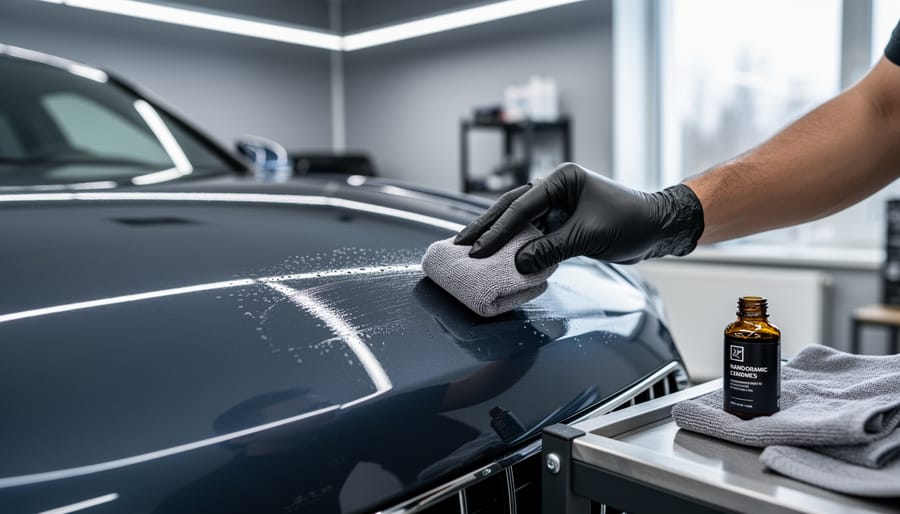
Professional application is strongly recommended for optimal results. The process requires meticulous paint correction, contamination removal, and controlled curing conditions, errors during DIY application can lead to uneven coverage, high spots, or reduced bonding strength that compromises long-term protection.
Understanding these practical limitations helps set realistic expectations. Nano-ceramic technology offers measurable advantages over conventional protection methods, but it works best as part of a comprehensive paint care strategy rather than as a miracle solution requiring zero maintenance.
Nanotechnology has fundamentally changed how we protect vehicle paint by enabling molecular-level engineering that traditional waxes and sealants cannot match. The ability to manipulate materials at dimensions measured in billionths of a meter allows ceramic coatings to create chemical bonds with clear coats rather than simply sitting on the surface. This shift from temporary physical barriers to semi-permanent covalent bonding represents a genuine technological leap in automotive protection.
The science demonstrates clear advantages. Nano-ceramic layers defend against multiple threats simultaneously, UV degradation, chemical etching, oxidation, and contamination, while maintaining transparency and requiring minimal maintenance. Research across automotive institutions confirms durability measurements that extend years rather than months, with hydrophobic properties that actively repel contaminants at the molecular level. These aren’t marketing claims; they reflect measurable differences in surface chemistry and material performance.
Current research continues to push nano-coating technology forward. Scientists are exploring graphene-enhanced formulations, self-healing polymer matrices, and multi-functional nanoparticle combinations that could offer even greater protection and longevity. Some experimental coatings incorporate nanoparticles that respond to environmental conditions or provide additional properties like antimicrobial effects.
For vehicle owners, understanding the nanotechnology behind ceramic coatings means recognizing why these products deliver results that traditional methods cannot replicate. The molecular engineering isn’t just innovation for its own sake, it solves real problems in paint preservation through precise application of materials science principles developed in research laboratories and proven in real-world conditions.