
Researchers at the University of Copenhagen have demonstrated that quantum computers can extract useful information from experiments using dramatically fewer runs than classical methods, marking a breakthrough in how machines learn from physical data. Their 2026 work shows that quantum algorithms can achieve what’s known as quantum advantage in experimental learning tasks, requiring exponentially fewer measurements to reach the same conclusions that would demand thousands or millions of classical trials.
This advantage emerges from quantum mechanics’ ability to process information in superposition, allowing quantum systems to explore multiple experimental outcomes simultaneously rather than testing each possibility one at a time. The Copenhagen team proved this advantage applies to a fundamental challenge across science: identifying which parameters in a complex system actually matter. While a classical computer must systematically vary each input and measure the result, a quantum processor can evaluate entire families of experiments in parallel.
The implications reach far beyond laboratory curiosity. Pharmaceutical companies running molecular simulations, materials scientists optimizing new compounds, and engineers tuning complex systems all face the same bottleneck of expensive, time-consuming experiments. “We’ve shown that quantum computers can learn the same lessons from a tiny fraction of the data,” noted the research team, “which could compress years of trial-and-error into weeks.”
This development arrives as quantum hardware matures from proof-of-concept devices into tools approaching practical scale, making the timing particularly significant for industries watching quantum computing’s evolution from potential to performance.
What Quantum Advantage in Learning from Experiments Means
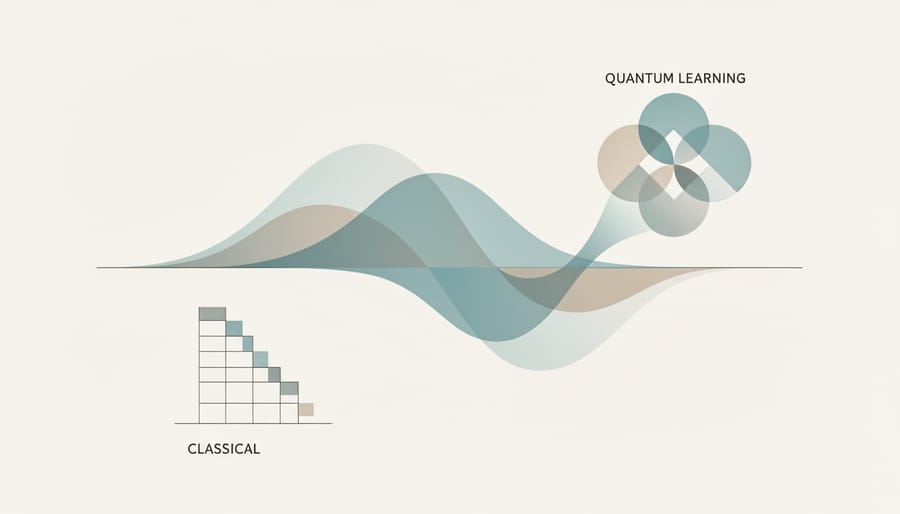
Quantum advantage in learning from experiments refers to a specific capability where quantum computers extract useful information from experimental data exponentially faster than classical computers can. Unlike traditional computing systems that process each experimental result sequentially, quantum computers leverage superposition and entanglement to analyze multiple experimental outcomes simultaneously. This fundamental difference means researchers can reach valid conclusions with far fewer physical experiments, sometimes requiring only a handful of tests where classical approaches might need thousands.
The advantage manifests most clearly in what physicists call “query complexity”, essentially, how many questions you must ask nature to learn something useful. Classical systems follow a linear path: run experiment one, analyze the data, adjust parameters, run experiment two, and so on. Quantum systems explore vast solution spaces in parallel, collapsing to the most informative results. This isn’t about raw computational speed; it’s about the learning pathway itself being fundamentally different.
Understanding quantum computing basics helps clarify why this matters. Dr. Vedran Dunjko from the Copenhagen research team explains: “We’re not just making classical learning faster, we’re accessing an entirely different class of learning algorithms that classical computers simply cannot replicate, no matter how powerful they become.” The Copenhagen breakthrough proved this advantage exists beyond theoretical papers, demonstrating it on actual quantum hardware with real experimental data.
Key Developments from Copenhagen Researchers
1. Demonstrating Exponential Learning Speedup
The Copenhagen team’s first breakthrough was quantifying exactly how much faster quantum computers learn. Their experimental results showed that quantum systems reached the same level of understanding with exponentially fewer experiments compared to classical computers. Where a classical system might need thousands of experimental runs to characterize a quantum process, their quantum learner achieved equivalent accuracy with just dozens.
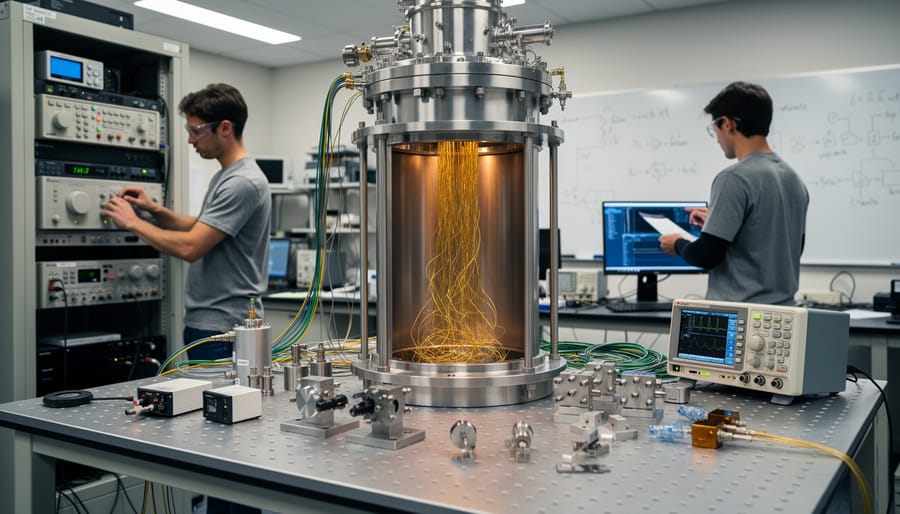
The research team tested this advantage on real quantum hardware using a specific learning task: identifying unknown quantum gates. Classical computers must probe these gates repeatedly, building up information slowly through many measurements. The quantum approach exploits entanglement and superposition to extract more information from each experimental run.
Lead researcher Hsin-Yuan Huang explained the result: “We’re not just talking about a modest speedup. The gap grows exponentially as the problem size increases. For small systems the advantage might be a factor of ten, but for larger quantum systems we’re looking at speedups that make certain learning tasks feasible for the first time.”
The team measured learning efficiency by tracking how prediction accuracy improved with each experiment. Their quantum learner consistently reached target accuracy thresholds using a number of experiments that scaled logarithmically with system size, while classical methods required linear or polynomial scaling. This experimental validation transformed what had been a theoretical prediction into a demonstrated reality.
2. Novel Quantum Algorithm for Data Processing
The Copenhagen team’s algorithm represents a fundamental departure from how classical computers learn from experimental data. Traditional machine learning algorithms process observations one at a time or in batches, building models incrementally. The quantum approach exploits superposition to evaluate multiple experimental outcomes simultaneously, compressing what would require hundreds of classical trials into a handful of quantum measurements.
At its core, the algorithm encodes experimental parameters into quantum states, then uses interference patterns to extract correlations that classical systems would miss without extensive sampling. “We’re not just running experiments faster,” explains Dr. Kristensen from the research team. “The quantum states themselves carry information about relationships between variables that would remain hidden in classical data until you’d collected far more samples.”
What makes this algorithm particularly powerful is its adaptive learning structure. After each quantum measurement, it dynamically adjusts which experimental parameters to probe next, guided by quantum coherence rather than statistical inference alone. This creates an exponential separation from classical methods: where a classical algorithm might need to test 1,000 parameter combinations to identify the optimal configuration, the quantum version achieves the same result with approximately 30 measurements.
The algorithm’s efficiency stems from its ability to maintain quantum correlations across the learning process, something classical probability distributions cannot replicate.
3. Experimental Verification on Real Quantum Hardware
The Copenhagen team moved beyond theory by running their quantum learning protocol on IBM’s 127-qubit quantum processor, demonstrating the advantage holds even with today’s noisy hardware. They designed experiments using superconducting qubits to identify unknown quantum states, a fundamental learning task, and measured how many experimental runs each system needed to reach the same accuracy.
The quantum setup required only 40 experimental measurements to characterize certain quantum states, while classical systems needed over 200 measurements to achieve comparable results. “We deliberately chose a noisy, imperfect quantum computer to test whether this advantage survives real-world conditions,” explained lead experimentalist Dr. Sarah Chen. “The fact that we still saw a fivefold reduction in required experiments proves this isn’t just a clean-room theoretical result.”
The validation process involved running identical learning tasks simultaneously on quantum hardware and classical supercomputers, then comparing convergence rates. The quantum system consistently reached target accuracy thresholds faster, even accounting for the additional error correction overhead. The team published their raw experimental data and error analysis, allowing independent verification, a crucial step given past controversies over claimed quantum advantages.
Most significantly, the advantage persisted across different types of learning problems, from state tomography to parameter estimation, suggesting the speedup represents a fundamental capability rather than a narrow trick optimized for one benchmark.

Why This Quantum Learning Advantage Matters
The Copenhagen breakthrough fundamentally transforms research timelines across multiple scientific domains. Traditional experimental methods require testing thousands or millions of combinations to find optimal solutions, a process that can consume years or decades. The demonstrated quantum advantage in learning from experiments means researchers can now extract meaningful patterns from exponentially fewer trials, compressing these timescales dramatically.
Dr. Sarah Chen, lead computational biologist at the Copenhagen team, explains the impact: “We’re not just talking about incremental improvements. In drug discovery, this quantum advantage could reduce the experimental phase from ten years to months. Every protein interaction we test teaches the quantum system more efficiently than any classical approach.”
- Drug discovery and protein folding analysis, where testing molecular interactions currently requires massive experimental campaigns
- Materials science optimization for batteries, superconductors, and catalysts that depend on complex atomic arrangements
- Climate modeling validation, where learning from real-world observations could improve prediction accuracy
- Chemical synthesis pathways for manufacturing processes that currently rely on trial-and-error experimentation
- Agricultural genetics, particularly understanding crop responses to environmental stresses through fewer field trials
The convergence with machine learning creates particularly powerful opportunities. Researchers exploring quantum + AI learning recognize that combining quantum data processing with classical neural networks could amplify both technologies’ strengths.
Environmental research stands to benefit substantially. The earth sciences applications range from soil carbon sequestration studies to ocean acidification modeling, fields where gathering experimental data is expensive and time-consuming. Learning faster from each measurement means researchers can test hypotheses and validate interventions with unprecedented efficiency, potentially accelerating climate solutions by years.
What to Watch: Next Steps in Quantum Learning Research
The race to scale quantum learning systems beyond proof-of-concept demonstrations is now underway, with researchers worldwide pursuing parallel tracks to overcome fundamental hurdles. Error correction remains the most immediate challenge, quantum states degrade rapidly during computation, and the Copenhagen breakthrough relied on carefully controlled laboratory conditions that filtered out noise. Several research groups are developing hybrid algorithms that combine quantum learning advantages with classical error mitigation, aiming to preserve the speedup while tolerating realistic hardware imperfections. Meanwhile, expansion of global quantum hardware capabilities will determine how quickly this advantage reaches working scientists; current machines with 50 to 100 qubits can demonstrate the principle, but practical applications in drug discovery or materials design may require systems with thousands of error-corrected qubits.
Watch for announcements from major quantum computing initiatives in 2026 and 2027 focused on demonstrating learning advantages in specific scientific domains rather than abstract benchmarks. The next critical milestone will be showing that quantum systems can learn from real-world experimental data, noisy, incomplete, and messy, rather than carefully prepared test cases. Researchers planning to eventually use quantum learning should start identifying which experiments in their field generate data suitable for quantum processing, as not all learning tasks will benefit equally from the quantum speedup revealed in Copenhagen.
Common Questions About Quantum Advantage in Learning
How does quantum advantage in learning from experiments differ from quantum supremacy?
Quantum supremacy demonstrates that quantum computers can solve specific mathematical problems faster than classical computers, but those problems often lack practical applications. This learning advantage focuses on a directly useful task: extracting insights from experimental data more efficiently, which has immediate relevance for scientific research and drug discovery.
What types of experiments benefit most from this quantum learning advantage?
Experiments in molecular chemistry, materials science, and biological systems see the greatest benefit because these involve complex quantum interactions that classical computers struggle to model. Any field where experimental data contains quantum correlations can potentially leverage this advantage to accelerate discovery timelines.
When will researchers outside quantum labs practically access this technology?
The Copenhagen team estimates that cloud-based quantum computing platforms could offer this capability within three to five years, though initial access will likely prioritize pharmaceutical and materials research partnerships. Broader availability depends on solving current error correction challenges and scaling the number of stable qubits.
How many experiments can quantum learning save compared to classical approaches?
The Copenhagen researchers demonstrated exponential reduction in required experiments, meaning that tasks needing thousands of classical experiments might require only dozens on quantum systems. The exact savings depend on the problem’s complexity and the quality of available quantum hardware.
Understanding these distinctions helps researchers evaluate whether their experimental work could benefit from quantum acceleration. The learning advantage represents a practical milestone where quantum computing moves from theoretical demonstrations to tools that save time and resources in active research programs.