

Quantum mechanics is the branch of physics that describes the behavior of matter and energy at the atomic and subatomic scale, where particles exhibit properties fundamentally different from everyday objects. At these microscopic dimensions, particles can exist in multiple states simultaneously, tunnel through barriers that should be impenetrable, and influence each other instantaneously across vast distances.
This century-old framework has evolved from a theoretical curiosity into the foundation of modern technology. The transistors powering your smartphone, the lasers enabling fiber-optic communication, and the magnetic resonance imaging machines diagnosing disease all operate on quantum principles. Yet quantum mechanics remains one of the most counterintuitive and mathematically challenging areas of science, often seeming to defy common sense while producing extraordinarily accurate predictions.
The year 2026 marks a particularly vibrant moment for quantum research. The Institute for Quantum Computing and the Perimeter Institute for Theoretical Physics recently hosted a symposium celebrating the 100-year anniversary of quantum mechanics’ discovery, while conferences like the International Quantum Horizons Symposium in Banff and the ML4QT Symposium at the Institute of Quantum Computing highlight the field’s expanding frontiers. As physicist Richard Feynman famously observed, “I think I can safely say that nobody understands quantum mechanics,” a statement that remains humbling even as researchers push the boundaries of quantum computing, cryptography, and sensing.
This article provides a foundational understanding of quantum mechanics, from its core principles and mathematical formulations to its real-world applications and current research directions. Whether you’re encountering wave functions for the first time or seeking to understand how quantum theory connects to emerging technologies, you’ll find clear explanations of what makes the quantum world so strange and so powerful.
What Quantum Mechanics Means
Quantum mechanics, also called quantum physics is the branch of physics that describes how matter and energy behave at the smallest scales, at the level of atoms, electrons, photons, and subatomic particles. These terms are essentially interchangeable in modern usage, though “quantum mechanics” often emphasizes the mathematical framework while “quantum physics” can encompass the broader field including applications. At its core, quantum mechanics is a complete departure from the classical physics that governs the everyday world we experience.
Classical physics, built on Newton’s laws and Maxwell’s equations, works brilliantly for objects we can see and touch. It predicts planetary orbits, falling apples, and radio waves with precision. But when physicists in the early 20th century began probing the atomic realm, they discovered that the rules changed completely. Particles didn’t behave like tiny billiard balls following predictable paths. Instead, they exhibited strange, counterintuitive behaviors that defied common sense.
Quantum effects become dominant at scales smaller than about a billionth of a meter. At these dimensions, particles exist in multiple states simultaneously, can tunnel through barriers that should be impenetrable, and influence each other instantaneously across distances. Our everyday intuition fails at the quantum level because we evolved to navigate a world of macroscopic objects where quantum effects average out into the predictable behavior we’re familiar with. You never see a car simultaneously traveling two routes, but an electron genuinely does take multiple paths.
- Superposition
- A quantum system’s ability to exist in multiple states at the same time until measured, like a coin spinning in the air being both heads and tails simultaneously.
- Wave-particle duality
- The principle that quantum objects exhibit both wave-like and particle-like properties depending on how they’re observed or measured.
- Quantization
- The concept that certain properties like energy come in discrete, indivisible packets rather than continuous values, similar to how money comes in cents rather than infinitely divisible amounts.
- Entanglement
- A phenomenon where two or more quantum particles become correlated such that measuring one instantly affects the other, regardless of the distance separating them.
Perhaps the most jarring conceptual shift is that quantum mechanics is fundamentally probabilistic. Unlike classical physics, which tells you exactly where a thrown ball will land, quantum mechanics only provides probabilities for where a particle might be found. The theory doesn’t describe definite outcomes but rather a spectrum of possible results, each with its own likelihood. This isn’t due to incomplete knowledge, it’s the actual nature of quantum reality. Even with perfect information about a quantum system, you can only predict the odds of different measurement outcomes, never guarantee a specific result.
How Quantum Mechanics Works
Wave-Particle Duality
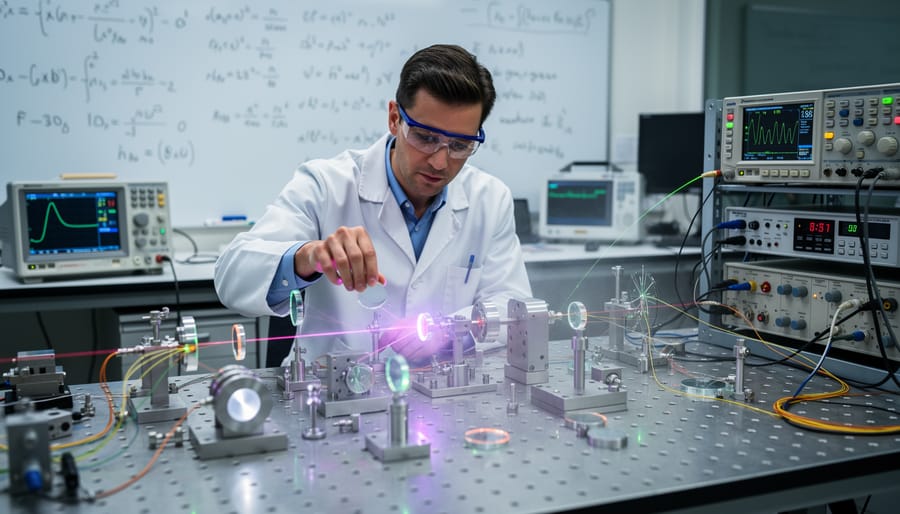
One of quantum mechanics’ most startling revelations is that fundamental particles such as electrons and photons don’t fit neatly into either the “particle” or “wave” category, they exhibit both behaviors depending on how we observe them. This wave-particle duality overturns the classical assumption that something must be exclusively one or the other.
The evidence is dramatic and repeatable. When electrons pass through a double slit and strike a detector screen, they create an interference pattern, alternating bands of high and low intensity, exactly as water waves or light waves do when they overlap. This pattern emerges even when electrons are fired one at a time, proving that each electron somehow interferes with itself as a wave. Yet when the same electrons hit the screen, they always arrive as discrete dots at specific locations, behaving as localized particles.
Photons demonstrate the same dual character. In experiments like the photoelectric effect, light behaves as a stream of particle-like quanta that transfer energy in discrete chunks. In other setups, the same photons produce diffraction and interference fringes characteristic of waves. The experimental arrangement determines which aspect we observe, but the underlying quantum entity possesses both natures simultaneously. This duality isn’t a limitation of our instruments, it reflects the actual quantum reality that operates beneath the everyday world of definite positions and trajectories.
Quantum Superposition and Measurement
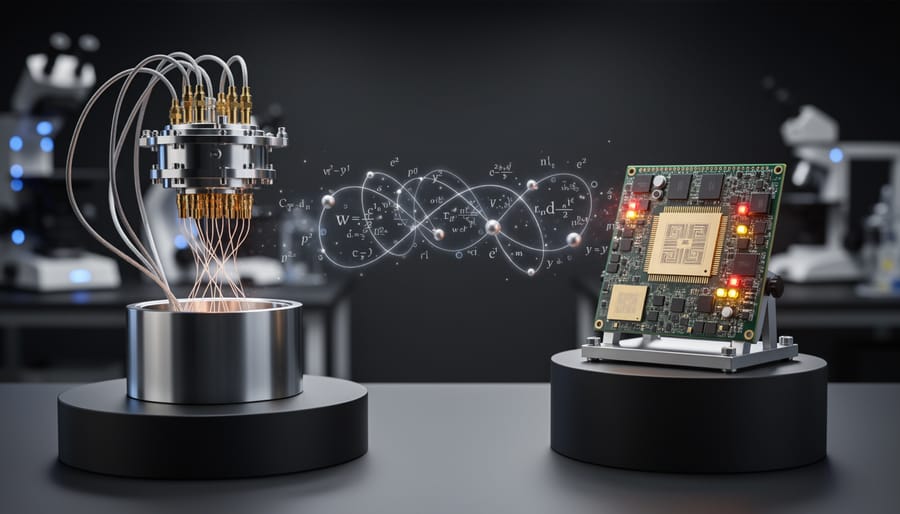
Quantum superposition is the principle that a particle or system can exist in multiple states at once, not switching between them, but genuinely inhabiting all possibilities simultaneously. An electron, for example, doesn’t occupy a single defined position or spin direction until something forces it to “choose.” Until that moment, it exists in a superposition of all allowed states, described mathematically by its wave function.
What collapses this superposition into a single outcome is measurement. When an observer interacts with a quantum system, detecting its position, measuring its energy, or observing its spin, the wave function collapses. The system instantly transitions from a probabilistic cloud of possibilities to one definite result. Which result appears is fundamentally random, governed only by the probabilities encoded in the wave function beforehand.
This isn’t a limitation of our tools or knowledge. Quantum mechanics tells us the electron genuinely had no fixed position before measurement. The act of observation doesn’t reveal a pre-existing reality; it creates one. That’s why quantum mechanics feels so counterintuitive, it contradicts our everyday experience that objects have definite properties whether we look at them or not. At the quantum scale, observation and reality are inseparable.

The Uncertainty Principle
In 1927, Werner Heisenberg discovered a fundamental limit to what we can know about quantum systems. The uncertainty principle states that certain pairs of properties, most famously position and momentum, cannot both be measured with perfect precision simultaneously. The more precisely you determine a particle’s location, the less precisely you can know its momentum, and vice versa. This isn’t about measurement errors or technological limitations. It’s a fundamental feature of nature itself.
The principle emerges directly from wave-particle duality. Because particles behave like waves, they don’t have perfectly defined positions and momenta at the same time. A wave spread out in space has a well-defined wavelength (related to momentum) but occupies a range of positions. To localize a particle precisely, you need a narrow wave packet, which requires combining many different wavelengths, making the momentum uncertain.
The implications are profound. Unlike classical physics, where objects have definite properties whether we measure them or not, quantum mechanics tells us that some properties simply don’t have simultaneous definite values. The uncertainty principle isn’t about our ignorance; it reflects the inherent probabilistic nature of reality at quantum scales. This means predictions in quantum mechanics are fundamentally statistical rather than deterministic, marking a radical departure from classical determinism.
Core Components and Formulations of Quantum Theory
At its mathematical core, quantum mechanics rests on several equivalent formulations that describe how quantum systems behave and evolve. These frameworks emerged in the 1920s and have since been refined into the powerful theoretical apparatus physicists use today.
The Schrödinger equation stands as the most recognizable element of quantum theory. This differential equation describes how the quantum state of a physical system changes over time, treating particles as wave functions that encode all possible information about the system. When you solve the Schrödinger equation for an electron in an atom, you obtain the probability distributions that tell you where the electron is likely to be found, not a definite orbit like a planet around the sun, but a cloud of possibilities that only becomes definite upon measurement.
The mathematical machinery of quantum mechanics also relies on operators and what physicists call Hilbert spaces. Think of a Hilbert space as the mathematical “arena” where quantum states live and evolve. Operators represent observable quantities like position, momentum, or energy, and when you apply these operators to quantum states, you extract predictions about measurement outcomes. This abstract structure allows quantum mechanics to handle the peculiar fact that measuring one property (like position) fundamentally disturbs another (like momentum).
Several equivalent formulations express these ideas:
- Schrödinger’s wave mechanics (1926), treats particles as wave functions evolving in time
- Heisenberg’s matrix mechanics (1925), represents observables as matrices and focuses on measurable quantities
- Dirac’s transformation theory (1930s), unified the earlier approaches using abstract vector spaces
- Feynman’s path integral formulation (1940s), sums over all possible paths a particle might take
These mathematical frameworks all produce identical predictions, but physicists often choose one over another depending on which makes a particular problem easier to solve.
Beyond the mathematics lies another layer: interpretation. The Copenhagen Interpretation developed primarily by Niels Bohr and Werner Heisenberg, treats the wave function as representing probabilities that collapse upon measurement. The many-worlds interpretation, by contrast, suggests every quantum measurement spawns parallel branches of reality where each outcome occurs. Other interpretations include de Broglie-Bohm pilot wave theory and quantum Bayesianism.
These interpretations differ not in their predictions, all agree on what experiments will show, but in what they claim quantum mechanics tells us about reality itself. After a century, no consensus exists on which interpretation is “correct,” though the mathematics itself remains unambiguous and extraordinarily successful.
How Quantum Mechanics Is Applied Today
Quantum Computing and Information
Quantum computers harness two distinctly quantum phenomena, superposition and entanglement, to process information in ways impossible for classical machines. Where a classical bit exists as either 0 or 1, a quantum bit (qubit) can exist in a superposition of both states simultaneously. This lets quantum computers explore vast solution spaces in parallel. When qubits become entangled, measuring one instantly reveals information about others, no matter the distance between them. These properties enable quantum algorithms to tackle specific problems, like factoring large numbers, simulating molecular interactions, or optimizing complex logistics, exponentially faster than any classical computer could.
Understanding quantum computing basics reveals why researchers worldwide are racing to scale up qubit counts and reduce error rates. Current machines remain noisy and prone to decoherence (qubits losing their quantum state), but the quantum computing leap from laboratory curiosity to practical tool continues. In 2026, researchers are exploring how machine learning can optimize quantum algorithms and error correction, a focus of the second annual ML4QT Symposium at the Institute of Quantum Computing from September 23 to 25. This convergence of quantum mechanics and artificial intelligence represents one of the most promising frontiers in computation today.
Electronics and Semiconductors
Modern electronics exist because quantum mechanics revealed how electrons behave in semiconductors. Every transistor in your phone, computer, or car relies on quantum tunneling and band theory, concepts that have no analog in classical physics. Engineers designing chips at the nanometer scale must account for quantum effects like electron wave interference and energy quantization to prevent devices from failing.
LEDs demonstrate quantum mechanics in action: when electrons drop from higher to lower energy levels in a semiconductor, they emit photons of precise wavelengths, producing the efficient colored light that now illuminates homes and screens worldwide. Lasers operate on stimulated emission, a purely quantum phenomenon where photons trigger identical photons from excited atoms, creating coherent light beams essential for fiber optics, surgery, and manufacturing.
The semiconductor industry’s roadmap depends entirely on quantum mechanical modeling. As transistors shrink below 5 nanometers, quantum effects that were once negligible now dominate device behavior. Designing next-generation processors requires solving Schrödinger’s equation for billions of interacting electrons, a challenge driving both computational advances and deeper understanding of quantum transport in materials.
Medical Imaging and Materials Science

Quantum mechanics underpins some of medicine’s most powerful diagnostic tools. Magnetic resonance imaging (MRI) exploits the quantum property of nuclear spin, the intrinsic angular momentum of atomic nuclei, to generate detailed images of soft tissues inside the body. When placed in a strong magnetic field, hydrogen nuclei in water molecules align with or against the field in quantized energy states. Radio-frequency pulses flip these spins, and as they relax back, they emit signals that reveal tissue structure and chemistry. This quantum behaviour allows clinicians to distinguish healthy tissue from tumours without invasive procedures.
Beyond established MRI technology, quantum medicine now encompasses quantum sensing techniques that detect magnetic fields, electric potentials and molecular interactions with unprecedented sensitivity. Nitrogen-vacancy centres in diamond, for instance, function as nanoscale quantum sensors capable of mapping neural activity or detecting single molecules.
In materials science, researchers design substances with tailored quantum properties, superconductors that conduct electricity without resistance, topological insulators with conducting surfaces and insulating interiors, and metamaterials engineered to manipulate light in ways impossible with conventional optics. These advances depend on precise control of electron wavefunctions and quantum states within crystal lattices, translating fundamental quantum principles into materials that perform functions classical physics cannot achieve.
The Quantum Mechanics Research Landscape in 2026
The field of quantum mechanics is experiencing a remarkable convergence of celebration and innovation as it marks its centennial anniversary. A century after the theory’s foundational discoveries, researchers worldwide are gathering to honor this milestone while pushing the boundaries of what quantum science can achieve.
In Canada, the Institute for Quantum Computing and the Perimeter Institute for Theoretical Physics jointly hosted a major symposium celebrating 100 years of quantum mechanics, bringing together leading physicists to reflect on the theory’s transformative impact and future directions. This commemorative spirit has extended throughout 2026, with Quantum Days in Victoria, BC in February serving as an early gathering point for researchers to discuss both fundamental theory and practical applications.
The research landscape demonstrates quantum mechanics’ expanding reach across disciplines. The second annual ML4QT Symposium, scheduled for September 23-25 at the Institute of Quantum Computing, highlights the growing intersection between quantum theory and machine learning, a frontier where quantum algorithms may revolutionize data processing and pattern recognition. Meanwhile, the 2nd International Quantum Horizons Symposium in Banff from July 22-24 brings together international collaborators exploring emerging quantum technologies, including advances in quantum sensing such as an ultra-sensitive detector for next-generation quantum computers.
The Canada France Quantum Alliance conference in Calgary from June 8-15 underscores the increasingly collaborative nature of quantum research, with multinational teams tackling challenges in quantum communication, materials development, and computational systems. The Institute for Quantum Computing’s annual Quantum Connections conference continues to serve as a hub for researchers across specializations to share breakthroughs and forge new partnerships.
These gatherings reflect quantum mechanics’ dual status as both mature theoretical framework and active research frontier, where fundamental questions about nature coexist with urgent practical challenges in building scalable quantum technologies.
Common Questions About Quantum Mechanics
The questions below come up repeatedly whenever quantum mechanics is introduced to new audiences, and answering them helps clarify common misconceptions while reinforcing the core principles covered earlier.
What’s the difference between quantum physics and quantum mechanics?
In practice, these terms are used interchangeably in modern physics. “Quantum mechanics” typically refers to the specific mathematical framework and rules governing quantum behavior, while “quantum physics” is a broader term encompassing all phenomena and theories at the quantum scale, but most physicists and textbooks use both terms to mean the same thing.
Has quantum mechanics been proven?
Yes, quantum mechanics is the most rigorously tested theory in physics, with predictions verified to extraordinary precision across countless experiments over the past century. Technologies like transistors, lasers, and MRI machines work precisely because quantum mechanics accurately describes how matter and energy behave at small scales.
Why is quantum mechanics so strange or counterintuitive?
Our brains evolved to understand objects at human scales where quantum effects average out to classical behavior. At atomic scales, particles genuinely exist in multiple states simultaneously and only settle into definite properties when measured, which contradicts everyday experience but is how nature actually operates.
How does quantum mechanics affect daily life?
Nearly all modern electronics rely on quantum mechanics, from the semiconductors in your phone to LED lights and solar panels. Medical imaging technologies like MRI and PET scans depend on quantum principles, and emerging quantum computers promise to revolutionize fields from drug discovery to cryptography.
Another frequent source of confusion involves the relationship between quantum mechanics and Einstein’s relativity. These theories operate at different scales and initially seemed incompatible, but physicists developed quantum field theory to reconcile them, successfully merging quantum mechanics with special relativity. The quest to unite quantum mechanics with general relativity (gravity) remains one of physics’ great unsolved problems, driving research into theories like string theory and loop quantum gravity.
Students often wonder whether quantum mechanics means “anything is possible” or that observation creates reality. The theory is actually quite strict: quantum probabilities follow precise mathematical rules, and measurement doesn’t create arbitrary outcomes but reveals one of the specific possibilities the wave function allowed. The universe operates probabilistically at quantum scales, but those probabilities are rigorously constrained and predictable in aggregate, which is why quantum mechanics produces such reliable technological results. As research continues through 2026, with events like the ML4QT Symposium exploring machine learning applications and the International Quantum Horizons Symposium bringing together researchers in Banff, these foundational questions remain starting points for deeper exploration into how quantum mechanics shapes both our understanding of nature and our technological future.
A century after its discovery, quantum mechanics stands as the most successful scientific theory humanity has ever developed. Its predictions have been verified to extraordinary precision, in some cases to twelve decimal places, and not a single experimental result has contradicted its core principles. This predictive power has translated into transformative technologies that shape modern life, from the semiconductors in every electronic device to the lasers enabling global communication networks.
The field shows no signs of slowing. In 2026, symposia and conferences worldwide, including the ML4QT Symposium at the Institute for Quantum Computing this September and the International Quantum Horizons Symposium in Banff, demonstrate the vibrant research community pushing quantum mechanics into new domains. Quantum computing, quantum sensing, and quantum materials represent the next wave of innovation, promising to solve problems currently beyond reach.
What makes quantum mechanics remarkable is how it balances maturity with frontier potential. The theory itself is well-established, yet its applications continue to surprise researchers and engineers. Understanding how nature behaves at the smallest scales has proven essential not just for satisfying curiosity, but for building the technologies that will define the coming decades. Whether you’re a student encountering superposition for the first time or an engineer designing quantum devices, you’re engaging with a framework that will remain central to physics and technology for generations to come.