
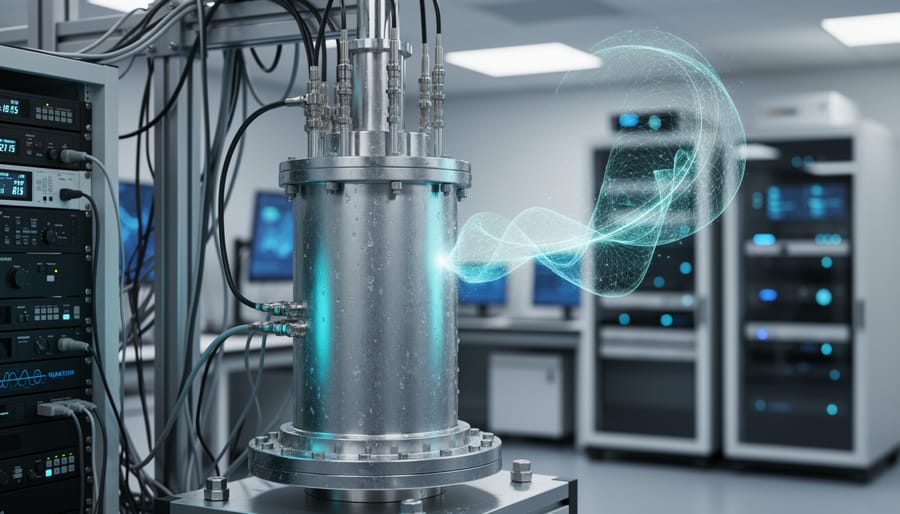
Quantum computing is a revolutionary approach to information processing that harnesses the principles of quantum mechanics to perform calculations fundamentally impossible for conventional computers. Unlike classical computers that store information as binary bits (0s and 1s), quantum computers use quantum bits, or qubits, which can exist in multiple states simultaneously through a property called superposition. This allows quantum machines to explore vast numbers of solutions in parallel, promising breakthroughs in fields from drug discovery to cryptography.
The difference is profound. A classical computer solves problems sequentially, testing one possibility at a time. A quantum computer can evaluate millions of possibilities at once. When researchers at IBM demonstrated quantum advantage in 2019, proving their quantum processor could solve a specific problem exponentially faster than the world’s most powerful supercomputer, they confirmed what physicists had theorized for decades: we’re witnessing a quantum computing leap that will reshape technology.
But quantum computing remains deeply counterintuitive. Qubits are fragile, requiring near-absolute-zero temperatures to maintain their quantum states. They operate through phenomena like entanglement, where particles become mysteriously connected regardless of distance, and interference, where quantum states can amplify correct answers while canceling wrong ones. These aren’t just faster versions of silicon chips. They’re entirely new machines built on quantum physics.
Why does this matter now? Because we’re approaching practical quantum systems. Universities worldwide, including the University of Toronto’s Fields Institute, host regular quantum information seminars where researchers share advances in building stable qubits and designing quantum circuits. Companies are racing to scale these systems from dozens of qubits to thousands. The applications span optimization problems that classical computers can’t crack, simulating molecular interactions for new materials, and securing communications against future threats.
This article breaks down how quantum computers actually work, what makes them different, the types of systems being built, and where they’ll make their first real-world impact.
What Quantum Computing Means
Quantum computing represents a fundamental shift in how we process information. Unlike classical computers that store and manipulate data as definite ones and zeros, quantum computers exploit the strange rules of quantum mechanics, the physics governing subatomic particles, to work with data in multiple states simultaneously. This isn’t just a faster version of what we already have; it’s a different computational model altogether.
The distinction matters because some problems that would take classical computers millennia to solve become tractable with quantum systems. Where traditional processors follow one logical path at a time through a calculation, quantum processors can explore many paths simultaneously. This parallel processing happens not through adding more conventional chips, but by leveraging quantum properties like superposition and entanglement, concepts we’ll explore in detail.
This technology isn’t confined to theory anymore. Research institutions worldwide are actively developing practical quantum systems and training new generations of scientists to work with them. The growing accessibility of quantum research, including programs like Toronto’s biweekly quantum information seminars running through June 2026, reflects how the field is maturing from pure physics into applied computing science with real-world implications.
How Quantum Computing Works

Qubits: The Building Blocks
At the heart of every quantum computer sits the qubit, quantum computing’s answer to the classical bit. While classical bits are 0 or 1 qubits exploit quantum mechanics to exist in both states at once. This property, called superposition, is what makes quantum computers fundamentally different from anything you’ve used before.
Think of a coin spinning in the air. While it’s airborne, it’s neither heads nor tails, it’s simultaneously both. Only when you catch it does the coin settle into one definite state. A qubit works similarly, occupying a blend of 0 and 1 until measured. This isn’t just theoretical; researchers are actively refining how we read these fragile states, developing ultra-sensitive tools like advanced microwave detector systems to capture qubit information without collapsing it prematurely.
Where classical computing processes one calculation path at a time, superposition lets qubits explore multiple possibilities simultaneously. Two classical bits can represent one of four values (00, 01, 10, or 11) at any moment. Two qubits in superposition can represent all four values at once. Scale that to fifty qubits, and you’re processing more combinations than there are atoms in a typical grain of sand.
The catch? The moment you measure a qubit, superposition collapses and you get a definite answer, 0 or 1, just like a classical bit. The quantum advantage lies in choreographing qubits to explore vast solution spaces before that final measurement reveals the answer you need.
Entanglement and Quantum Gates
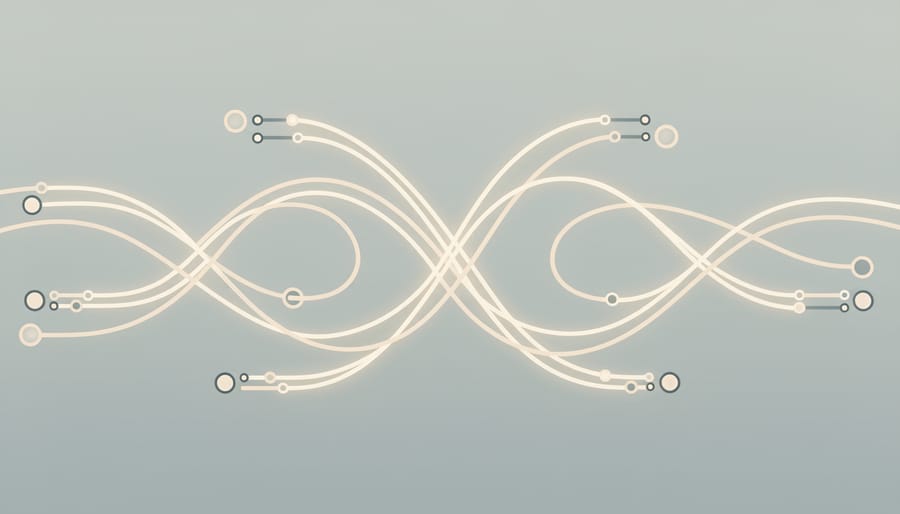
Entanglement represents one of quantum computing’s most counterintuitive features. When qubits become entangled, measuring one instantly influences the state of the other, regardless of physical distance. This correlation lets quantum computers perform calculations that would be impossible with independent bits. Researchers entangle qubits to harness power far beyond classical machines, creating computational resources that scale exponentially rather than linearly.
Quantum gates manipulate these entangled states to perform calculations. Unlike classical logic gates that flip bits between 0 and 1, quantum gates apply mathematical transformations that rotate qubits through superposition space while preserving quantum information. Common gates include the Hadamard gate, which creates superposition, and the CNOT gate, which entangles two qubits. Stringing these gates together forms quantum circuits that solve specific problems.
Building reliable quantum circuits presents significant challenges. Gates must operate with extreme precision because even tiny errors compound quickly across complex calculations. Recent research explores how to construct circuits that preserve symmetry properties throughout computation, which helps maintain quantum information and reduces errors. A May 2026 seminar at the University of Toronto examined methods for building exact, symmetry-preserving quantum circuits, addressing how mathematical structure can guide more stable designs.
Gate construction itself involves engineering hurdles. Semiconductor quantum dots, a promising qubit platform, face particular difficulties with control-target gate operations. Research presented in June 2026 highlighted common pitfalls in building these gates and strategies to avoid them, demonstrating that even fundamental quantum operations require careful physical implementation. The gap between theoretical gate designs and practical hardware remains a central focus as the field matures.
Measurement and Decoherence

The measurement problem lies at the heart of quantum computing’s fragility. When you measure a qubit, its superposition collapses instantly into a definite state, either 0 or 1. Before measurement, the qubit exists in both states at once, enabling quantum algorithms to explore multiple solutions simultaneously. The moment you observe it, that quantum advantage vanishes. You get one classical answer, losing all the parallel processing power.
This collapse happens because quantum states are extraordinarily delicate. Decoherence occurs when qubits interact with their environment, stray electromagnetic fields, temperature fluctuations, even cosmic rays. These interactions cause quantum information to leak away, transforming pristine qubits into ordinary bits. That’s why quantum computers operate at temperatures near absolute zero, often colder than outer space, inside heavily shielded chambers.
The challenge extends beyond temperature. Quantum states survive for mere microseconds before decohering, giving researchers a tiny window to perform calculations. Every additional qubit increases the chance of error, and every quantum gate risks introducing noise. Engineers fight decoherence through error correction codes and isolation techniques, but maintaining quantum coherence remains the field’s central obstacle. Until researchers solve these stability challenges, quantum computers will remain limited in scale and confined to specialized laboratory conditions.
Types of Quantum Computing Systems
Several distinct approaches to building quantum computers are currently under active development, each with unique engineering challenges and potential advantages. These systems differ fundamentally in how they create and control qubits, with researchers worldwide pursuing multiple paths rather than settling on a single architecture.
The major quantum computing platforms use different physical systems to encode quantum information:
- Superconducting Qubits
- These systems use tiny circuits cooled to near absolute zero where electrical current flows without resistance, creating quantum states in artificial atoms. Companies like IBM and Google currently use this approach for their most advanced systems.
- Trapped Ions
- Individual charged atoms suspended by electromagnetic fields in ultra-high vacuum serve as qubits, manipulated with precise laser pulses. This technology offers excellent qubit stability and high-fidelity quantum operations.
- Photonic Quantum Computers
- These devices encode quantum information in individual particles of light, operating at room temperature and potentially integrating with existing fiber-optic infrastructure. They excel at specific tasks like quantum communication and certain optimization problems.
- Semiconductor Quantum Dots
- Electrons trapped in nanoscale semiconductor structures act as qubits, potentially compatible with existing chip manufacturing processes. Recent research highlights specific control challenges in building gates for these systems, with ongoing work to overcome practical limitations.
- Topological Qubits
- This theoretical approach aims to encode information in exotic quantum states that resist disturbance from environmental noise. While promising for error correction, these systems remain largely experimental.
Each architecture represents trade-offs between competing priorities. Superconducting systems have achieved impressive qubit counts but require extreme cooling. Trapped ions offer superior coherence times, how long quantum information survives, but scaling to thousands of qubits presents engineering hurdles. Photonic systems operate at room temperature but face different scaling challenges.
No consensus has emerged on which approach will dominate. Many researchers believe different architectures may suit different applications, similar to how graphics processors excel at certain tasks while traditional CPUs handle others. Current quantum research explores hybrid approaches and continues refining each platform’s unique strengths.
The diversity of quantum computing systems reflects the field’s experimental nature. Academic programs examining topics from optical investigation of electrons to circuit design across platforms demonstrate that fundamental questions remain open, with active research pushing multiple technologies forward simultaneously.
What Quantum Computers Can Do
Quantum computers excel at problems involving massive calculations across many possible states simultaneously, tasks where classical supercomputers would take centuries. While researchers demonstrated quantum advantage in specific benchmark tests, practical applications are emerging across several domains:
- Drug discovery and molecular simulation, where quantum computers can model complex molecular interactions that are impossible for classical systems to calculate precisely
- Cryptography and security, including both breaking current encryption methods and developing quantum-resistant protocols
- Optimization problems such as route planning, supply chain logistics, and resource allocation across thousands of variables
- Financial modeling that requires analyzing multiple market scenarios and risk factors simultaneously
- Materials science, designing new compounds and predicting material properties at the atomic level
- Artificial intelligence and machine learning, particularly pattern recognition in massive datasets
- Climate modeling and weather prediction involving countless interacting variables across global systems
These applications share a common thread: they involve exploring vast solution spaces where checking every possibility would overwhelm classical computers. Quantum systems can evaluate multiple pathways at once through superposition, then use interference to amplify correct solutions while canceling out wrong ones.
The pharmaceutical industry shows particular promise. Simulating how a drug molecule binds to a protein involves tracking every electron interaction, calculations that grow exponentially complex. A quantum computer can represent these quantum mechanical systems naturally, potentially reducing drug development timelines from years to months.
Cryptography presents both opportunities and threats. Current encryption relies on the difficulty of factoring large numbers, a task quantum computers could eventually crack. This has spurred development of post-quantum cryptography while also enabling genuinely unpredictable quantum random numbers for security applications.
Financial institutions are exploring quantum algorithms for portfolio optimization and risk analysis, where traditional Monte Carlo simulations require millions of iterations. Quantum approaches could deliver more accurate models faster, though current hardware limitations mean these remain pilot projects rather than production systems.
Learning More: The Growing Quantum Community
The quantum computing landscape has grown far more welcoming in recent years, with universities and research institutes launching programs designed to bring this complex field within reach of curious minds beyond the specialist community. Once confined to advanced physics departments, quantum information science now appears in accessible lecture series, public talks, and hybrid-format seminars that anyone can join.
The Toronto Quantum Information Seminar exemplifies this shift. Running from July 2025 through June 2026 at the Fields Institute and University of Toronto, the biweekly program offers both in-person sessions across the UofT campus and online access via Zoom. Recent presentations have tackled cutting-edge challenges like optical investigation of strongly correlated electrons, the pitfalls of building control-target gates in semiconductor quantum dots, and techniques for constructing exact, symmetry-preserving quantum circuits. These aren’t simplified overviews but genuine research discussions, yet the hybrid format makes them available to students, professionals, and enthusiasts worldwide.
This pattern repeats globally. Universities stream quantum computing courses, researchers publish accessible primers, and online communities gather to decode papers and share insights. The field recognizes that widespread understanding drives progress. Whether you’re exploring quantum computing from professional curiosity or academic interest, you’ll find the community surprisingly open, with pathways into the conversation that didn’t exist a decade ago.
Common Questions About Quantum Computing
Common Questions About Quantum Computing
As quantum computing moves from theoretical physics labs into broader public awareness, people naturally have questions about what this technology really means and how it might affect them. Here are answers to some of the most common queries.
What is quantum computing explained in simple terms?
Quantum computing uses the principles of quantum mechanics, specifically superposition and entanglement, to process information in ways that classical computers cannot. Instead of bits that are either 0 or 1, quantum computers use qubits that can represent multiple states simultaneously, allowing them to explore many possible solutions at once.
How is quantum computing different from regular computing?
Classical computers process information sequentially using bits in definite states, while quantum computers leverage quantum phenomena to process information in parallel. This fundamental difference means quantum computers excel at specific problems like optimization and simulation, though they’re not simply “faster” versions of regular computers.
When will quantum computers be available?
Quantum computers already exist in research labs and some cloud-based services, but practical, widely-available quantum computers remain years away. Current systems require extreme cooling and controlled environments, and researchers are still working to scale up qubit counts while managing decoherence challenges.
Can quantum computers replace classical computers?
No, quantum computers won’t replace classical computers. They’re specialized tools designed for specific types of problems where quantum advantages exist, while classical computers remain superior for most everyday computing tasks like word processing, web browsing, and running applications.
Understanding the current quantum computing landscape helps set realistic expectations. While dozens of quantum systems now exist worldwide, they’re primarily research instruments rather than commercial products. The technology is advancing through academic programs and research initiatives, with institutions making quantum education increasingly accessible to students and professionals curious about the field.
What problems can quantum computers solve that classical ones cannot? The answer lies in complexity rather than impossibility. Quantum computers show particular promise for simulating molecular interactions for drug discovery, optimizing complex logistics networks, breaking certain encryption methods, and modeling quantum systems themselves. These aren’t problems classical computers can’t address, but quantum approaches could potentially solve them exponentially faster once the technology matures beyond current prototypes.
Quantum computing stands at the frontier of a computational revolution, promising to reshape how we solve problems that remain intractable for even the most powerful classical supercomputers. From drug discovery and materials science to cryptography and climate modeling, the potential applications span nearly every field of human inquiry. Yet quantum computers remain extraordinarily fragile machines, demanding near-absolute-zero temperatures and contending with decoherence that collapses their delicate quantum states within milliseconds. These aren’t limitations that diminish the technology’s promise, but rather engineering challenges driving intense research efforts worldwide.
What’s genuinely encouraging is how quantum computing knowledge has moved beyond specialized physics departments. Research institutions now offer accessible educational programs, including hybrid seminars that bring cutting-edge topics to global audiences. Growing public interest, coupled with increasingly collaborative academic communities, means the barriers to understanding quantum fundamentals continue to fall. As researchers tackle practical challenges in circuit design, error correction, and qubit stability, each breakthrough brings us closer to realizing quantum computing’s transformative potential. The quantum era isn’t a distant future, it’s unfolding now through the sustained work of scientists making the impossible merely difficult.