
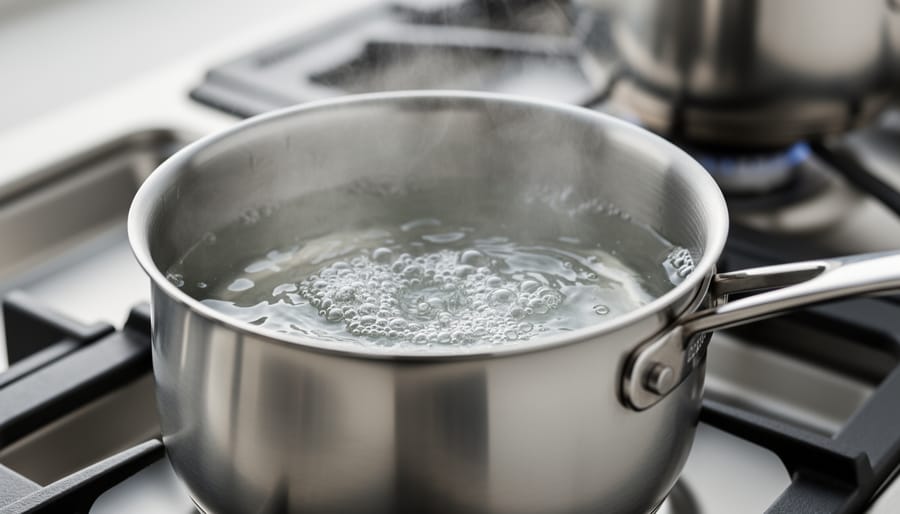
Simmering water is water heated to a temperature between 180°F and 205°F (82°C to 96°C), producing gentle bubbles that break the surface intermittently rather than the vigorous, rolling boil seen at 212°F. This narrow temperature range represents one of cooking’s most essential yet frequently misunderstood techniques, sitting at the intersection of culinary art and thermal physics.
Understanding what constitutes a true simmer matters far beyond kitchen semantics. The difference between a simmer and a boil determines whether your chicken stock turns cloudy or crystal clear, whether delicate fish fillets hold together or fall apart, and whether tough cuts of meat transform into tender perfection or become rubbery disappointments. Professional chefs and food scientists agree that temperature control in this zone affects protein denaturation, flavor extraction, and texture preservation in ways that more aggressive heat cannot replicate.
The challenge for most home cooks lies in recognizing a simmer by sight and maintaining it without constant thermometer checks. Visual cues provide reliable indicators: small bubbles rising from scattered points on the pan bottom, gentle surface movement, and occasional wisps of steam rather than billowing clouds. This article breaks down the physics behind water’s behavior at sub-boiling temperatures, distinguishes between gentle simmers and rapid simmers, and explains when each matters in both culinary applications and laboratory settings. Whether you’re preparing a reduction sauce or conducting controlled heating experiments, mastering the simmer unlocks precise thermal control that transforms outcomes.
What Simmering Water Means
Simmering water occupies a precise thermal sweet spot between gentle poaching and vigorous boiling. It refers to water heated to approximately 185-205°F (85-96°C), just below the boiling point of 212°F (100°C) at sea level. At this temperature range, water exhibits distinctive visual characteristics that distinguish it from other cooking states: small bubbles form steadily at the bottom of the pot, rise slowly through the liquid, and occasionally break the surface with gentle pops. Wisps of steam curl upward, but the water’s surface remains relatively calm with only slight, rhythmic movement rather than the turbulent rolling of a full boil.
- Simmer
- A cooking state where water is heated to 185-205°F, producing gentle bubbles and slight surface movement without the vigorous agitation of boiling.
- Rolling boil
- Water heated to 212°F or above, characterized by rapid, continuous bubble formation and vigorous surface turbulence that doesn’t diminish when stirred.
- Poaching temperature
- A lower heat range of 160-180°F where water produces no visible bubbles, used for delicate foods like eggs and fish that require the gentlest possible cooking.
- Convection currents
- Circular flow patterns created when heated water rises and cooler water sinks, distributing heat throughout the liquid during simmering.
- Nucleation sites
- Microscopic imperfections on pot surfaces or suspended particles in water where vapor bubbles preferentially form when temperature reaches the simmering range.
Understanding these temperature distinctions matters because each state affects food differently. Poaching’s lower temperatures cook gently without breaking apart delicate proteins. Simmering provides enough heat energy to extract flavors and tenderize tougher ingredients while maintaining structure. A full boil, by contrast, agitates food violently and can toughen proteins or break down textures excessively.
“The transition to simmering represents a critical threshold in water’s behavior,” explains Dr. Maria Chen, a thermal physicist at the Institute of Fluid Dynamics. “At these temperatures, dissolved gases begin escaping and localized boiling occurs at nucleation sites, but the bulk liquid temperature remains below the saturation point. This creates the characteristic gentle bubble formation we associate with simmering.”
Steaming differs entirely, it uses water vapor rather than liquid water, typically requiring temperatures at or above boiling point to generate sufficient steam for cooking.
The Physics Behind Simmering
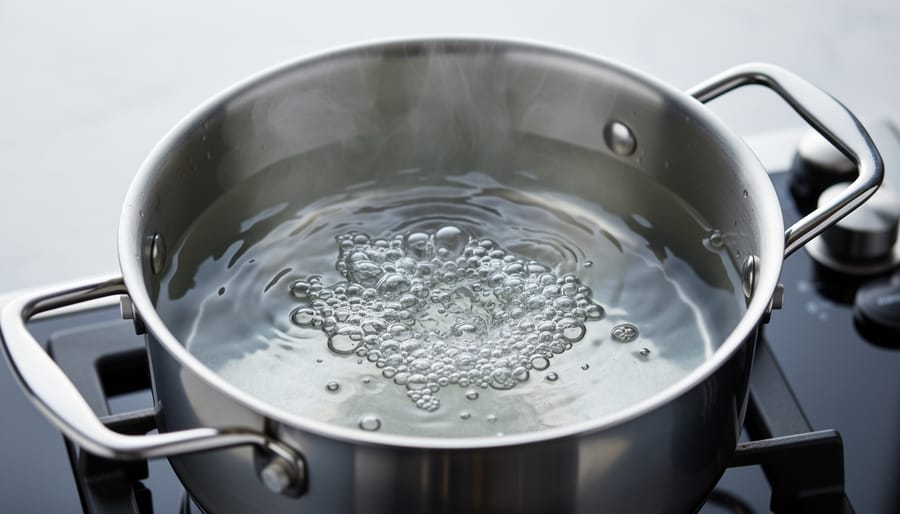
Heat Transfer and Convection
When you place a pot of water on a heat source, energy doesn’t distribute itself evenly on its own. Instead, the water near the bottom absorbs heat first, becomes less dense, and rises upward through the cooler liquid above. This rising warm water displaces the cooler water at the surface, which then sinks back down to be heated in turn. The result is a continuous loop called a convection current, the engine that drives simmering.
These currents move slowly and methodically during a simmer, typically at speeds of just a few centimeters per second. The gentle circulation creates what physicists call laminar flow, where water molecules travel in relatively smooth, parallel paths rather than chaotic tumbles. This orderliness matters enormously for cooking and laboratory work alike. When you’re extracting delicate flavors from herbs or preventing proteins from toughening, you need heat to penetrate gradually without the violent agitation that full boiling produces.
The temperature gradient in simmering water remains relatively small, usually just 5-15 degrees Celsius between the hottest bottom layer and the cooler surface. Compare this to a rolling boil, where turbulent convection creates dramatic temperature swings and aggressive mixing that can tear apart tender ingredients or disrupt sensitive chemical reactions.
Convection also explains why covering a pot affects simmering behavior. A lid traps rising steam, which condenses and drips back down, adding energy to the system and accelerating the convection cycle. Remove the lid, and evaporative cooling at the surface slows the current noticeably.
Bubble Formation and Vapor Pressure
At the molecular level, simmering water is a battleground between liquid cohesion and vapor pressure. Bubbles form through nucleation, the process where microscopic pockets of water vapor emerge at specific sites on the container’s surface or around impurities suspended in the liquid. These nucleation sites provide the rough surfaces where vapor molecules can gather and overcome the surrounding water’s pressure.
Vapor pressure is the key player here. As water heats toward its boiling point, molecules move faster and more escape from liquid to gas phase. Below 180°F, these vapor pockets collapse before reaching the surface because external pressure still dominates. Between 185°F and 205°F, the simmering range, vapor pressure approaches but doesn’t quite match atmospheric pressure, creating those characteristic small, gentle bubbles that rise slowly and sometimes dissolve before breaking through.
This delicate balance explains why you see occasional bubbles at a simmer versus the continuous, vigorous stream of a rolling boil. At true boiling point, vapor pressure equals atmospheric pressure throughout the liquid, allowing bubbles to form rapidly anywhere in the water column.
Materials scientists exploit this temperature-dependent bubble behavior when studying surface properties and coating adhesion. Dr. Yuki Chen at MIT’s Department of Materials Science notes that “observing nucleation patterns in controlled sub-boiling conditions reveals how different materials interact with liquid-vapor interfaces, critical for developing better heat exchangers and microfluidic devices.” Chemical engineers similarly use near-simmering temperatures to control reaction rates where precise bubble formation matters, from pharmaceutical synthesis to polymer production.
Different Types of Simmers
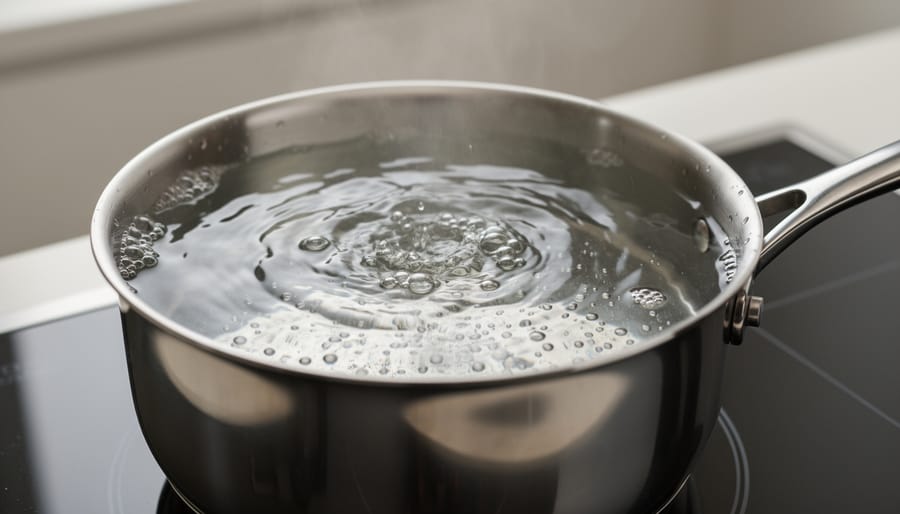
Simmering isn’t a single fixed state but rather a spectrum of heat intensities, each with distinct characteristics and culinary applications. Understanding these variations allows cooks and researchers to select the appropriate level for specific tasks, ensuring optimal results whether extracting delicate flavors or maintaining gentle heat transfer.
At the lowest end sits the bare simmer or slow simmeroccurring at approximately 185-195°F (85-90°C). This gentlest form produces only occasional bubbles that break lazily at the surface, sometimes with intervals of several seconds between them. The water’s surface barely moves, with just slight ripples indicating the convection currents below. This temperature range proves ideal for poaching fish, infusing broths with subtle aromatics, or cooking delicate proteins that toughen at higher heat. To achieve a bare simmer, set your heat source to its lowest setting and partially cover the pot to retain heat while allowing some evaporation.
The medium simmer represents the middle ground, typically ranging from 195-205°F (90-96°C). Here you’ll observe steady streams of small bubbles rising from multiple points across the pot’s bottom, breaking the surface in a consistent but not vigorous pattern. The liquid moves noticeably but gently, creating what many recipes simply call “a simmer.” This temperature suits most braising tasks, simmering sauces to marry flavors, and cooking grains or legumes that need thorough but not aggressive heat. Medium simmers require moderate heat settings and occasional monitoring to prevent escalation into boiling.
A rapid simmer approaches the boundary with boiling, operating at 205-210°F (96-99°C). Large bubbles break constantly across the entire surface, creating significant agitation and visible rolling motion. Steam rises continuously. This intensity works for reducing sauces quickly, maintaining heat when adding cold ingredients to a pot, or in scientific applications requiring maximum heat transfer without the violent turbulence of a full boil. Achieving a rapid simmer demands higher heat settings with careful attention, as it easily tips into boiling with just a small temperature increase.
Mastering these gradations transforms simmering from a vague instruction into a precise, reproducible technique.
How Simmering Is Used in Practice
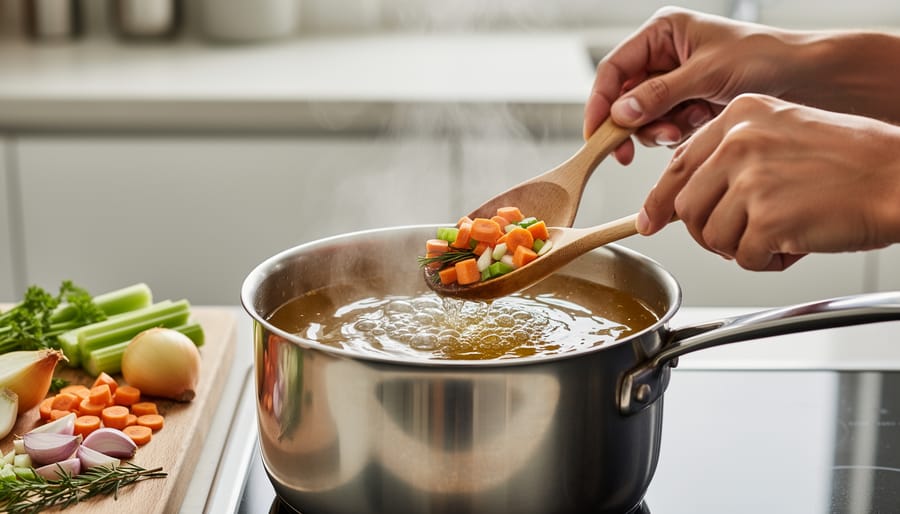
Simmering finds applications across surprisingly diverse fields, from the professional kitchen to the research laboratory. In culinary arts, chefs rely on this gentle heat to coax maximum flavor from ingredients without breaking them down through aggressive boiling. Stock-making exemplifies this perfectly: bones, vegetables, and aromatics release collagen, minerals, and flavor compounds steadily over hours at simmering temperature, producing clear, richly flavored liquids that would turn cloudy and bitter under a rolling boil. Delicate proteins like fish and eggs benefit similarly, poaching salmon or eggs in barely simmering water preserves their tender texture while cooking them through evenly.
Beyond cooking, simmering plays a critical role in laboratory procedures where precise, sustained temperatures below boiling are essential. Chemical extractions often require this range to dissolve specific compounds without degrading heat-sensitive molecules. Water baths maintained at simmering temperatures provide consistent heating for reactions, enzyme assays, and sample preparations. Some water desalination processes use controlled heating in this temperature range during distillation phases, while solar water desalination systems optimize energy efficiency by operating near simmering thresholds rather than bringing water to a full boil.
Common applications span multiple industries:
- Preparing stocks, broths, and long-simmered soups that require extended cooking without reduction
- Poaching delicate proteins like fish, chicken breasts, and eggs to preserve moisture and texture
- Extracting plant compounds for pharmaceuticals, herbal preparations, and chemical research
- Maintaining constant-temperature water baths for laboratory experiments and quality control testing
- Textile dyeing processes where fiber damage from boiling must be avoided
- Pharmaceutical manufacturing requiring sterile conditions without the mechanical stress of vigorous boiling
The simmering range matters because it represents a sweet spot in thermodynamics, hot enough to drive reactions, extractions, and cooking processes forward, yet gentle enough to preserve delicate structures and prevent unwanted chemical changes. Materials testing laboratories use simmering water baths to evaluate how substances respond to sustained heat exposure under controlled conditions. According to Dr. Harold McGee, food science researcher, “Simmering allows time for tough collagen to dissolve into gelatin and for flavors to meld, while the relatively calm water prevents emulsions from breaking and proteins from toughening.” This principle extends beyond food: anywhere precise, prolonged heating below boiling point is required, simmering temperature provides the optimal balance of energy input and gentle treatment.
Controlling and Maintaining a Simmer
Achieving a consistent simmer requires attention to your heat source and cookware. Start by bringing water to a full boil, then reduce heat to the lowest setting that maintains gentle bubble activity. Gas burners offer immediate responsiveness, you can dial down the flame and see results within seconds. Electric coil and ceramic cooktops take longer to adjust, so reduce heat before the boil becomes too vigorous. Induction cooktops provide precise heat transfer efficiency making them ideal for maintaining stable simmer temperatures.
Pot characteristics significantly impact simmer consistency. Heavy-bottomed pots made from materials like cast iron or clad stainless steel distribute heat evenly and prevent hot spots that can cause localized boiling. Thin aluminum pots heat quickly but create uneven temperature zones. A wider pot exposes more surface area to heat, requiring lower burner settings than a tall, narrow vessel containing the same water volume.
Altitude dramatically affects simmering temperature. Water boils at 212°F at sea level but only 194°F at 6,000 feet elevation. Your simmer range shifts downward accordingly, what looks like a proper simmer at high altitude occurs at temperatures 15-20 degrees lower than in coastal kitchens. This affects cooking times and technique precision.
Lid position serves as a fine-tuning mechanism. A fully covered pot traps steam and raises internal pressure slightly, intensifying the simmer. Leaving the lid slightly ajar allows steam to escape, cooling the water surface and creating a gentler simmer. Completely removing the lid increases evaporation and may require turning up the heat to maintain bubble activity.
Modern temperature control technology has advanced kitchen precision. Immersion circulators and smart burners can hold water within 1-2 degree ranges, eliminating the guesswork that comes with traditional stovetop methods. These tools prove particularly valuable for techniques requiring extended simmering periods where consistency matters.
Common Questions About Simmering Water
Several common questions arise when cooks and students first encounter the concept of simmering. Understanding these nuances helps clarify the practical differences between similar heat levels and addresses misconceptions about what simmering can and cannot achieve.
Can you simmer without visible bubbles?
Yes, a bare simmer produces only occasional bubbles that may break below the surface. You’ll see gentle movement and steam, even when bubbles aren’t constantly visible at the top.
What’s the difference between simmering and slow boiling?
Simmering occurs at 185-205°F with small, infrequent bubbles, while slow boiling happens at 212°F with constant, larger bubbles breaking the surface. The temperature difference is small, but the mechanical action differs significantly.
Does simmering purify water?
Simmering alone doesn’t reliably kill all pathogens. Water must reach a full rolling boil (212°F at sea level) and maintain it for at least one minute to ensure microbial safety.
Why does recipe timing vary between simmer intensities?
A rapid simmer at 205°F cooks food faster and extracts flavors more aggressively than a bare simmer at 185°F. The 20-degree range significantly affects how quickly proteins denature, starches gelatinize, and flavors concentrate.
The temperature precision matters more than many realize. A stock that simmers too vigorously becomes cloudy as proteins break down aggressively, while insufficient heat fails to extract collagen into gelatin. This explains why experienced cooks adjust heat throughout long cooking processes rather than setting one temperature and walking away.
Simmer duration depends entirely on what you’re cooking. Delicate fish might need only 10 minutes at a gentle simmer, while extracting flavor from bones for stock can take 4-8 hours. The water itself can simmer indefinitely as long as you replenish what evaporates, but the food and your intended outcome determine the appropriate timeframe.
Understanding simmering water reveals how a commonplace kitchen technique embodies sophisticated thermodynamic principles. What appears as gentle bubbles rising through a pot actually represents precise vapor pressure equilibrium, convection-driven heat transfer, and controlled energy input, concepts that matter in chemical laboratories, industrial processing, and materials science research as much as they do in making soup.
The same physics that determines whether your stock extracts maximum flavor also governs how pharmaceutical compounds are synthesized, how polymers are processed, and how food safety protocols achieve pathogen reduction without destroying nutrients. Mastering the distinction between a bare simmer at 185°F and a rapid simmer at 205°F gives you control over outcomes ranging from tender braised meat to accurate experimental replication.
Research continues to deepen our knowledge of water’s behavior in this temperature range. Food scientists are mapping how different simmer intensities affect flavor compound extraction rates, while engineers refine models of bubble nucleation for industrial applications. As precision cooking technology advances and scientific instruments grow more sophisticated, our ability to harness and understand this fundamental process only improves, turning everyday observations into quantifiable, reproducible results.