
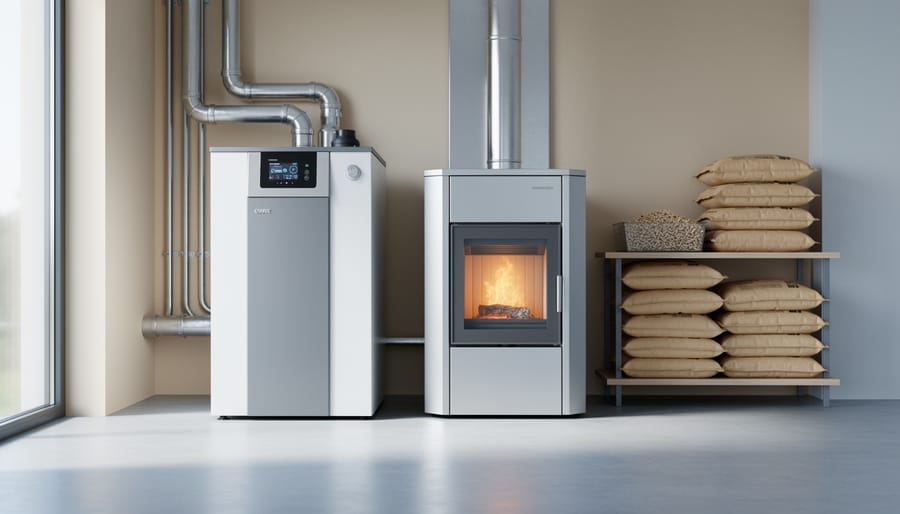
Combustion research for cleaner home heating is the scientific study of how fuels burn in residential heating systems, with the goal of reducing emissions, improving efficiency, and minimizing environmental impact. Scientists examine everything from flame chemistry and airflow patterns to fuel composition and ignition processes, seeking to understand precisely what happens when wood, natural gas, oil, or pellets combust in furnaces, boilers, and stoves.
This work matters because home heating accounts for roughly 10% of residential energy use globally, and traditional combustion methods release particulate matter, carbon monoxide, nitrogen oxides, and greenhouse gases into both indoor and outdoor air. Poor combustion wastes fuel, costs homeowners money, and contributes to respiratory health problems. As demand grows for low-carbon energy solutions, researchers are rethinking how we burn fuels at the molecular level.
Recent advances have produced tangible improvements. Modern wood stoves now achieve up to 90% combustion efficiency compared to 50% in older models. Condensing gas furnaces recover heat from exhaust gases that once went up the flue. Pellet boilers use computer controls to optimize air-fuel ratios in real time, cutting emissions by 70% or more.
We’re not just making heating systems incrementally better, notes Dr. Maria Chen, a combustion engineer at the National Renewable Energy Laboratory. We’re fundamentally redesigning how residential combustion happens, from initial ignition through complete fuel consumption. These improvements often require complementary services like chimney repair Sarasota professionals provide to ensure safe venting of exhaust gases.
This article explains what combustion researchers actually do, how their methods translate into cleaner heating technologies, the different research approaches being used, and the practical applications already warming homes more efficiently today.
What Combustion Research Means for Home Heating
Combustion research in the context of home heating is the systematic scientific study of how fuels burn to produce heat, what happens during that burning process, and how to make it cleaner and more efficient. Researchers examine everything from the fundamental chemistry of flames to the way heat moves through a boiler, with the ultimate goal of reducing harmful emissions while maximizing the useful warmth delivered to homes. This research matters because heating accounts for a significant portion of residential energy use and air pollution, and understanding combustion at a detailed level allows engineers to design systems that waste less fuel and release fewer pollutants into both indoor and outdoor air.
At its core, combustion research investigates the complex reactions that occur when fuels like natural gas, oil, wood, or pellets combine with oxygen and ignite. Scientists study flame temperatures, the speed at which reactions proceed, how completely the fuel burns, and what byproducts form under different conditions. This work directly connects to broader energy goals, including what low-carbon means for residential heating systems. Several key terms define this research landscape:
- Complete combustion
- The ideal burning process where fuel reacts fully with oxygen to produce mainly carbon dioxide and water, releasing maximum heat with minimal pollutants.
- Emission factors
- Measurements that quantify how much of specific pollutants a heating system produces per unit of fuel burned or heat delivered.
- Thermal efficiency
- The percentage of fuel energy that actually heats your home rather than escaping up the flue or being lost in other ways.
- Fuel-air mixing
- How thoroughly fuel and oxygen combine before and during combustion, which critically affects both efficiency and emissions.
- Particulate matter
- Tiny solid or liquid particles released during incomplete combustion that contribute to air pollution and health concerns.
Laboratory studies allow researchers to isolate variables and understand combustion fundamentals using specialized equipment, while computational models simulate thousands of scenarios faster than physical testing allows. These controlled insights then guide the development of real heating equipment that performs better in actual homes, where conditions vary with weather, fuel quality, and how people operate their systems.
How Combustion Research Works to Improve Home Heating
Laboratory and Computational Methods
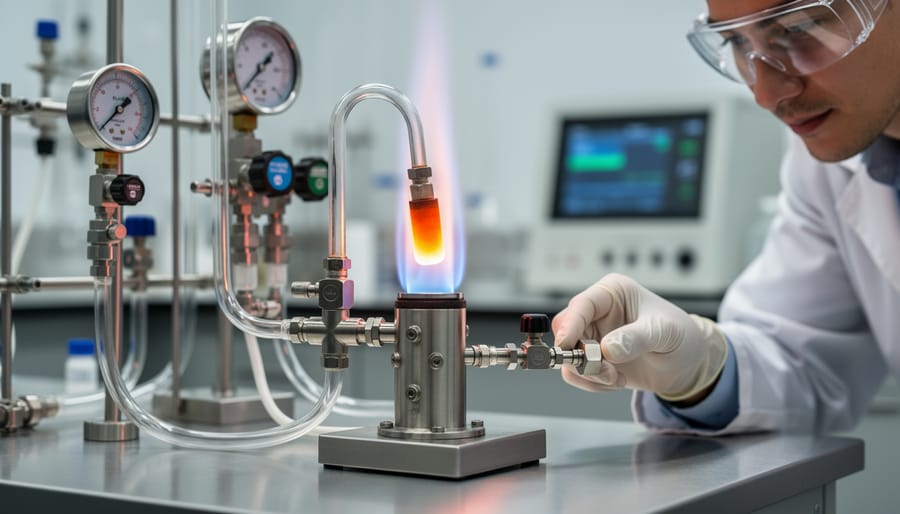
Researchers study combustion for home heating systems using two complementary approaches: physical experiments in controlled laboratory settings and mathematical simulations on high-performance computers.
In the lab, scientists employ laser-based diagnostics to capture flame behavior at microsecond timescales. Planar laser-induced fluorescence (PLIF) creates detailed temperature maps showing exactly where heat concentrates and where combustion remains incomplete. Particle image velocimetry tracks how air and fuel mix within burner chambers, revealing turbulence patterns that affect efficiency. Mass spectrometry identifies which chemical species form during burning, pinpointing where nitrogen oxides, carbon monoxide, and unburned hydrocarbons originate.
Computational fluid dynamics (CFD) modeling complements these experiments by simulating millions of chemical reactions occurring simultaneously in a flame. Researchers input fuel composition, burner geometry, and airflow rates, then calculate temperature distributions, emission formation pathways, and heat transfer to surrounding surfaces. These simulations can test hundreds of design variations in days rather than building and testing each physical prototype, which might take months.
The two methods work together: laboratory measurements validate the accuracy of computational models, while simulations explain mechanisms that remain invisible even to advanced diagnostics. A researcher might measure particulate emissions from a prototype oil burner, then use CFD to understand why those particles form and how redesigning the fuel nozzle angle could reduce them by 40 percent before building the improved version.
Field Testing and Real-World Validation
Once a research team achieves promising results in controlled laboratory settings, they must confirm those findings translate to actual homes where conditions vary dramatically. Real-world validation involves installing prototype heating systems in occupied residences and monitoring performance through heating seasons. Researchers equip these homes with extensive sensor networks measuring flue gas composition, particulate emissions, fuel consumption, and heat output under the unpredictable demands of daily life.
Field studies reveal operational realities that laboratory tests miss. A burner that performs flawlessly at steady state in a lab may struggle during the frequent cycling of mild autumn days. Researchers document how homeowners actually operate their systems, thermostat adjustments, maintenance intervals, fuel quality variations, and measure the resulting emission profiles. Portable emission analyzers capture real-time data on nitrogen oxides, carbon monoxide, and particulate matter under these authentic conditions.
This validation phase often exposes unexpected challenges. Researchers discovered, for instance, that certain low-emission burner designs showed higher emissions during cold starts than lab tests predicted, prompting redesigns that address real startup behavior. Field testing also quantifies annual efficiency rather than peak performance, accounting for standby losses and seasonal variations that laboratory conditions cannot replicate.
The data collected from multiple homes over entire heating seasons provides the statistical evidence needed to refine designs and establish realistic performance specifications. This rigorous validation process typically extends two to three years before researchers confidently recommend commercial deployment of new heating technologies.
Types of Combustion Research for Residential Heating
Combustion researchers approach cleaner residential heating from multiple angles, each targeting different aspects of the burning process and its environmental impact. These research directions often overlap and inform one another, creating synergistic improvements when combined in real heating systems.
Advanced Burner Design Research
Scientists studying burner geometry and flame dynamics work to optimize how fuel mixes with air and burns. This research examines burner port shapes, flame stabilization mechanisms, and airflow patterns to achieve complete combustion with minimal pollutant formation. Researchers use high-speed imaging and temperature mapping to understand how subtle design changes affect flame structure and emission profiles. Modern burners incorporating these findings can reduce carbon monoxide and unburned hydrocarbon emissions by 40-60% compared to older designs while maintaining or improving heat output.
Alternative and Renewable Fuel Studies
A significant research focus involves adapting combustion systems to cleaner fuel sources including hydrogen blends, renewable natural gas, advanced biofuels, and processed biomass pellets. Scientists investigate how these alternatives burn differently from conventional fossil fuels, what modifications heating equipment requires, and how to maintain efficiency while switching fuels. This work includes studying flame stability with varying fuel compositions and developing burners that can handle multiple fuel types without major retrofitting.
Staged Combustion and Air Management
Staged combustion research explores splitting the burning process into multiple zones with controlled air supply at each stage. Researchers have found that introducing fuel and air in carefully timed sequences dramatically reduces nitrogen oxide formation while maintaining efficiency. AI for emissions prediction now helps optimize these staging patterns by modeling thousands of combustion scenarios. This approach has proven particularly effective in both gas and solid fuel systems, achieving NOx reductions exceeding 70% in some applications.
Catalytic Combustion Technologies
Scientists investigate how catalysts can lower the temperature at which complete combustion occurs, reducing thermal NOx formation while improving efficiency. Catalytic research focuses on developing durable, cost-effective materials that maintain activity over thousands of heating cycles and resist poisoning from fuel impurities. These systems enable stable, clean combustion at temperatures 200-300°C lower than conventional burners.
Emission Control and Filtration Research
Beyond improving the combustion process itself, researchers develop post-combustion technologies to capture remaining pollutants. Major research categories include:
- Burner optimization studies examining flame shape, mixing patterns, and heat distribution for maximum efficiency
- Fuel switching research testing hydrogen blends, biogas, and synthetic fuels in residential equipment
- Low-NOx technology development using staged air injection and temperature control strategies
- Particulate reduction techniques including electrostatic precipitation and advanced filtration
- Smart combustion controls integrating sensors and adaptive algorithms for real-time optimization
Each research category addresses specific pollutants or efficiency challenges, but the most promising advances emerge when multiple approaches combine. A modern condensing boiler, for instance, might incorporate optimized burner geometry, staged combustion, and smart controls working together to achieve emission levels once thought impossible for residential heating.
Research Applications: Cleaner Heating Technologies in Practice

The laboratory insights from decades of combustion research now heat millions of homes through technologies that deliver measurable improvements in efficiency and emissions. These aren’t distant possibilities. They’re systems you can buy today, each shaped by specific research breakthroughs.
Condensing boilers represent one of the most successful transfers from research to market. Scientists studying exhaust gas heat recovery discovered that cooling flue gases below their dew point could capture latent heat from water vapor, a phenomenon conventional boilers waste. Modern condensing units routinely achieve 95% efficiency compared to 80% for older models, cutting fuel consumption by roughly 15%. The key innovation came from understanding corrosion chemistry at low temperatures, which allowed engineers to design heat exchangers that survive the acidic condensate formed during this process.
Wood heating has undergone a transformation driven by particulate research. Ultra-low emission wood stoves use staged combustion chambers that separate initial pyrolysis from complete combustion, a design informed by studies of flame chemistry and mixing patterns. These stoves inject secondary air precisely where unburned gases concentrate, achieving up to 90% lower particulate emissions than conventional wood stoves. Some models incorporate catalytic combustors that enable complete oxidation at lower temperatures, another direct application of catalysis research.
Advanced oil burners benefit from decades of spray combustion studies. Modern flame-retention head burners create controlled air turbulence that stabilizes the flame while promoting thorough fuel-air mixing, reducing soot formation by 70% compared to older designs. Research into droplet atomization led to nozzles that produce finer, more uniform fuel sprays, improving combustion completeness and cutting emissions.
Natural gas furnaces apply research findings on lean premixed combustion and flame stabilization. Contemporary modulating burners adjust firing rates smoothly across a wide range while maintaining low emissions, using control strategies developed through computational modeling of transient combustion. Sealed combustion designs that draw outdoor air for burning eliminate indoor air quality concerns, addressing safety research on carbon monoxide formation.
These technologies share a common thread: fundamental research uncovered specific combustion mechanisms, then engineers designed practical systems that exploit those insights. The gap between laboratory discovery and commercial availability has narrowed considerably, with some advances reaching the market within five to seven years.
Key Research Findings on Emission Reduction
Recent combustion research has yielded measurable breakthroughs in reducing home heating emissions. Studies on optimal fuel-air ratios demonstrate that maintaining precise stoichiometric conditions, where fuel and oxygen combine completely, can reduce carbon monoxide emissions by 60-80% compared to traditional systems that run fuel-rich or oxygen-starved. Researchers at national laboratories have mapped the exact air-to-fuel mixtures that minimize incomplete combustion products while maximizing heat output.
Staged combustion represents another major advance. By introducing fuel and air in carefully timed phases rather than all at once, scientists have achieved nitrogen oxide reductions of 40-70% in residential burners. Primary combustion occurs in a fuel-rich, lower-temperature zone that limits NOx formation, then secondary air completes the burn. Field tests in European homes showed this approach works reliably across varied heating loads.
Low-temperature combustion strategies, operating below 1400°C, address the temperature-dependent formation of thermal NOx. Japanese research teams documented that flameless oxidation techniques, where fuel mixes with hot exhaust gases before igniting, cut NOx emissions by half while maintaining 95% combustion efficiency. These findings now inform next-generation condensing boiler designs.
Particulate matter control has advanced through understanding soot formation mechanisms. Research reveals that introducing turbulence at specific points in the flame breaks up particle agglomerations before they grow. Modern wood stove designs incorporating research-backed air injection patterns achieve 90% reductions in fine particulate emissions compared to conventional stoves. Testing shows sustained performance over thousands of operating hours.
Computational studies modeling millions of individual chemical reactions have identified which combustion conditions favor pollutant formation and which suppress it. This molecular-level understanding lets engineers design burners that avoid problematic temperature zones and residence times where emissions form, translating fundamental science into cleaner heating systems homeowners can install today.
Common Questions About Combustion Research and Home Heating

How long does it take for combustion research to reach actual heating products?
The timeline from laboratory discovery to market-ready heating system typically spans five to ten years. Researchers must first validate findings through field testing, then manufacturers need time to redesign products, obtain safety certifications, and scale up production before homeowners can purchase the improved systems.
Are heating systems based on recent research more expensive?
Advanced combustion technologies often carry higher upfront costs, sometimes 20-40% more than conventional systems, but lower fuel consumption and reduced maintenance typically offset the initial investment within several years. The price premium has been declining as manufacturers refine production processes and competition increases.
What should homeowners look for when choosing cleaner heating options?
Look for systems certified to current emission standards, efficiency ratings above 90%, and technologies like staged combustion or condensing heat exchangers. Ask installers about real-world performance data rather than relying solely on laboratory test results, and consider how the system integrates with broader home energy efficiency measures.
How much cleaner are modern research-driven heating systems compared to older models?
Contemporary systems designed using recent combustion research can reduce particulate emissions by 70-90% and nitrogen oxide emissions by 50-80% compared to equipment from the 1990s. These improvements stem from better fuel-air mixing, optimized combustion temperatures, and advanced emission controls that researchers have refined through detailed flame studies.
The questions homeowners raise about combustion research often intersect with concerns about AI climate solutions and broader environmental monitoring. Research findings on emission reduction don’t exist in isolation, they contribute to larger efforts in atmospheric science that track how residential heating impacts regional air quality. When choosing a cleaner heating system, understanding the research foundation helps homeowners distinguish genuine innovations from marketing claims and make decisions aligned with both their comfort needs and environmental goals.
Combustion research has transformed home heating from a largely empirical craft into a science-backed discipline capable of delivering dramatic emission reductions. The laboratory work, computational modeling, and field testing described throughout this article directly translate into furnaces, boilers, and stoves that burn cleaner while maintaining or improving efficiency. Real-world emission reductions of 50-90% across various pollutants demonstrate that scientific understanding leads to measurable air quality gains both inside homes and in communities.
The research pipeline remains active. Scientists are exploring hydrogen-compatible burners that could enable carbon-free home heating, refining biomass combustion to extract more energy with fewer particulates, and developing near-zero emission systems that approach the performance of electric heating without requiring grid upgrades. Each advance builds on fundamental knowledge of flame chemistry, heat transfer, and pollutant formation mechanisms.
For homeowners, this ongoing research means cleaner heating options will continue to emerge. The combustion systems available in 2026 burn far cleaner than those from a decade ago, and the trajectory points toward even greater improvements. Understanding what combustion research reveals empowers better choices today while anticipating the cleaner technologies researchers are developing for tomorrow.