
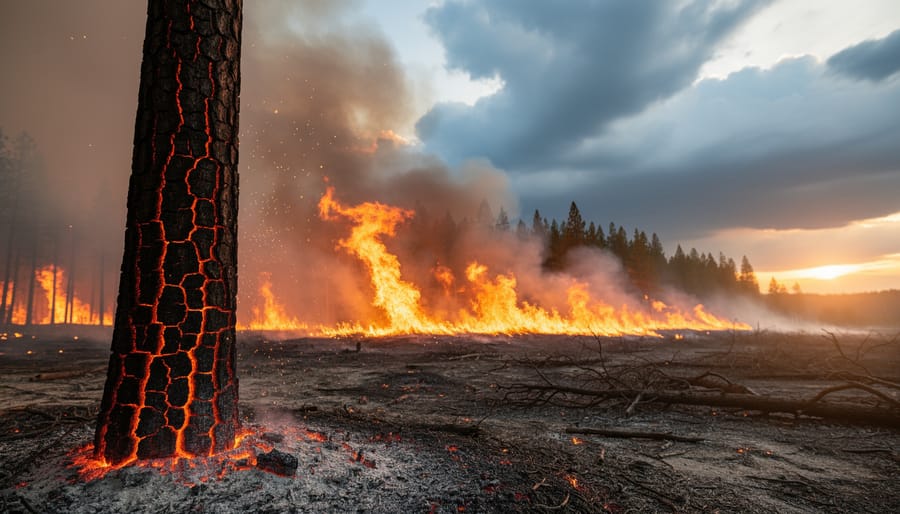
Climate change examples are the observable events and trends that result when rising greenhouse gas concentrations warm the planet: longer droughts, hotter heat waves, wildfires that burn bigger and faster, and downpours that overwhelm drainage systems. They matter because they turn an abstract average, a degree or two of global warming, into things people actually live through.
The mechanism is easier to grasp than most people expect. A hotter atmosphere holds about 7% more moisture for every degree Celsius of warming, which loads storms with more water. Warmer air also pulls moisture out of soil and vegetation, drying the fuel that wildfires need. Both processes are already visible. In the first half of 2025, the United States recorded at least 14 separate billion-dollar weather and climate disasters. Prolonged drought and powerful Santa Ana winds fed the devastating fires around Los Angeles, and drought in California and Oregon helped fuel the Bootleg and Dixie Fires.
The sections ahead sort the main types of climate impacts, explain how each one works, and point to real-world cases and the practical efforts underway to reduce them.
What Counts as a Climate Change Example
A climate change example is an observable event or measurable trend that scientists connect to a warming climate. Think of intensifying wildfires, record heat, or flash floods. The key word is “connect,” because the link is rarely as simple as one cause and one effect.
Start with the difference between weather and climate. Weather is what happens on a given day or week: a storm, a heat spike, a smoky afternoon. Climate is the long-term pattern across decades. A single hot day tells you little. A steady rise in hot days across many years tells you a great deal.
That’s why researchers lean on long-term records and a method called attribution science. They compare what happened with simulations of a world without human-driven warming, then ask how much more likely or intense the event became. A fire or storm is almost never “caused” by climate change alone. Drought, wind, and fuel conditions all play a part. Warming loads the dice, making certain outcomes more probable and more severe. The Los Angeles-area wildfires, for instance, were fueled by prolonged drought and powerful Santa Ana winds, with a warmer climate shaping the dry backdrop.
The encouraging part is how much sharper this science has become. Scientists can now assess events in near real time and tell communities what role warming played.
Here are a few terms that will help throughout this article:
- Weather vs. climate
- Weather describes short-term conditions at a place and time, while climate describes the average pattern of those conditions over many years.
- Extreme event attribution
- A research approach that estimates how much climate change altered the likelihood or strength of a specific event.
- Fuel moisture
- The amount of water held in vegetation and dead plant material, which determines how easily it ignites and burns.
- Atmospheric moisture capacity
- The amount of water vapor air can hold, which rises by about 7% for every degree Celsius of warming.
- Billion-dollar disaster event
- A weather or climate event whose damages reach at least one billion dollars, used to track the growing cost of extremes.
With these definitions in hand, the examples that follow are easier to read as connected evidence rather than isolated headlines.
How a Warming Climate Produces These Events
Why a Hotter Atmosphere Changes Rainfall
Here’s the core physics: a hotter atmosphere holds about 7% more moisture for every degree Celsius of warming. This is the starting point for understanding how climate change works on rainfall, and it comes down to simple physics. Warmer air holds more moisture so when a storm forms, there’s more water available to fall.
That extra water vapor doesn’t change how often it rains everywhere. It changes how hard it rains when conditions line up. A storm drawing on a moister atmosphere can dump more water in less time, and that’s what overwhelms streets, creeks, and drainage systems. Rain that arrives faster than the ground can absorb it runs off, and flash flooding follows.
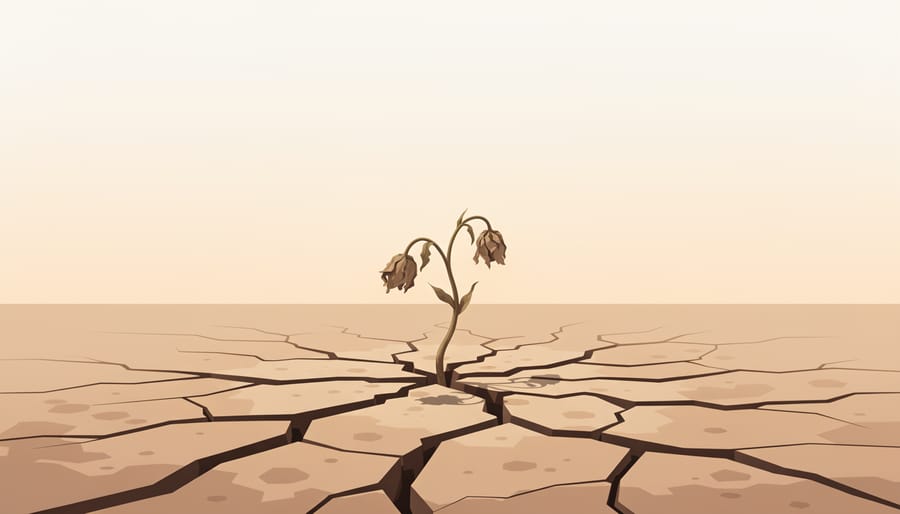
The same warmth also works in the opposite direction. Heat pulls more moisture out of soils and plants, so dry stretches can grow harsher even as individual downpours get heavier. That’s why drought and deluge aren’t contradictions. A region can bake through a long dry spell and then get hit by an intense storm, leaving hard, parched ground that sheds water instead of soaking it in.
Why Heat, Smoke, and Floods Arrive Together
Record heat, wildfire smoke, and flash flooding can look like separate stories, but they often share the same roots. Warmer air dries out soil and vegetation, which sets the stage for fire. That same warmer air also holds about 7% more moisture for every degree Celsius of warming, so when a storm does form, it can unload far more rain in a short time.
Think of it as one loaded system showing up in different forms. A heat dome bakes a region and parches the land. Smoke drifts downwind from fires burning in dry fuels. Meanwhile, moisture-heavy storms elsewhere can overwhelm the ground and trigger flash floods. Dry ground sheds water poorly, so intense rain can run off instead of soaking in.
This is why late July 2026 stood out, with much of the United States facing several climate extremes at once: record heat, wildfire smoke, and flash flooding. As of late July, nearly every region was contending with some form of dangerous extreme weather. No single event proves the pattern. But when the underlying conditions are shared, it makes sense that these hazards overlap in time rather than taking turns.
Types of Climate Change Examples: Heat, Drought, Fire, and Flood
Drought and Wildfire
Drought is the first ingredient, and it works quietly. When soils and vegetation dry out, the plants in a landscape become fuel, and a warmer climate speeds that drying along. Think of it as stacking dry kindling long before any spark arrives.
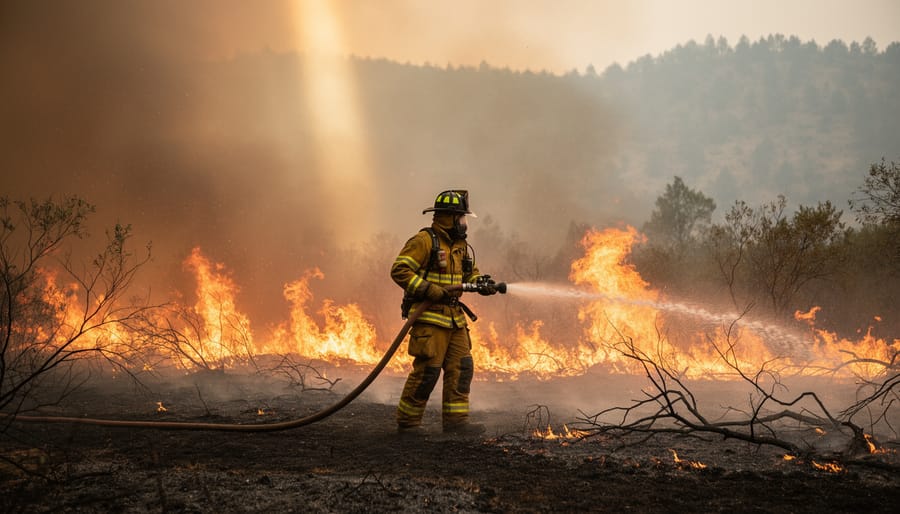
California and Oregon show how this plays out. Drought conditions in both states fueled the Bootleg and Dixie Fires, with parched forests and grasslands ready to burn once ignition came. Readers curious about how warming reshapes forests in the Pacific Northwest can explore climate change in Oregon for a closer look at one region.
Wind is the second ingredient, and it turns a dry landscape into a fast-moving threat. In the Los Angeles area, prolonged drought and Santa Ana winds combined to fuel devastating wildfires. Dry fuel supplied the energy, and powerful gusts carried flames quickly across the terrain.
Scientists also track how ready the fuel is to burn. Fuel-moisture levels, which measure how much water the vegetation holds, are near or below their historic lows for this time of year across most of Colorado and southern Wyoming. Low readings signal that plants will ignite more easily and burn more intensely.
Each factor matters on its own, but the danger comes from their overlap: extended dryness, depleted fuel moisture, and strong wind arriving together.
Heat, Smoke, and Flash Flooding
Record heat, wildfire smoke, and flash flooding can look like three separate stories, but they often share the same roots. Late July 2026 offers a clear example: much of the country faced several climate extremes at once, including all three, and nearly every region of the United States was contending with some form of dangerous extreme weather.
Heat is the thread that ties them together. Hotter air dries out soil and vegetation, and in places already short on rain, that sets the stage for fire. Fuel-moisture levels across most of Colorado and southern Wyoming were near or below their historic lows for the time of year, which means the landscape was primed to burn. When fires take hold, the smoke they produce can drift well beyond the burn area, so people far from the flames still feel the effects.
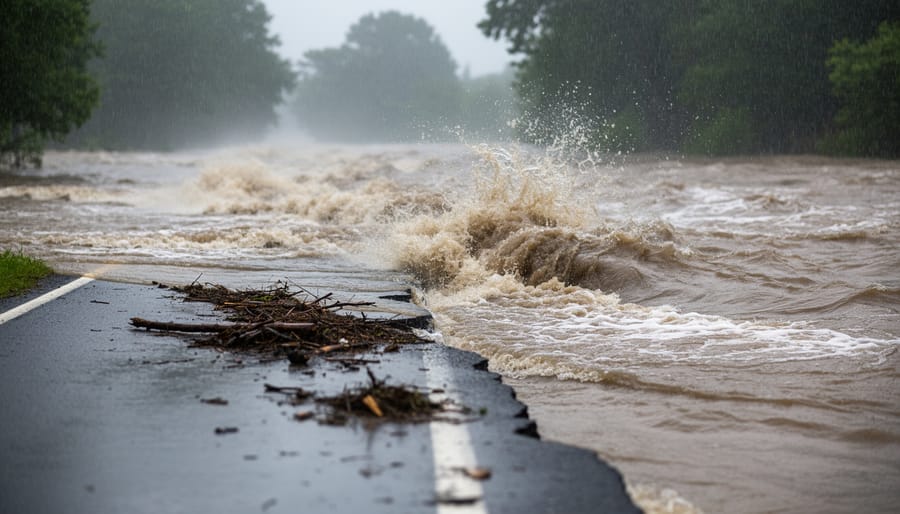
Flooding follows a different path through the same mechanism. A hotter atmosphere holds about 7% more moisture for every degree Celsius of warming. When that extra moisture finally falls, it can arrive as a sudden, intense downpour rather than a gentle, steady rain. Dry, hardened ground absorbs less of it, so water runs off quickly and flash flooding becomes more likely.
That is why a hot, smoky stretch and a flash flood warning can show up in the same week. Each one is a different expression of a warmer, thirstier atmosphere acting on the land below.
Measuring the Impact: What the Numbers Show
Counting costly disasters turns scattered headlines into a dataset. In the first half of 2025, the United States experienced at least 14 separate billion-dollar weather and climate disaster events. That single metric packs a lot of information: how often damaging events occur, how widely they spread, and how heavily they weigh on communities and economies.
Why does the tally matter? One expensive storm tells us very little about the climate. A running count across months and years lets researchers spot patterns, compare regions, and test whether costly events are becoming more frequent. Planners use the same numbers to decide where to strengthen infrastructure, how to budget for recovery, and which risks deserve attention first.
Keep in mind what the count does and doesn’t say. Cost reflects more than weather. Where people build, how much property sits in harm’s way, and how prepared a community is all shape the final dollar figure. That’s why the count works best alongside physical measurements such as temperature, rainfall, and fuel moisture.
This is also the place where a climate or atmospheric scientist’s voice adds the most value, explaining how researchers separate the influence of warming from other factors. The encouraging news is that atmospheric science advances are steadily improving attribution science, which estimates how much a warming climate raised the odds or intensity of a specific event. As those methods sharpen, the numbers tell a clearer story.
How Climate Change Examples Are Used in Research and Planning
Documented examples of climate change do more than illustrate a problem. They feed directly into the tools people use to prepare for it. When researchers record how and where extreme events unfold, planners gain a practical evidence base to work from.
Fire-weather monitoring is a clear case. Fuel-moisture levels in most of Colorado and southern Wyoming are near or below their historic lows for this time of year, and tracking that single measurement helps forecasters and land managers judge how readily vegetation will burn. The same logic applies to lessons drawn from the Bootleg and Dixie Fires in drought-stricken California and Oregon, and from the Los Angeles-area wildfires, where prolonged drought and powerful Santa Ana winds combined. Each event refines our understanding of which conditions to watch.
Counting costly events matters too. With at least 14 separate billion-dollar weather and climate disasters in the first half of 2025, emergency managers can see where to focus resources and how to stage responses before the next season arrives. Knowing that a hotter atmosphere holds about 7% more moisture for every degree Celsius of warming also helps flood planners anticipate heavier downpours.
Evidence eventually becomes policy. The Climate Pollution Reduction Grants (CPRG) program, for example, provided a grant to the DC MSA to develop and implement plans for reducing economy-wide pollution. It is a good illustration of turning observation into action. Efforts like this sit within the broader balance of mitigation and adaptation where communities both cut emissions and strengthen their defenses.
The encouraging takeaway is that measurement keeps improving, and every documented event sharpens the tools we use to respond.
Common Questions About Climate Extremes
Climate extremes rarely show up one at a time, and the questions below come up often. The answers draw only on the verified facts covered earlier in this article.
Why are climate extremes arriving together?
A warmer climate loads the dice for several kinds of extreme weather at once. As of late July, nearly every region of the United States is contending with some form of dangerous extreme weather, and much of the country is facing several extremes at the same time.
Why do heat, smoke, and floods happen at the same time?
They share the same underlying conditions: extra heat, drier landscapes, and a hotter atmosphere loaded with moisture. Record heat, wildfire smoke, and flash flooding can therefore appear in the same period, even in different parts of the country.
How does a hotter atmosphere affect rainfall?
A hotter atmosphere holds about 7% more moisture for every degree Celsius of warming. That extra moisture can fall as heavier downpours, which raises the risk of flash flooding.
What is driving wildfire season?
Drought and dry fuels are central. Drought in California and Oregon fueled the Bootleg and Dixie Fires, prolonged drought and powerful Santa Ana winds fueled the Los Angeles-area wildfires, and fuel-moisture levels in most of Colorado and southern Wyoming are near or below historic lows for this time of year.
Taken together, these answers point to one consistent story. Warming does not create each event from nothing, but it shifts the odds, making drier fuels, heavier rain, and stacked extremes more likely.
Climate change examples can look like separate stories: a wildfire in one place, a flash flood in another, a heat wave somewhere else. Underneath, they share the same physical logic. A hotter atmosphere holds about 7% more moisture for every degree Celsius of warming, which loads storms for heavier downpours. Meanwhile, heat and drought dry out soils and vegetation, so landscapes burn more readily when wind and a spark arrive.
That shared cause is why so many extremes can land together, as they did when nearly every region of the United States was contending with dangerous weather at once.
There is real reason for optimism, though. Better measurement, such as tracking fuel moisture, helps communities see danger coming. Attribution science keeps getting sharper at linking events to warming. Planning efforts like the Climate Pollution Reduction Grants program turn that evidence into action. Understanding the pattern is the first step toward preparing for it.