
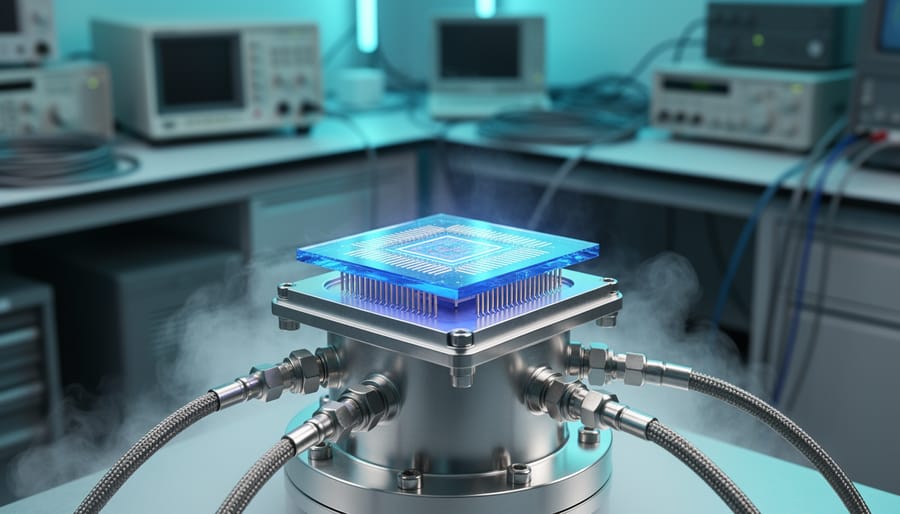
Yes, quantum computers exist today, but they’re not yet the revolutionary machines capable of solving all the problems promised in headlines. As of 2026, we’re in what researchers call the “Noisy Intermediate-Scale Quantum” era, where real quantum processors from companies like IBM, Google, and IonQ are performing calculations, but they’re limited by errors and can only tackle specific problems better than classical computers.
The confusion around quantum computing’s current state stems from a gap between scientific reality and public perception. While quantum breakthroughs make regular headlines, the machines behind them aren’t the fault-tolerant quantum computers that will eventually crack encryption or revolutionize drug discovery. Instead, today’s systems are sophisticated research tools that demonstrate quantum principles while requiring near-absolute-zero temperatures and existing in a constant battle against environmental interference.
Understanding whether quantum computers are “here” depends entirely on your definition of success. If you’re asking whether physical devices that manipulate quantum bits exist and perform computations impossible for classical computers, the answer is an unequivocal yes. If you’re wondering whether you can buy one to speed up your laptop or solve practical business problems, we’re still years away from that reality.
This article cuts through the hype to explain what quantum computers actually are, how current systems work, what types exist today, and what they can genuinely accomplish right now versus what remains on the horizon.
What a Quantum Computer Actually Is
A quantum computer is a computing machine that harnesses quantum mechanics, the physics governing particles at atomic and subatomic scales, to process information in fundamentally different ways than conventional computers. While your laptop or smartphone stores data as bits that are definitively either 0 or 1, a quantum computer uses quantum bits, or qubits, which can exist in multiple states simultaneously until measured.
This isn’t just a faster version of what we already have. Classical computers process information sequentially through logic gates that manipulate bits in predetermined ways. Quantum computers exploit strange quantum phenomena that have no everyday equivalent, allowing them to explore vast numbers of possible solutions at once for certain types of problems.
The key quantum properties that make this possible include:
- Qubit
- The basic unit of quantum information that can exist in a superposition of both 0 and 1 states simultaneously, unlike classical bits that must be either 0 or 1.
- Superposition
- The ability of a quantum system to exist in multiple states at once until measured, when it “collapses” to a single definite state, a concept central to interpretations like the Copenhagen Interpretation of quantum mechanics.
- Entanglement
- A quantum connection between qubits where the state of one immediately influences the state of another, regardless of distance, creating correlations impossible in classical systems.
- Quantum Gate
- An operation that manipulates qubits by changing their quantum states, similar to logic gates in classical computers but exploiting quantum properties.
- Coherence
- The duration that qubits maintain their quantum properties before environmental interference causes them to lose their quantum behavior and act classically.
What separates a true quantum computer from a “quantum-inspired” classical device is the actual use of quantum mechanics at the hardware level. Some classical algorithms mimic quantum approaches or use quantum-inspired optimization, but they run on traditional processors. A genuine quantum computer physically manipulates quantum states in qubits, whether those qubits are superconducting circuits, trapped ions, or photons, and demonstrates measurable quantum behavior like superposition and entanglement during computation.
How Quantum Computers Work
The Role of Quantum Error Correction
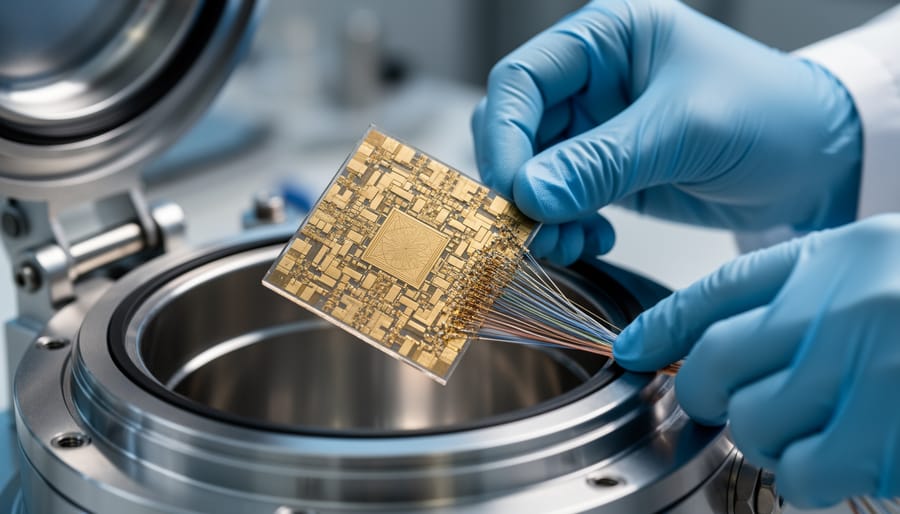
Quantum computers face a fundamental challenge that classical computers largely solved decades ago: errors. While a bit in your laptop reliably stays 0 or 1, qubits are extraordinarily fragile. Even minuscule environmental disturbances, stray electromagnetic fields, thermal vibrations, cosmic rays, can destroy the delicate quantum states that make computation possible. This phenomenon, called decoherence, happens so quickly that qubits typically maintain their quantum properties for mere microseconds to milliseconds.
These errors accumulate rapidly. Performing a million operations? Each one introduces new errors, compounding until the final result becomes meaningless noise. This fragility is precisely why building reliable quantum computers has taken so long despite understanding the basic principles for decades.
Quantum error correction addresses this by encoding a single “logical qubit” across multiple physical qubits. If one physical qubit fails, the others preserve the information, similar to how RAID systems protect data across multiple hard drives. However, there’s a catch: detecting and correcting quantum errors requires enormous overhead. Current estimates suggest hundreds or thousands of physical qubits may be needed to create one reliable logical qubit.
Researchers at IBM, Google, and universities worldwide are making steady progress. Recent demonstrations have shown that adding more physical qubits genuinely reduces error rates, proving the concept works, a crucial milestone toward fault-tolerant quantum computers.
Different Types of Quantum Computing Platforms
Quantum computers aren’t being built using a single, standard design. Multiple competing platforms have emerged, each with distinct approaches to creating and controlling qubits. The variety reflects both the experimental nature of the field and the fact that no one method has clearly proven superior for all applications.
Superconducting qubits currently lead in commercial development. Companies like IBM and Google use tiny circuits cooled to near absolute zero, where electrical current can flow without resistance. These circuits behave quantum mechanically, with their electrical states representing qubit information. Superconducting systems can perform operations quickly, in billionths of a second, and researchers have successfully scaled them to over 100 qubits. However, they require extreme cooling and the qubits lose their quantum properties rapidly, typically within microseconds.
Trapped ion systems confine individual charged atoms using electromagnetic fields, then manipulate their quantum states with precisely tuned lasers. Each ion serves as a qubit with exceptional stability. “Trapped ions have the longest coherence times we’ve achieved so far,” notes Dr. Christopher Monroe, whose work at the University of Maryland helped pioneer this approach. The ions can maintain their quantum states for seconds rather than microseconds, and they produce highly accurate operations. The challenge lies in scaling: controlling hundreds of individual ions with separate laser beams becomes enormously complex.
Photonic quantum computers encode information in particles of light. Photons interact weakly with their environment, making them naturally resistant to certain errors, and they can operate at room temperature rather than requiring refrigeration. Canadian company Xanadu has built cloud-accessible photonic systems. The difficulty comes in getting photons to interact with each other reliably, which quantum computation requires.
Neutral atom platforms, a newer contender, trap uncharged atoms in grids formed by focused laser beams. Researchers can rearrange these atoms into different patterns, offering flexibility that other platforms lack. This approach combines some advantages of trapped ions with better scaling potential.
Topological qubits remain largely theoretical but promise qubits that resist errors through their fundamental physics rather than requiring constant correction. Microsoft has invested heavily in this approach, though creating the exotic quantum states needed has proven exceptionally difficult.
Each platform represents a different bet on how to overcome quantum computing’s central challenge: maintaining delicate quantum states long enough to complete useful calculations.
The Current State: Yes, Quantum Computers Exist, With Caveats
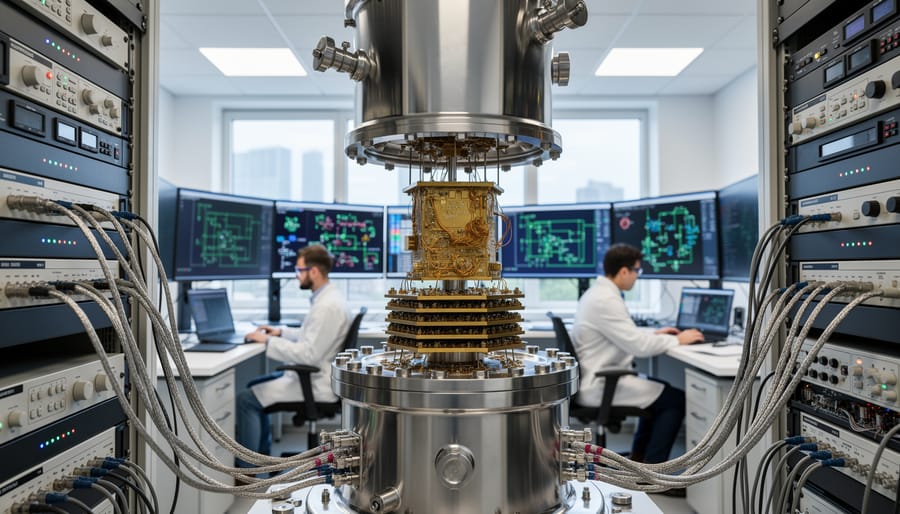
Yes, quantum computers exist today, you can even access them through the cloud. Companies like IBM, Google, IonQ, and Rigetti offer platforms where researchers and developers can run quantum algorithms on real quantum hardware. Universities and national laboratories operate their own systems. These aren’t science fiction or purely theoretical devices; they’re functioning machines processing quantum information right now.
But here’s the crucial caveat: today’s quantum computers are what researchers call NISQ devices, Noisy Intermediate-Scale Quantum systems. They work, but within narrow constraints that limit their practical usefulness.
Current quantum computers typically have between 50 and 1,000 qubits, though qubit count alone doesn’t tell the full story. Error rates remain high, with even the best systems losing quantum information within milliseconds due to decoherence. Every operation introduces errors, and without sufficient error correction, complex calculations quickly become unreliable.
Dr. John Preskill, who coined the term NISQ, describes the current era as “exploring what we can do with these imperfect devices before we have full fault tolerance.” The machines exist, but they can’t yet outperform classical computers on most practical problems.
The specialized use cases matter too. Today’s quantum computers excel at specific tasks, simulating molecular behavior for drug discovery, solving certain optimization problems, and testing quantum algorithms. They’re not general-purpose machines. You can’t run your spreadsheet software or stream video on them, and for many computational tasks, your laptop remains vastly more capable.
Cloud platforms like IBM Quantum Experience have democratized access, allowing thousands of researchers to experiment with quantum algorithms. This accessibility has accelerated learning and development, even as the hardware remains fundamentally limited.
The answer to “is there a quantum computer yet?” is unambiguously yes. The more nuanced question is what these machines can accomplish today versus the transformative potential of tomorrow’s fault-tolerant systems.
What Quantum Computers Can Actually Do Today
Despite their limitations, today’s quantum computers are already being deployed in real-world testing scenarios across several fields. The current quantum computing landscape includes machines accessible through cloud platforms from IBM, Google, and Amazon, allowing researchers and companies to experiment with quantum algorithms on actual hardware.
The most active application areas right now include:
- Drug discovery and molecular simulation, where quantum computers model protein folding and chemical interactions that classical computers struggle to simulate accurately
- Materials science research, particularly simulating quantum properties of new materials for batteries, catalysts, and superconductors
- Optimization problems in logistics, such as route planning and supply chain management, where quantum algorithms can explore many possible solutions simultaneously
- Financial modeling for portfolio optimization and risk analysis, with major banks running pilot quantum programs
- Machine learning applications, testing whether quantum systems can speed up certain pattern recognition and classification tasks
It’s crucial to distinguish proven capabilities from theoretical promise. Current quantum computers excel at very specific problems involving quantum simulation, modeling other quantum systems. A team at Google demonstrated quantum advantage in 2019 by performing a specialized calculation faster than classical supercomputers, though the task itself had limited practical use. More recently, researchers have used quantum computers to simulate molecular behavior with accuracy matching laboratory experiments, suggesting genuine near-term value in chemistry and materials research.
However, claims about quantum computers “breaking encryption” or “revolutionizing AI” remain firmly in the future category. Today’s systems lack the qubit counts and error rates needed for these applications. What we’re seeing now is exploratory research and algorithm development, essential groundwork, but not yet transformative real-world impact.
The Path to Next-Generation Quantum Systems
The next generation of quantum computers centers on achieving fault-tolerance, systems that can run complex calculations despite errors, using logical qubits built from multiple physical qubits through error correction codes. Today’s quantum computers operate as “noisy intermediate-scale quantum” (NISQ) devices, where errors accumulate too quickly for long calculations. Reaching quantum advantage at scale requires crossing several thresholds: improving qubit quality so physical error rates drop below 0.1%, scaling systems to thousands or millions of qubits, and demonstrating that logical qubits maintain coherence long enough to solve practical problems.
Major milestones being pursued include building modular quantum processors that can link together, developing room-temperature quantum systems to eliminate costly cooling infrastructure, and creating quantum networking protocols for distributed quantum computing. Google’s Quantum AI team achieved a demonstration of quantum error correction that extended qubit lifetime in 2023, while IBM’s roadmap targets over 4,000 qubits by 2025. Universities like MIT, Caltech, and the University of Waterloo are advancing the theoretical foundations, exploring new materials for qubits, refining gate operations, and devising algorithms that could work on near-term machines.
The transition from today’s experimental systems to practical quantum computers capable of revolutionizing science and industry hinges on engineering breakthroughs as much as physics insights. Companies like IonQ, Rigetti, and PsiQuantum are racing to build commercially viable platforms, each betting on different qubit technologies. Progress is measurable but gradual, quantum volume doubles roughly every year, tracking toward machines that can tackle optimization and simulation problems no classical supercomputer can solve.
Common Questions About Quantum Computing Reality
The gap between quantum computing’s theoretical promise and practical reality generates persistent questions. Many people wonder if they’re missing out on a technology they’ve heard is revolutionary, while others remain skeptical that quantum computers exist at all outside marketing hype.
Can I buy a quantum computer for personal use?
No commercial quantum computers are available for individual purchase. The technology requires specialized infrastructure including dilution refrigerators that cool qubits to near absolute zero, extensive shielding, and expert maintenance teams. Accessing quantum computers happens through cloud platforms like IBM Quantum Experience, Amazon Braket, or Microsoft Azure Quantum.
Will quantum computers replace classical computers?
Quantum computers won’t replace classical systems but will complement them for specific problems. Your laptop, smartphone, and servers will remain classical because quantum computers excel only at particular tasks like molecular simulation and optimization, while classical computers handle everyday computing far more efficiently and affordably.
When will quantum computers become practical for real-world problems?
Current estimates suggest fault-tolerant quantum computers capable of solving commercially valuable problems beyond classical capabilities may emerge in the 2030s, though limited applications in drug discovery and materials science are being explored now. The timeline depends on achieving error correction at scale and building machines with thousands of logical qubits.
Are quantum computers faster at everything?
Quantum computers aren’t universally faster, they’re fundamentally different. For most tasks like browsing the web, editing documents, or playing games, a classical computer vastly outperforms any quantum system. Quantum advantage appears only for problems involving quantum simulation, certain optimization challenges, and specific mathematical structures that classical algorithms struggle with.
These questions reveal a common pattern: expectations shaped by breathless media coverage collide with the constrained reality of early-stage technology. Quantum computing isn’t about raw speed but about approaching particular problems through quantum mechanical principles that classical physics can’t efficiently replicate. A quantum computer struggling with ten qubits might eventually crack problems that would take classical supercomputers millennia, but it can’t run your email client.
The “when will they be practical” question especially frustrates researchers because it conflates different meanings of practical. Some quantum computers already provide practical research value in university labs. Others may demonstrate quantum advantage for niche industrial applications within five years. Broad commercial practicality across multiple sectors likely requires another decade of development, assuming no unexpected breakthroughs or setbacks.
So yes, quantum computers exist today, but with an important qualifier: they’re real, functional machines operating in laboratories and accessible through cloud platforms, yet they remain in early development stages rather than being practical, general-purpose tools.
The progress over the past decade has been remarkable. Researchers have moved from demonstrating basic quantum effects with a handful of qubits to building systems with hundreds of qubits that can tackle specific problems beyond the reach of classical computers. Companies and universities worldwide are refining different quantum computing platforms, each advancing toward more stable, error-resistant systems. The fundamental physics works, and the engineering challenges, while formidable, are being systematically addressed.
The road ahead requires overcoming substantial technical hurdles, particularly achieving fault-tolerant quantum computing with logical qubits that can perform extended calculations reliably. This isn’t a matter of if, but when, with realistic timelines measured in years rather than decades for meaningful milestones.
The quantum computers we have now represent the foundation of a transformative technology still taking shape. They’re not science fiction anymore, but they’re not yet the revolutionary tools that will reshape entire industries either. That transformation is unfolding right now, one breakthrough at a time.