
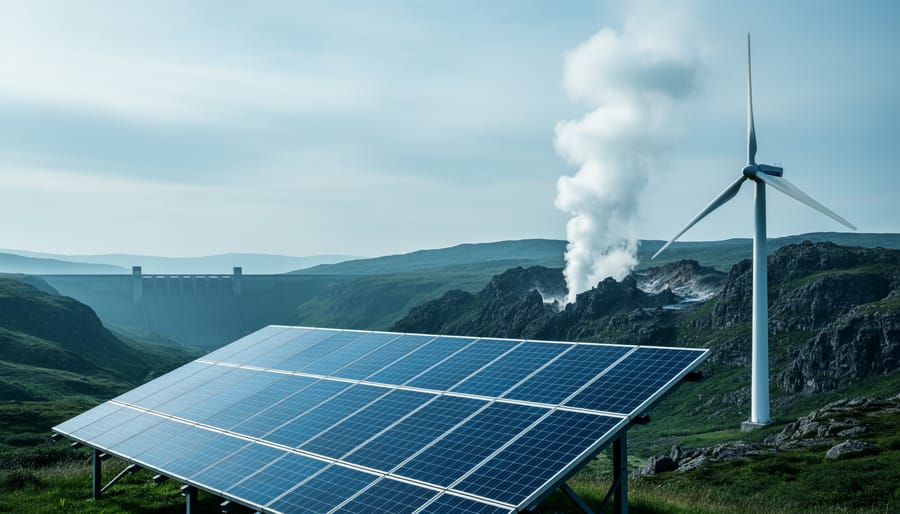
Low-carbon energy sources are energy generation methods that produce significantly lower greenhouse gas emissions throughout their lifecycle compared to fossil fuels, typically releasing less than 100 grams of carbon dioxide equivalent per kilowatt-hour of electricity. These technologies represent humanity’s most viable pathway to powering civilization while avoiding catastrophic climate change.
The stakes couldn’t be higher. Energy production currently accounts for roughly three-quarters of global greenhouse gas emissions, making the transition to cleaner alternatives essential for climate mitigation. Yet confusion persists about which energy sources genuinely qualify as low-carbon and how they actually work. Solar panels, nuclear reactors, wind turbines, and hydroelectric dams each harness fundamentally different natural phenomena to generate power with minimal carbon footprints.
Understanding these technologies matters because energy decisions being made today will shape emissions trajectories for decades. Countries worldwide are investing trillions in clean energy infrastructure, while businesses and homeowners increasingly face choices about which technologies to adopt. The landscape has transformed dramatically in recent years. Solar and wind have plummeted in cost, making them the cheapest electricity sources in most markets by 2026. Nuclear technology has evolved beyond traditional reactor designs. Geothermal energy has expanded into new geological settings.
This article systematically examines each major low-carbon energy source, explaining the physics behind how they work, their carbon profiles, real-world applications, and the roles they play in modern energy systems. Whether you’re a student researching renewable energy, a professional evaluating options, or simply curious about how we can power society sustainably, you’ll find clear answers grounded in current science and engineering.
What Low-Carbon Energy Means
Low-carbon energy sources are defined by how much carbon dioxide and other greenhouse gases they emit during operation and across their entire lifecycle. The standard metric is carbon intensity, measured in grams of CO2-equivalent per kilowatt-hour (gCO2eq/kWh). This number captures not just direct emissions from burning fuel, but the total climate impact from building the facility, extracting raw materials, operating the plant, and eventually decommissioning it.
Most experts consider energy sources emitting below 100 gCO2eq/kWh as low-carbon, though some organizations set the threshold even lower at 50 gCO2eq/kWh. For context, coal-fired power typically produces 820-1000 gCO2eq/kWh, while natural gas ranges from 400-500. Wind power, by comparison, generates just 11 gCO2eq/kWh, and nuclear comes in around 12.
- Carbon Intensity
- The total greenhouse gas emissions from an energy source divided by the electricity it generates, expressed in grams of CO2-equivalent per kilowatt-hour. This metric enables fair comparison across different technologies.
- Lifecycle Emissions
- All emissions produced during the entire existence of an energy facility, from manufacturing components and construction through decades of operation to final decommissioning. This accounts for the full climate impact, not just operational emissions.
- gCO2eq/kWh
- Grams of carbon dioxide equivalent per kilowatt-hour, the standard unit for measuring carbon intensity per kWh that allows direct comparison of different energy sources regardless of their technology or fuel type.
A common source of confusion involves the relationship between low-carbon, zero-carbon, and renewable energy. These terms overlap but are not identical. Renewable sources like solar and wind are nearly always low-carbon because they harness naturally replenishing energy flows. However, not all low-carbon sources are renewable. Nuclear energy produces minimal emissions but consumes finite uranium fuel. Conversely, some renewable sources like biomass can have surprisingly high carbon footprints depending on how the fuel is grown, harvested, and transported.
Zero-carbon energy specifically refers to sources with effectively no lifecycle emissions, though in practice even wind and solar have small carbon footprints from manufacturing. The distinction matters because achieving climate targets requires focusing on actual emissions reductions, not just the renewable label.
The Main Types of Low-Carbon Energy
Renewable Energy Sources
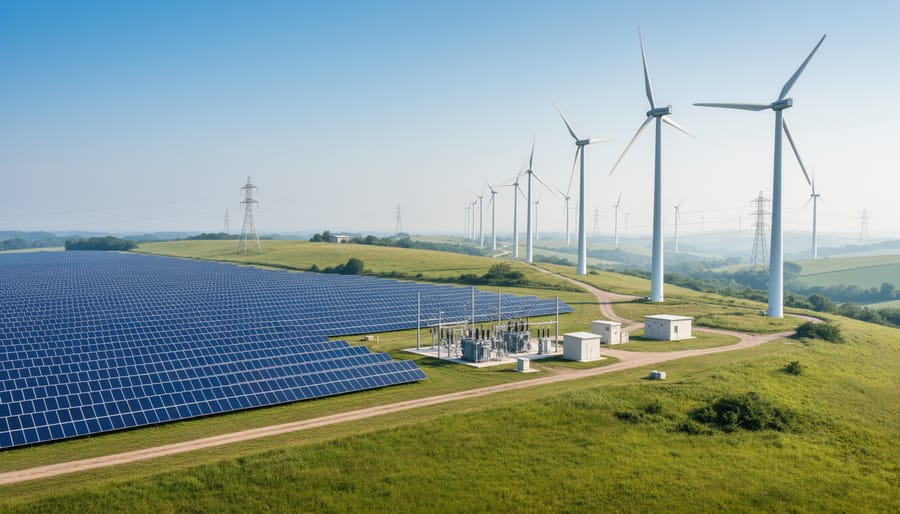
Renewable energy sources generate electricity by harnessing naturally replenishing resources without burning fossil fuels. While all renewable sources produce significantly fewer emissions than coal or natural gas, their carbon footprints differ depending on manufacturing processes, operation, and end-of-life disposal.
Solar energy converts sunlight into electricity through photovoltaic cells made of semiconductor materials, typically silicon. When photons strike these cells, they knock electrons loose, creating an electrical current. Modern panels achieve solar efficiency rates of 15 to 22 percent for residential installations, with laboratory prototypes pushing higher. The carbon intensity ranges from 40 to 50 grams of CO2 equivalent per kilowatt-hour across the panel’s lifecycle, including manufacturing and disposal.
Wind turbines capture kinetic energy from moving air using aerodynamic blades that spin a generator. As wind flows over the curved blades, it creates pressure differences that produce rotation, converting mechanical energy into electricity. Wind power typically emits 11 to 15 grams of CO2 equivalent per kilowatt-hour, making it one of the lowest-carbon options available.
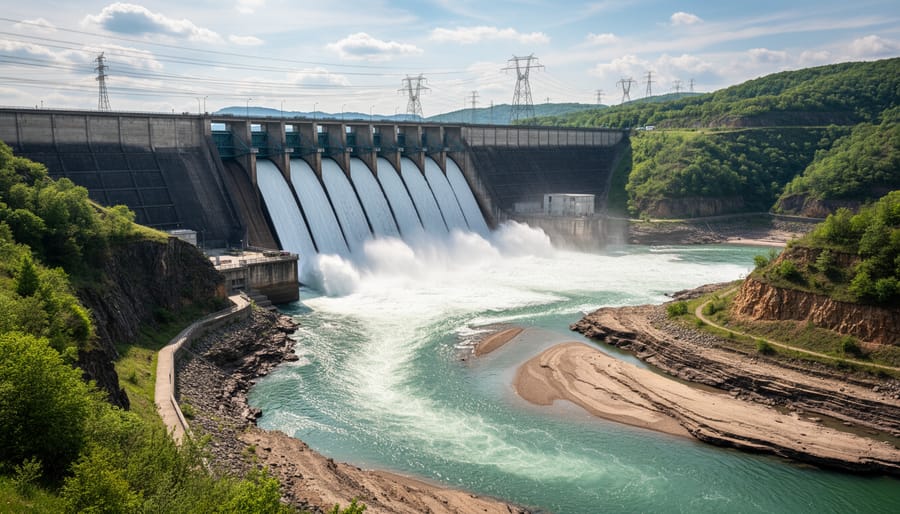
Hydroelectric systems use flowing or falling water to turn turbines connected to generators. Most installations dam rivers to create reservoirs, though run-of-river designs minimize environmental disruption. Hydropower’s carbon profile varies dramatically based on reservoir size and location, ranging from 4 grams to over 100 grams of CO2 equivalent per kilowatt-hour for large tropical reservoirs where decomposing vegetation releases methane.
Geothermal plants tap heat from Earth’s interior by drilling wells to access hot water or steam underground. This thermal energy drives turbines directly or heats a secondary fluid in binary cycle systems. Geothermal typically produces 30 to 50 grams of CO2 equivalent per kilowatt-hour, though some volcanic sites release additional gases from underground.
Biomass energy burns organic matter such as wood pellets, agricultural waste, or dedicated energy crops to generate heat and electricity. While plants absorb CO2 as they grow, lifecycle emissions vary widely based on feedstock, cultivation practices, and transportation distances, ranging from carbon-neutral to over 200 grams per kilowatt-hour for some configurations.
- Solar: Photovoltaic cells convert sunlight to electricity; 40-50 g CO2e/kWh
- Wind: Turbine blades capture kinetic energy from moving air; 11-15 g CO2e/kWh
- Hydroelectric: Flowing water spins turbines; 4-100+ g CO2e/kWh depending on reservoir type
- Geothermal: Underground heat drives steam turbines; 30-50 g CO2e/kWh
- Biomass: Burning organic matter for heat and power; highly variable, 0-200+ g CO2e/kWh
The manufacturing phase contributes most emissions for solar and wind, while operational emissions dominate for biomass and certain hydroelectric installations. Understanding these differences helps policymakers and utilities design energy portfolios that minimize overall carbon intensity while meeting reliability requirements.
Nuclear Energy
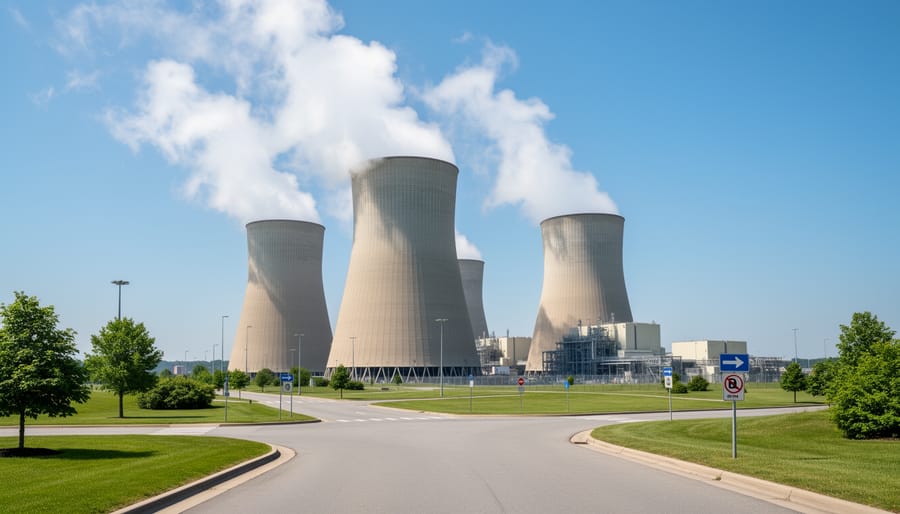
Nuclear fission works by splitting uranium or plutonium atoms in a controlled chain reaction, releasing enormous amounts of heat that boils water into steam to drive turbines. Unlike fossil fuel combustion, this process produces no direct carbon dioxide emissions during operation. A single uranium pellet the size of a fingertip contains as much energy as a ton of coal, making nuclear power plants extraordinarily energy-dense and capable of generating continuous baseload electricity for months without refueling.
Nuclear earns its low-carbon classification through lifecycle analysis. While the technology isn’t renewable in the sense that it consumes finite fuel, nuclear lifecycle emissions typically range from 10 to 30 grams of CO2 equivalent per kilowatt-hour when accounting for mining, enrichment, construction, operation, and decommissioning. This puts nuclear in the same low-carbon category as wind and hydroelectric power, and often lower than solar photovoltaics depending on manufacturing location.
The carbon footprint comes mainly from the upfront construction phase and uranium processing, not from generating electricity. Once operational, a nuclear plant can run at over 90 percent capacity for decades, delivering reliable power regardless of weather or time of day. Modern reactors operate for 60 years or longer, spreading their embodied carbon across enormous electricity output.
The radioactive waste challenge doesn’t significantly affect carbon emissions but remains a key consideration in nuclear’s sustainability profile. High-level waste requires secure geological storage for thousands of years, though the actual volume is remarkably small compared to fossil fuel ash or mining waste. Advanced reactor designs under development promise to reduce waste longevity and even use existing waste as fuel.
Emerging Low-Carbon Technologies
Beyond the established low-carbon sources, a wave of emerging technologies promises to expand our decarbonization toolkit. These innovations, while not yet widely deployed, could fill critical gaps in the global energy transition.
Advanced geothermal systems represent a significant leap beyond conventional geothermal plants. Enhanced Geothermal Systems (EGS) create artificial reservoirs by fracturing hot rock deep underground and circulating water through them, potentially unlocking geothermal resources in regions without natural hydrothermal activity. This technology could theoretically tap into the vast heat beneath the Earth’s surface almost anywhere, not just at geological hotspots.
Ocean energy technologies harness the power of tides and waves. Tidal energy systems exploit predictable tidal flows through underwater turbines, while wave energy converters capture the kinetic energy of surface waves. Though still in pilot stages, these sources offer the advantage of high predictability compared to solar and wind.
Green hydrogen production uses renewable electricity to split water into hydrogen and oxygen through electrolysis. The resulting hydrogen burns without carbon emissions and can store energy long-term, fuel heavy transport, and decarbonize industrial processes that currently rely on fossil fuels. Several countries are investing heavily in scaling this technology.
Carbon capture technologies applied to power plants can dramatically reduce emissions from existing infrastructure. Post-combustion capture systems remove CO2 from flue gases before it reaches the atmosphere, potentially transforming natural gas plants into much lower-carbon generators during the transition period. While energy-intensive, these systems offer a bridge solution for grid reliability.
Each technology faces distinct challenges around cost, scalability, and technical maturity, but their combined potential strengthens the pathway toward comprehensive decarbonization.
How Low-Carbon Energy Systems Work
Low-carbon energy systems operate as interconnected networks where multiple generation sources feed power into the electrical grid simultaneously. Unlike traditional fossil fuel plants that can ramp output up or down on demand, these systems must balance variable sources (solar and wind) with more predictable ones (nuclear, geothermal, and hydroelectric). Grid operators coordinate this mix in real time, dispatching different sources based on availability, demand patterns, and grid stability requirements.
The fundamental challenge lies in matching electricity supply with consumption every second of every day. Solar panels generate nothing at night. Wind turbines produce power only when air moves. This intermittency requires grid operators to maintain backup capacity and increasingly rely on energy storage solutions like lithium-ion batteries, pumped hydro storage, and emerging technologies such as compressed air systems. Modern forecasting tools, including AI for renewables have dramatically improved prediction accuracy for wind and solar output, allowing better planning.
Nuclear and geothermal plants provide baseload power, running continuously at stable output levels. Hydroelectric dams offer flexibility, ramping up quickly to fill gaps when wind dies or clouds block the sun. Natural gas plants still serve as backup in many grids during this transition period, though their role shrinks as battery storage capacity expands. Countries like Denmark demonstrate that grids can handle over 50% variable renewable penetration when combined with strong interconnections to neighboring grids, diverse generation portfolios, and responsive demand management programs that shift some electricity consumption to times of abundant supply.
Real-World Applications and Deployment
Low-carbon energy sources now power significant portions of national grids worldwide, with deployment accelerating across diverse geographic and economic contexts. In 2025, renewables generated approximately 30% of global electricity, while nuclear contributed another 9%, combining to meet nearly 40% of worldwide demand, a share that continues growing as countries pursue decarbonization targets.
Utility-scale deployment takes varied forms depending on regional resources. China operates the world’s largest hydroelectric facility, the Three Gorges Dam, producing 22,500 megawatts, alongside massive wind and solar installations in Inner Mongolia and the Gobi Desert. The United Kingdom generates over 40% of its electricity from wind power during peak conditions, with offshore wind farms in the North Sea providing baseload-equivalent capacity. France derives roughly 70% of its electricity from nuclear energy, demonstrating how a single low-carbon source can anchor an entire grid when deployed systematically over decades.
Distributed generation is reshaping energy systems in both developed and developing regions. Rooftop solar installations have proliferated across Australia, where one in four homes now generates electricity on-site. In East Africa, small-scale solar systems provide power to communities never connected to centralized grids, bypassing the need for fossil fuel infrastructure entirely. Iceland uses abundant geothermal resources for 90% of its heating needs and most electricity generation, showcasing how countries can leverage local low-carbon resources.
Transportation electrification increasingly relies on low-carbon power sources to deliver genuine emissions reductions. Norway charges its predominantly electric vehicle fleet with hydropower and wind, while California pairs solar generation with EV charging infrastructure. Heavy industry presents more complex challenges, but low-carbon electricity now powers aluminum smelting in Iceland (using geothermal and hydro), while green hydrogen produced from renewable electricity is entering pilot programs for steel production in Sweden and chemical manufacturing in Germany. These industrial applications demonstrate pathways for decarbonizing sectors historically dependent on fossil fuels.
Common Questions About Low-Carbon Energy Sources
As low-carbon energy becomes a bigger part of national and global energy strategies, several questions come up repeatedly. Here are answers to the most common concerns.
Can low-carbon energy sources completely replace fossil fuels?
Technically yes, but the transition requires massive infrastructure investment, expanded energy storage, and grid modernization. Most energy experts see a realistic timeline of several decades for a full transition, with interim periods using a mix of sources.
Don’t solar panels and wind turbines have a large carbon footprint from manufacturing?
They do require energy to manufacture, but studies show they typically offset their production emissions within one to four years of operation, then continue generating low-carbon electricity for 20 to 30 years. Over their lifetime, their carbon intensity remains far below fossil fuels.
How reliable are renewable energy sources like wind and solar?
Individual wind and solar installations are variable, producing electricity only when conditions allow. However, grid-scale reliability improves dramatically when you combine diverse renewable sources across wide geographic areas, pair them with dispatchable sources like nuclear or hydroelectric, and deploy battery storage systems.
What role does energy storage play in low-carbon systems?
Energy storage, particularly large-scale batteries and pumped hydro, addresses the intermittency challenge by storing excess renewable energy when production is high and releasing it during periods of low generation or high demand. It’s become essential for grids with high renewable penetration.
Are low-carbon energy sources affordable compared to fossil fuels?
Solar and wind are now often the cheapest sources of new electricity generation in many regions, with costs falling dramatically over the past decade. While some low-carbon sources like nuclear remain expensive to build, the levelized cost of renewable electricity has become competitive or lower than fossil fuels in most markets.
Beyond these basics, people often wonder about the land requirements for renewable installations, the disposal of solar panels and batteries at end-of-life, and whether small-scale nuclear reactors might solve some challenges. These concerns are legitimate and being actively addressed through improved recycling technologies, more efficient designs, and ongoing research into next-generation systems.
Low-carbon energy sources represent our most practical pathway to mitigating climate change while meeting humanity’s growing energy demands. The transition from fossil fuels to these cleaner alternatives isn’t just an environmental imperative, it’s an economic and technological revolution already underway across every continent.
What makes this shift achievable is the diversity of options available. Solar and wind have matured into cost-competitive workhorses of electricity generation, while nuclear provides reliable baseload power with minimal emissions. Hydroelectric installations continue delivering decades of service, and emerging technologies like advanced geothermal and green hydrogen promise to fill remaining gaps in our energy portfolio. No single source offers a complete solution, but together they form a robust toolkit for decarbonization.
The pace of progress offers genuine cause for optimism. Renewable capacity additions broke records in 2025, and deployment costs continue falling. Energy storage technologies are solving intermittency challenges that once seemed insurmountable. Countries worldwide are demonstrating that economic growth and emission reductions can occur simultaneously.
Challenges remain, grid modernization, manufacturing scale-up, policy coordination, but these are engineering and governance problems, not fundamental barriers. Continued investment in research accelerates innovation, while each new installation drives down costs and builds expertise. The question isn’t whether we can transition to low-carbon energy systems, but how quickly we choose to complete the transformation. The technologies work. Now it’s about deployment at the scale and speed climate science demands.