

The Intergovernmental Panel on Climate Change, or IPCC, is the United Nations body that assesses the existing science on climate change, and it does so on behalf of 195 member countries. It doesn’t run its own experiments or set policy. Instead, it gathers thousands of published studies, weighs the evidence through layered expert and government review, and distills it into reports that governments, researchers, and businesses treat as a shared reference point. Think of it less as a lab and more as the world’s most rigorous literature review.
That shared evidence base matters because it gives negotiators and planners common facts to argue from. The underlying climate change science is complex, and the IPCC’s job is to make it usable without flattening it.
The timing is worth watching right now. The panel is deep in its seventh assessment cycle, with an expert review running from 10 August to 2 October 2026, and its Sixty-Fifth Session resuming from 1 to 3 December 2026. A Special Report on Climate Change and Cities is scheduled for March 2027, and the cycle’s Synthesis Report is expected by late 2029.
This article explains how those reports are produced, who takes part, and where to find the official material yourself.
What the IPCC Is and What It Does in UN Climate Science
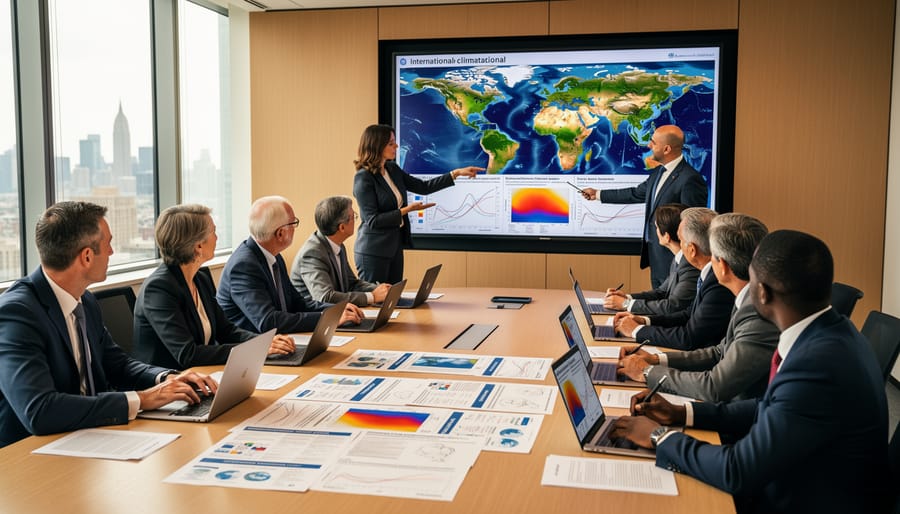
Assessment Reports, Special Reports, and the Synthesis Report
The IPCC publishes three main kinds of reports, and each does a different job. Knowing which is which makes the whole system easier to follow.
Assessment reports are the flagship products. The panel produces one on a roughly 5 to 7 year cycle, and each one takes stock of what published research says about the physical science of climate change, its impacts, and the options for responding. Think of them as a full audit of the field, with every working group contributing its own volume.
Special reports are narrower and faster. Instead of surveying everything, they zoom in on a single topic that governments have asked the panel to examine. Past examples have looked at subjects such as land and the biosphere, including the broader effects on the biosphere. The Special Report on Climate Change and Cities, scheduled for March 2027, will be the first report published in the seventh assessment cycle.
The synthesis report is the capstone. It pulls the findings of the cycle’s working group reports and special reports into one integrated document, written so that policymakers can read the whole picture in a single place. The Synthesis Report of the Seventh Assessment Report is due to be released by late 2029.
How an IPCC Report Gets Written, Reviewed, and Approved
Imagine a single sentence in a draft chapter, say a statement about how a particular trend has changed over recent decades. Before it reaches the public, it has to survive a long journey, and that journey is the best way to see why IPCC reports carry such weight.
It starts with volunteers. Scientists from around the world give their time to assess the published literature, weighing what thousands of studies collectively show rather than running new experiments. The first draft of our sentence reflects that assessment, with each claim tied to the research behind it.
Then the scrutiny begins. Reports move through several review stages, and the sequence looks roughly like this:
- Author teams assess the published literature and write a first draft.
- Expert reviewers comment on that draft, as in the current cycle, where the expert review ran 10 August to 2 October 2026 as the first of multiple review stages.
- Authors respond to every comment and revise the text.
- Governments review further drafts and take part in approving the summaries.
- The final report is published once approval is complete.
Back to our sentence. During expert review, a specialist might question whether the evidence really supports the wording, or point to a newer study the authors missed. The authors must respond to that comment and either revise the text or explain why they are keeping it. Nothing is simply waved through.
Later, when governments help approve the summaries, the language is examined line by line with the underlying science in view. A claim that cannot be traced back to the assessed literature does not survive.
This layering is the point. Each stage catches different kinds of mistakes, from a missed study to an ambiguous phrase, so no single reviewer or group has the final word. By the time a finding appears in print, it has been tested by many independent eyes. That openness is what lets readers, researchers, and policymakers trust the result.
Key Dates in the Seventh Assessment Cycle
The Seventh Assessment cycle runs across several years, so it helps to see the verified milestones in one place. Each date below comes from the IPCC’s published schedule, and the table keeps to those items only.
| Milestone | Date or timeframe | What it represents |
|---|---|---|
| Expert review | 10 August to 2 October 2026 | The first of multiple review stages |
| IPCC-65 resumed session | 1 to 3 December 2026 | The Sixty-Fifth Session of the panel continuing |
| Special Report on Climate Change and Cities | March 2027 | The first IPCC report published in the seventh cycle |
| Synthesis Report of the Seventh Assessment Report | By late 2029 | The report that brings the whole cycle together |
The expert review is already behind us, and the next visible step is the panel’s own meeting. The Sixty-Fifth Session will resume from 1 to 3 December 2026, which keeps the cycle moving between its review stages and its published outputs.
Notice how the milestones are spaced. The cities report arrives in March 2027, and the Synthesis Report follows by late 2029. That gap is normal, since the IPCC produces an assessment report every five to seven years, and each one takes time to draft, review, and approve.
Dates in a process this long can shift, and new details can be added as the work advances. For the latest scheduling, check the IPCC’s official announcements rather than relying on a date you saw months ago.
Who Can Take Part: Governments, Scientists, and the Public
The IPCC is not a club you join by applying. It is a panel of 195 member countries, and its work draws on three groups who each play a distinct part: governments, scientists, and ordinary readers.
Governments sit at the center. Member countries nominate experts, and they take part in approving the summaries that accompany major reports. Scientists do the assessing itself, contributing as authors and reviewers who evaluate published research rather than running their own experiments. The public, meanwhile, holds the simplest role of all: reading the finished outputs.
- Member governments nominate experts and take part in approving report summaries.
- Authors assess the published scientific literature and draft the report text.
- Reviewers comment on drafts so errors and gaps can be caught before publication.
- General readers can access, read, and cite the published reports.
For students and researchers, the review process is the most practical doorway. The expert review, the first of multiple review stages for the seventh cycle, ran from 10 August to 2 October 2026. Stages like this exist so qualified reviewers can scrutinize drafts, though the specific qualifications and procedures are set by the IPCC, not by this article. If you want to contribute in the future, the IPCC’s own announcements are the place to check what is open and to whom.
The same applies to eligibility more broadly. Formal participation rules belong to the IPCC, so treat any outside description, including this one, as a general map rather than a rulebook.
Your Rights and Responsibilities as a Reader of IPCC Findings
IPCC reports are public goods, and that comes with a few simple expectations on both sides. As a reader, you can freely access the published assessments, and you can see how their conclusions were reached: the review stages, the evidence base and the approval process are all open to inspection. You don’t have to take anyone’s word for what a report says.
With that access comes some responsibility. Cite the final published text rather than a summary written by someone else. Keep assessed findings separate from commentary, including your own interpretation, so readers know which is which. And never present draft material as final.
That care matters because assessments don’t stay on the shelf. Governments, city planners and researchers draw on them when they weigh options for mitigation and adaptation, and when they decide where to focus further study. Urban planning is one clear example: the Special Report on Climate Change and Cities, scheduled for March 2027 as the first report of the seventh cycle, points to how closely this science connects to the places where most people live. Reading it, and everything the IPCC publishes, with accuracy and even-handedness keeps that connection trustworthy.
Where to Get Help Finding and Understanding IPCC Reports
The best place to start is the IPCC’s own website and publications. Reports are published there, along with summaries and details on how each assessment was produced. Because the panel’s 195 member countries approve the summaries, the official versions are the ones to cite, not second-hand coverage.
The UN climate science resources linked from the IPCC site are a good next step. They help place a single report within the wider picture of how climate research is organized. University and library science resources are just as useful. Many research libraries run subject guides and can show you how to locate a report, a chapter, or a cited study, which is especially handy if you’re a student working on an assignment.
A few habits make the reading easier:
– Start with a summary before the full chapters. It gives you the main findings in accessible language, and you can drop into chapters for detail.
– Check which report type you’re reading, whether an assessment report, a special report, or the synthesis report, since each has a different scope.
– Watch the publication stage. Treat anything labeled a draft as unfinished, not as the final word.
– Keep a note of the exact title and date when you quote a finding, so your citation stays accurate.
Frequently Asked Questions About the IPCC and Its Reports
What is the IPCC and what does it do?
The IPCC is a panel of 195 member countries that works within the UN system to assess climate change science. It does not run its own experiments. Instead, it evaluates published research and summarizes it so governments and the public can use it.
How often does the IPCC produce an assessment report?
It produces a major assessment report every five to seven years. Each cycle also brings special reports on specific topics, with a Synthesis Report that pulls the cycle together at the end.
When will the Seventh Assessment Report be released?
The Synthesis Report of the Seventh Assessment Report is due by late 2029. The expert review, the first of multiple review stages, ran from 10 August to 2 October 2026, so the process is already well underway.
What is the Special Report on Climate Change and Cities?
It is scheduled for release in March 2027 and will be the first IPCC report published in the seventh assessment cycle. Its findings are not yet available, so check official IPCC announcements for the latest details.
If you’re tracking the next milestone, the IPCC’s resumed Sixty-Fifth Session (IPCC-65) runs from 1 to 3 December 2026. Official IPCC communications are the most reliable place to confirm what happens there.
The strength of the IPCC lies in how it works. Thousands of studies are gathered, assessed, reviewed in layers, and shaped into findings that governments and the public can all draw on. That open, collaborative process turns a vast body of research into a shared evidence base, and it is a genuinely hopeful model for how science can inform real decisions.
The Seventh Assessment cycle gives you a front-row seat. The expert review has wrapped up, and the IPCC resumes its Sixty-Fifth Session from 1 to 3 December 2026. Next up is the Special Report on Climate Change and Cities, scheduled for March 2027 as the first report of the cycle, with the Synthesis Report due by late 2029.
Keep an eye on official IPCC announcements for the December session and the 2027 cities report. Following the science as it develops is the best way to understand where the evidence stands and what it means for the places we live.