
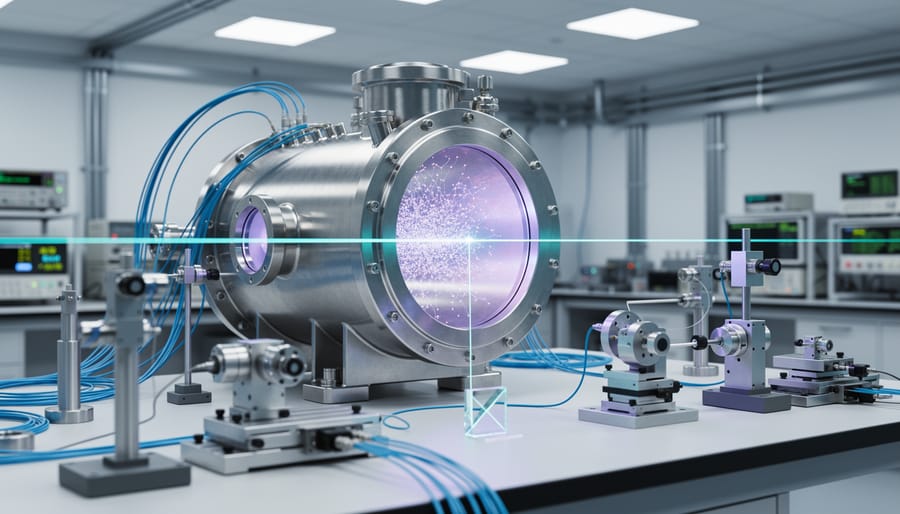
Trapped-ion quantum computing harnesses individually controlled charged atoms suspended in electromagnetic fields to perform quantum calculations, representing one of the most promising platforms for building fault-tolerant quantum computers. Unlike other approaches to what is quantum computing trapped ions offer exceptional qubit stability and remarkably low error rates, with systems now achieving operational fidelities above 99.9%.
The technology reached a commercial milestone in 2026 when Quantinuum launched Helios, a 98-qubit trapped-ion quantum computer now available through cloud services and on-premise installations. During its two-month early access program, major institutions including SoftBank Corp. and JPMorgan Chase conducted commercially relevant research on the system, demonstrating real-world applications in finance, optimization, and materials science. The momentum continued when Quantinuum announced on May 21, 2026, a letter of intent with the U.S. Department of Commerce’s CHIPS Research and Development Office proposing federal funding to develop large-scale, fault-tolerant trapped-ion quantum computers.
The approach works by using precisely tuned laser beams to manipulate ytterbium or strontium ions held motionless in a vacuum chamber. These ions serve as qubits, with quantum information encoded in their electronic states. Because the ions are physically identical and isolated from environmental noise, they maintain quantum coherence far longer than solid-state alternatives. This stability allows researchers to perform complex quantum algorithms with minimal error correction overhead, bringing practical quantum advantage closer to reality across industries from drug discovery to cryptography.
What Is Trapped-Ion Quantum Computing?
Trapped-ion quantum computing harnesses individual electrically charged atoms, ions, suspended in a vacuum by precisely tuned electromagnetic fields. These ions serve as quantum bits, or qubits, with their quantum states manipulated through finely focused laser pulses to execute calculations that would overwhelm classical computers. The approach relies on isolating ions so completely that they remain stable enough to hold delicate quantum information for extended periods, then orchestrating their interactions with lasers to perform logical operations.
The core mechanism begins with stripping a neutral atom of one or more electrons to create an ion, then trapping it using radio-frequency electromagnetic fields in a configuration known as a Paul trap. Engineers arrange these traps to hold chains of ions, sometimes dozens in a row, each separated by just micrometers yet addressable individually by laser beams. To minimize thermal noise that would scramble quantum states, researchers cool the ions to near absolute zero using precisely tuned laser light, a process that essentially freezes their motion. Once stabilized, different laser frequencies encode quantum information into the ion’s internal energy levels and entangle multiple ions by coupling their vibrational modes, enabling the multi-qubit operations essential for complex computations.
This contrasts sharply with superconducting qubit platforms, which embed quantum circuits on chips cooled to millikelvin temperatures inside bulky dilution refrigerators and typically suffer shorter coherence times due to material defects and electromagnetic interference. Photonic quantum computers encode information in light particles, offering speed advantages but facing challenges in creating stable two-qubit gates and scalable architectures. Trapped ions stand out for their intrinsic uniformity, every ytterbium ion, for instance, is identical to every other, and their operational stability, which translates directly into fewer errors during computation. While scaling trapped-ion systems to thousands of qubits demands engineering breakthroughs in trap design and laser control, the platform’s high gate fidelity positions it as a leading contender for fault-tolerant quantum computing, the threshold where error correction becomes practical and quantum advantage within reach.
How Trapped-Ion Systems Work
Qubit Encoding and Manipulation
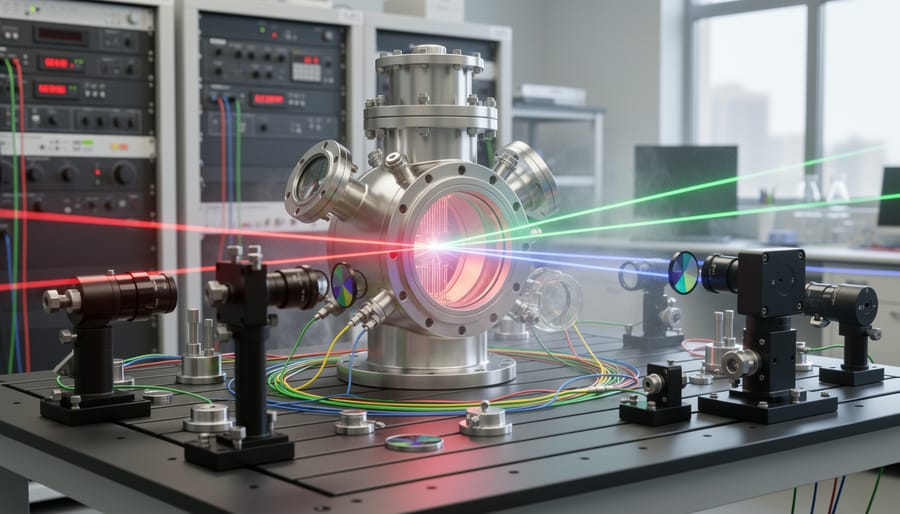
Quantum information in trapped-ion systems lives in the internal electronic energy levels of each ion. Typically, two stable states, often different hyperfine or Zeeman sublevels within the ion’s electronic structure, serve as |0⟩ and |1⟩, forming a qubit. Researchers manipulate these states using finely tuned laser pulses that drive transitions between energy levels with extreme precision.
Single-qubit gates rotate one ion’s quantum state by adjusting laser frequency, intensity, and duration. A π-pulse, for instance, flips |0⟩ to |1⟩ or vice versa, while shorter pulses create superposition states. Two-qubit gates, the backbone of quantum computation, entangle pairs of ions through their shared motion. When lasers couple an ion’s internal state to the collective vibrational mode of the ion chain, they enable controlled interactions between qubits separated by microns. The Coulomb repulsion linking trapped ions mediates this entanglement, allowing high-fidelity single- and two-qubit gates that form universal quantum circuits.
Gate fidelities above 99.5% are routine in modern trapped-ion systems, a direct result of long coherence times and the ability to individually address ions with laser beams. This precision underpins the pathway to fault tolerance.
Error Correction and Fidelity
Quantum errors pose the fundamental challenge to practical quantum computing. Unlike classical bits that are either 0 or 1, qubits exist in fragile superposition states that degrade through decoherence and operational imperfections. Every gate operation, measurement, and environmental interaction introduces potential errors that accumulate rapidly, corrupting calculations before they complete.
Trapped-ion systems excel precisely where this challenge is most critical: gate fidelity. Leading trapped-ion platforms routinely achieve single-qubit gate fidelities exceeding 99.9% and two-qubit gate fidelities above 99.5%. These numbers aren’t marginal improvements over competing technologies; they represent the difference between quantum computers that merely demonstrate principles and those capable of useful work. The physics behind this advantage is straightforward: ions are identical atomic systems isolated in vacuum, manipulated by precisely controlled lasers rather than fabricated circuit elements with inherent variability.
High fidelity translates directly to fault tolerance feasibility. Quantum error correction requires redundancy, encoding one logical qubit across multiple physical qubits and continuously checking for errors without collapsing the quantum state. This overhead only works when physical error rates fall below specific thresholds, typically around 99% fidelity. Trapped-ion systems already operate comfortably above these thresholds, which is why Quantinuum’s proposed federal funding focuses on scaling fault-tolerant architectures rather than improving basic gate quality.
Quantinuum’s Helios: A Commercial Milestone
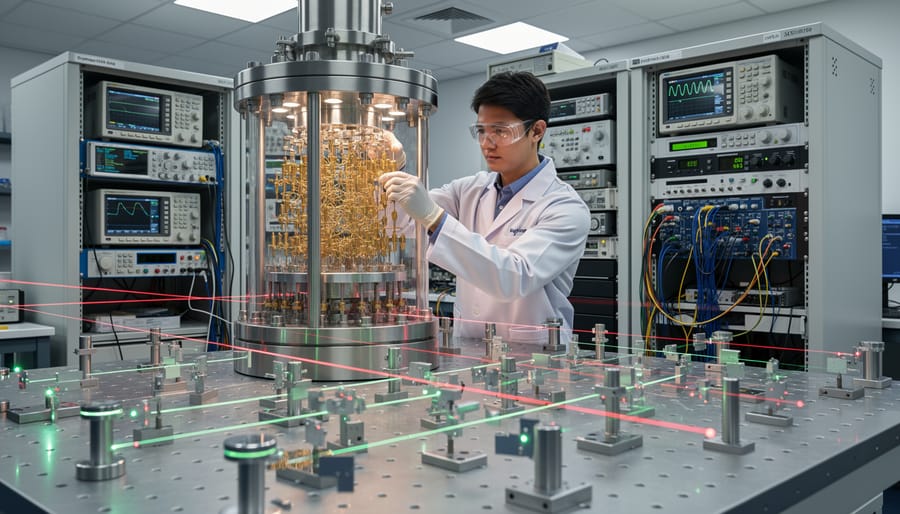
Quantinuum’s Helios represents a pivotal moment in the evolution from experimental quantum systems to machines doing real commercial work. This commercially available Helios system delivers 98 qubits of trapped-ion processing power, packaged in a form that organizations can access either through cloud services or deploy on their own premises. That dual delivery model marks a significant departure from the purely lab-based or single-access-point quantum computers that dominated the field just a few years ago.
Before its general release, Helios underwent a rigorous two-month early access program with hand-picked partners tackling genuine business challenges. SoftBank Corp. and JPMorgan Chase both participated, running commercially relevant research that went beyond academic proof-of-concept experiments. SoftBank explored optimization scenarios tied to telecommunications infrastructure, while JPMorgan Chase investigated financial modeling applications where quantum advantages could translate directly to competitive edge. The program validated not just the hardware’s technical capabilities but also the workflows, integration paths, and support infrastructure needed for enterprise deployment.
The system’s 98-qubit configuration sits at an interesting inflection point. It’s large enough to demonstrate quantum advantage on specific problem classes and to begin implementing basic error correction schemes, yet small enough to remain manageable in terms of calibration overhead and operational complexity. Quantinuum’s trapped-ion architecture provides the high gate fidelities that make those qubits genuinely useful rather than just numerous. Each additional qubit in a trapped-ion system carries less noise penalty than in many competing technologies, which is why the company can credibly position Helios as a stepping stone toward fault tolerance rather than merely a larger version of existing hardware.
The broader trajectory became clearer on May 21, 2026, when Quantinuum announced a letter of intent with the U.S. Department of Commerce’s CHIPS Research and Development Office. The proposal seeks federal funding to accelerate development of large-scale, fault-tolerant trapped-ion quantum computers. This initiative signals that trapped-ion technology has matured enough to warrant national-level investment in scaling it to the hundreds of thousands or millions of qubits required for transformative applications. Helios serves as the foundation, proving that the architecture can move from lab curiosity to commercial product while maintaining the fidelity and coherence needed for the next leap forward.
Real-World Applications and Industry Adoption
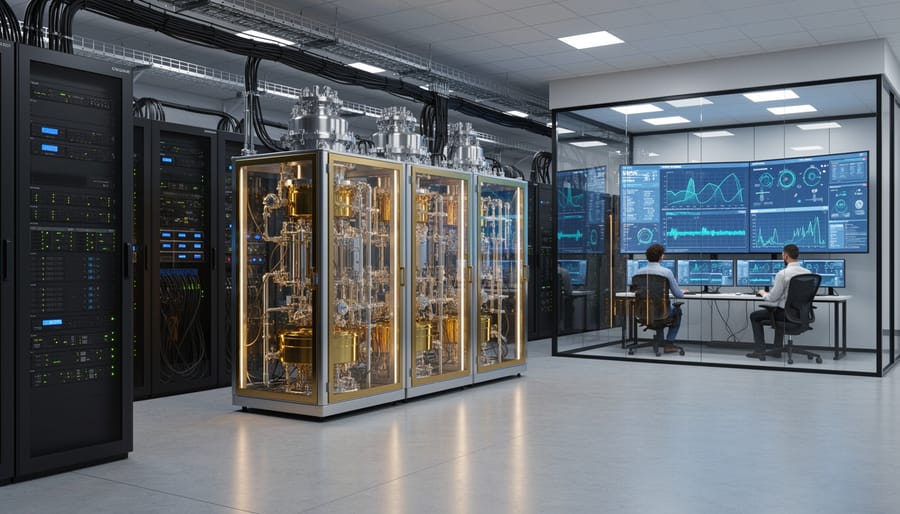
Trapped-ion quantum computers like Helios are moving beyond benchmarking exercises and into commercially relevant work across multiple industries. During Helios’s two-month early access program, partners including SoftBank Corp. and JPMorgan Chase tested the system on real business problems, demonstrating that these machines can tackle practical challenges today rather than in some distant future.
In quantum chemistry and materials science, trapped-ion systems excel at simulating molecular interactions that overwhelm classical computers. Researchers use them to model catalyst behavior for industrial chemical processes, predict protein folding pathways for drug discovery, and design novel materials with specific electronic or magnetic properties. The high gate fidelity of trapped ions, often exceeding 99.5%, makes them particularly suited to these simulations, where even small errors compound quickly and render results meaningless.
Financial institutions are exploring quantum computing for portfolio optimization, risk analysis, and derivative pricing. JPMorgan Chase’s participation in the Helios early access program signals serious interest in using quantum systems to model complex market scenarios and improve capital allocation decisions. These applications demand both computational precision and the ability to handle large state spaces, strengths that align well with trapped-ion architectures.
Logistics and supply chain optimization represent another active area. Quantum computers can evaluate millions of route combinations simultaneously, finding optimal solutions for delivery networks, warehouse placement, and resource allocation. Companies are testing these systems on real scheduling problems that have direct bottom-line impacts.
As the global quantum computing landscape expands, trapped-ion systems offer a compelling mix of stability and performance. Their long coherence times allow deeper quantum circuits, and their all-to-all connectivity means any qubit can interact with any other without physical routing overhead. These technical advantages translate into practical benefits: businesses can run more sophisticated algorithms, trust the output with greater confidence, and explore applications that remain out of reach for noisier quantum platforms.
The Path to Fault-Tolerant Quantum Computing
Fault tolerance represents the threshold where quantum computers can correct errors faster than they accumulate, enabling sustained computation on problems beyond classical reach. Without it, quantum systems remain experimental tools rather than practical engines for solving real-world challenges. The journey toward fault tolerance demands not just more qubits, but dramatically lower error rates and sophisticated error correction protocols that can detect and fix mistakes mid-computation without destroying the fragile quantum states.
Quantinuum’s Helios system exemplifies this incremental path. With 98 qubits and gate fidelities exceeding 99.5%, the platform provides a foundation for testing error correction codes at meaningful scale. The company is layering multiple strategies: increasing qubit counts to create redundancy for logical qubits (where several physical qubits encode one error-protected qubit), refining laser control systems to push gate fidelities even higher, and developing hybrid algorithms that offload classical preprocessing to conventional computers while reserving quantum resources for tasks where they deliver quantum advantage.
On May 21, 2026, Quantinuum announced a letter of intent with the U.S. Department of Commerce’s CHIPS Research and Development Office, proposing federal funding for large-scale, fault-tolerant trapped-ion quantum computers. This initiative signals national recognition that fault tolerance isn’t a distant research goal but an engineering milestone within reach. Federal investment accelerates the timeline by funding the expensive infrastructure, ultra-stable lasers, precision optics, cryogenic systems, required to scale from hundreds to thousands of qubits while maintaining the coherence and control that trapped-ion architectures inherently offer. As error correction matures alongside hardware improvements, the industry moves closer to systems that run for hours rather than microseconds, unlocking applications in drug discovery, climate modeling, and cryptography that demand sustained quantum computation.
Common Questions About Trapped-Ion Quantum Computing
How does trapped-ion quantum computing stack up against superconducting qubits and photonic approaches? Trapped-ion systems excel at coherence times and gate fidelities, often exceeding 99.5% accuracy, which makes them particularly attractive for building fault-tolerant quantum computers. While superconducting qubits currently dominate in terms of qubit counts and have captured headlines with systems from IBM and Google, they require dilution refrigerators operating at temperatures near absolute zero and face faster decoherence. Photonic quantum computers promise room-temperature operation and excellent connectivity, but remain earlier in development. Trapped ions occupy a middle ground: they need vacuum chambers and precise laser control, yet their long coherence times and high-fidelity operations position them as strong candidates for the future of quantum computing at commercial scale.
What makes a quantum computer fault-tolerant?
A fault-tolerant quantum computer can perform meaningful computations despite quantum errors by implementing quantum error correction codes that detect and fix mistakes faster than they accumulate. This requires many physical qubits per logical qubit and gate fidelities above critical thresholds, typically around 99% or higher.
When will trapped-ion systems be practical for everyday problems?
Some applications in quantum chemistry and financial modeling are already showing commercial relevance, as demonstrated by the early access research on Quantinuum’s Helios system. However, broad practical advantage for everyday problems likely requires larger, fully fault-tolerant systems with thousands of logical qubits, which researchers expect in the next five to ten years.
How can businesses access trapped-ion quantum computers today?
Quantinuum’s Helios system is now available commercially through cloud services and on-premise installations. Organizations can access 98 trapped-ion qubits for research and development without building their own infrastructure, similar to how early access partners like JPMorgan Chase and SoftBank Corp. conducted their initial work.
Do trapped-ion systems scale more easily than other quantum technologies?
Scaling trapped-ion systems presents unique challenges, particularly in managing laser control for hundreds or thousands of ions simultaneously. However, their superior coherence times and gate fidelities mean fewer physical qubits may be needed per logical qubit compared to other approaches, potentially offsetting the control complexity.
Understanding these practical considerations helps contextualize where trapped-ion quantum computing stands today. The May 2026 letter of intent between Quantinuum and the U.S. Department of Commerce’s CHIPS Research and Development Office proposing federal funding for large-scale, fault-tolerant systems signals confidence that trapped-ion technology can scale beyond current demonstrations. As error rates continue to improve and qubit counts increase, the gap between research experiments and commercially viable quantum advantage continues to narrow.
Trapped-ion quantum computing has moved decisively from laboratory curiosity to commercial reality. Quantinuum’s Helios system exemplifies this shift: a 98-qubit trapped-ion computer now serving customers through cloud access and on-premise installations, delivering the high-fidelity operations and long coherence times that make fault-tolerant quantum computing achievable. The two-month early access program with partners like SoftBank Corp. and JPMorgan Chase demonstrated that these systems can tackle commercially relevant problems today, not in some distant future.
The May 2026 letter of intent between Quantinuum and the U.S. Department of Commerce’s CHIPS Research and Development Office signals federal commitment to scaling this technology further. With proposed funding to develop large-scale, fault-tolerant trapped-ion systems, the infrastructure is aligning to support continued growth. As qubit counts rise, error correction improves, and more industries discover practical applications, trapped-ion platforms are positioned to lead quantum computing’s next phase. The trajectory is clear: from early prototypes to production systems, from academic experiments to solving real-world challenges across chemistry, finance, logistics, and security. The quantum advantage we’ve anticipated is arriving, one precisely controlled ion at a time.