
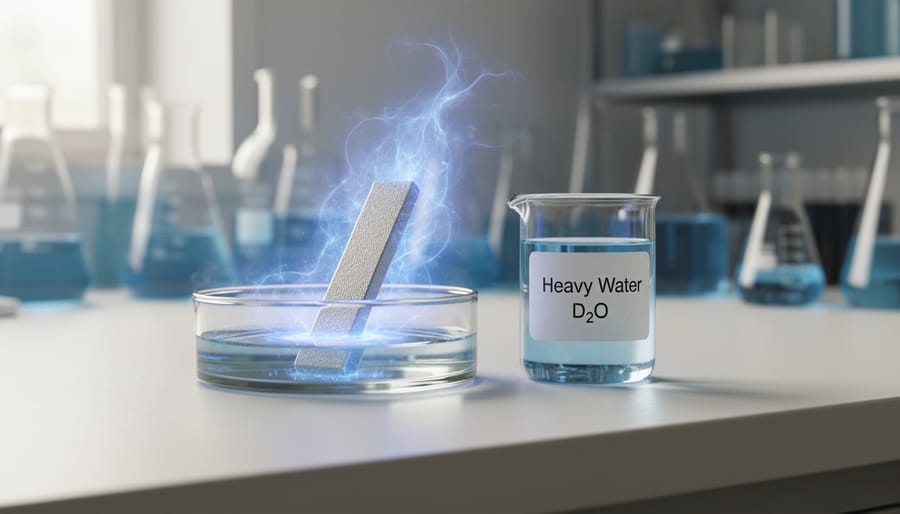
Cold fusion energy refers to a theoretical form of nuclear reaction that would occur at or near room temperature, rather than the millions of degrees required for conventional nuclear fusion. If proven viable, it would represent one of the most transformative energy breakthroughs in human history, offering a clean, virtually limitless power source. Yet more than three decades after its dramatic introduction to the world, the phenomenon remains one of science’s most contentious debates.
On March 23, 1989, electrochemists Martin Fleischmann and Stanley Pons held a press conference at the University of Utah that sent shockwaves …

Is There Any Hope for Climate Change? What Climate Scientists Say in 2026
Climate hope means something specific to scientists: a realistic pathway still exists to limit global warming to levels that avoid the worst outcomes, even as we face accelerating impacts. This isn’t optimism born from wishful thinking. The scientific consensus in 2026 is clear: while we’ve already locked in significant warming and are experiencing more severe heat waves, floods, and ecosystem disruption than previous generations, catastrophic runaway warming is not inevitable if we act with …

What Is Carney’s Climate Finance Framework (and How Could It Reshape Carbon Markets)?
Mark Carney’s climate finance framework represents a systematic approach to integrating climate risk into economic policy and carbon markets, leveraging tools from central banking and financial regulation to accelerate decarbonization. Since becoming Canada’s Prime Minister, Carney has brought his expertise from leading the Bank of England and Bank of Canada to reshape how governments can use financial mechanisms to drive climate action.
The framework matters because it bridges a critical gap between climate science and economic reality. Traditional environmental policy often treated carbon emissions as an externality, …

The Good News About Climate Change Scientists Are Celebrating Right Now
Climate change is delivering genuinely good news in 2026, and the evidence is concrete: solar energy costs have reached historic lows, major ecosystems are showing measurable recovery, and ambitious protection targets are actually being met. These aren’t vague promises or corporate greenwashing. They’re verifiable breakthroughs documented by scientists, tracked in peer-reviewed studies, and visible in real-world data.
For anyone wrestling with climate anxiety, the relentless drumbeat of catastrophic headlines can feel paralyzing. But while the challenges remain urgent, a quieter revolution has been unfolding across …

The Global Quantum Computing Landscape: How Many Machines Are Really Out There?
As of 2023, approximately 50 to 100 quantum computers were operational worldwide, though pinning down an exact number requires understanding what qualifies as a true quantum computer. These machines ranged from experimental prototypes with fewer than 10 qubits to IBM’s 433-qubit Osprey processor and Atom Computing’s 1,180-qubit neutral atom system, representing a dramatic acceleration from just a handful of machines five years earlier.
The question of how many quantum computers existed in 2023 isn’t as straightforward as counting laptops in an office. The quantum computing landscape that year included everything …

Why DEI in Higher Education Creates Better Science (And Smarter Solutions)
When a pharmaceutical company ignored insights from diverse research teams in 2006, they nearly missed a critical discovery: a diabetes medication worked differently across ethnic populations. That oversight could have endangered millions of patients. The near-miss highlights why diversity, equity, and inclusion in higher education isn’t simply about fairness. It’s about producing better science, solving harder problems, and preparing researchers who can see what homogeneous teams miss.
The evidence is compelling. Research institutions with diverse faculty and student bodies consistently produce more innovative solutions…

Why Paid Reddit Comments Could Destroy Your Science News Credibility
Efforts to buy Reddit upvotes, comments, or engagement metrics for science news might seem like a shortcut to visibility, but they fundamentally undermine the credibility that scientific content demands. Reddit’s community-driven platform thrives on authentic discussion, and its users possess remarkable ability to identify artificial engagement. When research institutions or science communicators deploy promotion services that manipulate voting patterns or generate fake discussions, they risk permanent damage to their reputation and potential subreddit bans.
The stakes are particularly …

Why Renewable Energy Researchers Are Turning to Guest Posting (And How It Advances Science)
Leverage guest posts strategically to amplify breakthrough renewable energy research beyond academic journals and into public consciousness. Scientific discoveries in solar efficiency, wind turbine optimization, and battery storage innovations often remain confined to specialized publications, limiting their societal impact and funding opportunities. Guest posting on high-authority science platforms bridges this gap, connecting researchers with policymakers, investors, and engaged citizens who drive adoption.
Target platforms that balance scientific rigor with accessibility, ensuring …

Why Quantum Random Numbers Could Finally Make Online Gambling Truly Fair
Every time you place a bet on Moonbet crash games or spin a digital roulette wheel, you’re trusting that the outcome is truly random, but how can you be certain? Traditional online gambling platforms rely on mathematical algorithms called pseudorandom number generators, which, despite their sophistication, follow deterministic patterns that skilled hackers can potentially predict or manipulate. Russian hackers demonstrated this vulnerability by reverse-engineering slot machine PRNGs to predict outcomes, exploiting the fact that these generators start with a seed and other inputs that …

What Really Happens When You Eat a THC Gummy: The Science Your Body Doesn’t Tell You
Buy delta 9 edibles containing THC follow a dramatically different path through your body than inhaled cannabis, creating a slower onset but longer-lasting experience that puzzles many users and fascinates pharmacologists alike. When you consume a THC gummy, you’re initiating a complex metabolic journey that transforms delta-9-THC into the more potent 11-hydroxy-THC—a conversion that explains why edibles feel fundamentally different from smoking or vaping.
Understanding the pharmacokinetics of THC gummies reveals why effects take 30 …