

Mark Carney’s climate finance framework represents a systematic approach to integrating climate risk into economic policy and carbon markets, leveraging tools from central banking and financial regulation to accelerate decarbonization. Since becoming Canada’s Prime Minister, Carney has brought his expertise from leading the Bank of England and Bank of Canada to reshape how governments can use financial mechanisms to drive climate action.
The framework matters because it bridges a critical gap between climate science and economic reality. Traditional environmental policy often treated carbon emissions as an externality, something outside the core concerns of finance ministries and central banks. Carney’s approach flips this logic: climate change poses fundamental risks to financial stability, and carbon markets need the same rigor applied to them as any other major economic instrument.
This article examines how the framework operates in practice, from its foundational components to its real-world applications in carbon pricing systems. We’ll explore the mechanics that make it work, including the three pillars of industrial carbon pricing that environmental advocates highlighted in a March 2026 letter to Prime Minister Carney: strength, predictability, and enforceability. You’ll also see how this framework connects to Canada’s broader economic strategy, where climate competitiveness has moved from environmental priority to economic centerpiece. The approach offers a blueprint for other nations grappling with how to make carbon markets effective tools rather than symbolic gestures.
What Is Mark Carney’s Climate Finance Framework?

Mark Carney’s climate finance framework is an economic strategy that treats carbon pricing not as a regulatory burden but as a tool for competitive advantage in the global economy. At its core, the framework insists that industrial carbon pricing must be strong enough to drive meaningful emissions reductions, predictable enough to enable long-term business planning, and enforceable in practice to maintain market credibility.
The approach emerged from international coordination efforts, particularly work by the Finance Ministers for Climate Coalition, which released a report in January 2026 aimed at improving macroeconomic analysis and modeling tools for finance ministries worldwide. Rather than viewing climate policy and economic growth as competing priorities, the framework positions climate competitiveness at the centre of economic strategy, the premise being that nations with robust carbon pricing systems will attract investment, drive innovation, and secure advantages in the transition to clean energy.
- Industrial Carbon Pricing
- A mechanism that assigns a cost to carbon emissions from large industrial facilities, creating financial incentives for companies to reduce their greenhouse gas output and invest in cleaner technologies.
- Climate Competitiveness
- The economic advantage gained by countries or companies that move early and decisively on climate action, positioning themselves to lead in low-carbon markets and technologies.
- Carbon Market Integrity
- The reliability and credibility of carbon pricing systems, ensured through transparent rules, consistent enforcement, and pricing signals strong enough to change behavior.
The framework gained renewed attention in Canada when the David Suzuki Foundation and other organizations sent a joint letter to Prime Minister Carney on March 16, 2026, calling for the restoration of strength and integrity to Canada’s industrial carbon pricing system. That letter explicitly referenced the three pillars, strength, predictability, and enforceability, as essential to making carbon markets function as intended rather than as symbolic gestures.
What distinguishes this framework from earlier climate finance approaches is its explicit focus on economic competitiveness rather than compliance alone. By framing strong carbon pricing as a strategic asset, it challenges the traditional narrative that climate action requires economic sacrifice.
How the Framework Works in Practice
In practice, Carney’s climate finance framework operates through a direct mechanism: industrial carbon pricing becomes a binding economic signal that shapes business decisions, investment flows and competitive positioning. When a manufacturing facility or oil refinery faces a price per tonne of carbon emitted, that cost enters every production calculation. The stronger and more predictable the price, the more reliably it channels capital toward lower-emission processes, cleaner fuels and efficiency upgrades. Rather than treating carbon pricing as a peripheral environmental levy, the framework treats it as a core input to economic strategy.
The operational backbone of this approach rests on rigorous macroeconomic analysis. Finance Ministries need modeling tools that can project how carbon pricing interacts with growth, employment, inflation and trade balances. A January 2026 report from the Finance Ministers for Climate Coalition outlines precisely this need: improving the analytical capacity to understand carbon pricing as an economic instrument, not just an environmental one. These models help governments set price trajectories that are ambitious enough to drive decarbonization but calibrated to avoid sudden competitive shocks. The result is a carbon price path that industries can plan around, enabling multi-year capital decisions without constant policy whiplash.
Enforcement mechanisms ensure the system delivers real emissions reductions rather than paper compliance. Robust monitoring tracks actual emissions against reported figures. Penalties for non-compliance must be meaningful enough to deter gaming. Transparent verification processes build market confidence that the carbon price reflects genuine abatement. When enforcement is credible, predictability follows: companies know the rules will be applied consistently, so they invest accordingly. This closed loop between strength, predictability and enforceability is what transforms carbon pricing from a static tax into a dynamic market signal that reshapes industrial behavior at scale.
Core Components of the Climate Finance Approach

Strength in Carbon Pricing
A strong carbon pricing system sets a sufficiently high price on emissions to genuinely alter industrial behaviour rather than function as a token gesture. The price must be ambitious enough to make continued high emissions costlier than investing in cleaner alternatives, creating a real economic incentive for decarbonisation. Without meaningful strength, carbon pricing becomes merely accounting theatre, companies pay modest fees while continuing business as usual, and emissions reduction stalls.
Strength also means the pricing mechanism applies broadly across industrial emitters rather than exempting major polluters or creating loopholes that undermine the signal. When the March 2026 letter to Prime Minister Carney called for restoring strength to Canada’s system, it reflected concern that weakened pricing had lost its power to drive the emissions cuts needed to meet climate targets while maintaining competitive advantage for early movers.
Predictability for Market Actors
Predictable policy frameworks give businesses and investors the confidence to commit capital over decades, not quarters. When companies know carbon pricing rules will remain stable, with clear floor prices, consistent adjustment mechanisms, and transparent timelines, they can justify spending billions on emission-reduction infrastructure that may not break even for fifteen years. This certainty transforms carbon pricing from a compliance burden into a planning parameter. Clean technology developers can forecast returns, manufacturers can retool production lines, and financial institutions can underwrite green bonds with realistic risk models. Without predictability, even strong carbon prices fail to shift behavior because rational actors wait to see if rules will change, soften, or disappear entirely. The framework’s emphasis on predictability recognizes that capital allocation decisions hinge not just on today’s price signal but on confidence that tomorrow’s signal will honor the same commitments.
Enforceability in Practice
Enforceability transforms carbon pricing from voluntary guidance into binding market infrastructure. Without effective compliance mechanisms, even strong and predictable frameworks fail, creating opportunities for gaming the system and undermining legitimate participants who invest in emissions reduction.
Modern enforcement relies on three interconnected elements. First, transparent emissions monitoring through verified reporting systems and third-party audits ensures that industrial emitters can’t underreport their carbon footprint. Second, graduated penalties, rising financial consequences for non-compliance, make cheating more expensive than investing in clean technology. Third, legal recourse through administrative and judicial channels provides clear pathways to challenge violations and defend market integrity.
The March 2026 letter to Prime Minister Carney emphasizes that enforceability must work “in practice,” not just on paper. This distinction matters because regulatory frameworks often contain loopholes or face resource constraints that prevent consistent application. Effective enforcement requires adequate funding for regulatory agencies, technical capacity to investigate complex industrial emissions, and political will to apply penalties fairly across all market participants regardless of sector influence.
How Climate Competitiveness Reshapes Carbon Markets
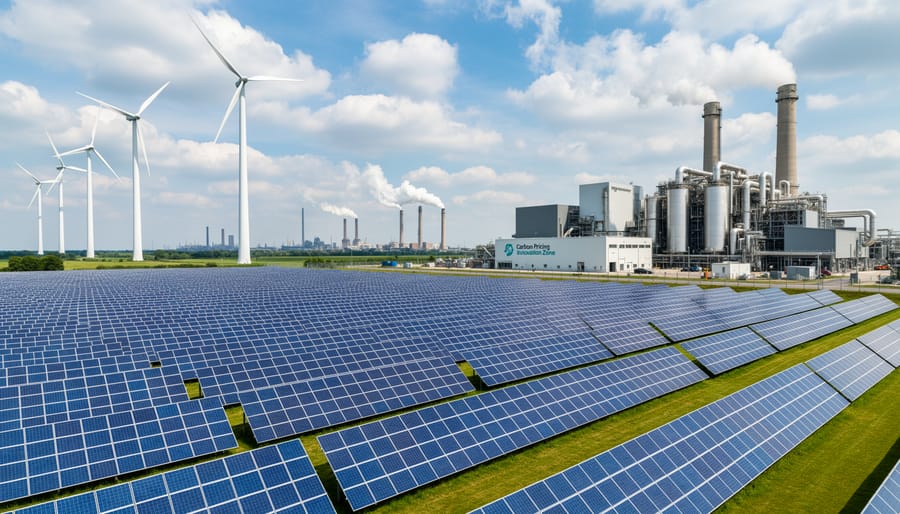
When climate action becomes a competitive advantage rather than a regulatory burden, carbon markets transform. Carney’s framework reframes carbon pricing as a driver of industrial innovation and economic positioning, creating a fundamentally different playing field for how nations and industries engage with emissions reduction.
Under this approach, carbon credit trading shifts from a compliance exercise to a strategic tool. Industries that invest in low-carbon energy infrastructure or deploy carbon capture technologies gain tradable advantages in markets where predictable pricing creates long-term value. Companies can plan capital investments knowing that carbon price signals will remain stable, making clean technology deployment a rational business decision rather than speculative bet.
The competitiveness lens also reshapes international carbon border adjustments. When strong domestic carbon pricing becomes an economic asset, border measures evolve from protective tariffs to mechanisms that level the playing field between jurisdictions with robust climate frameworks and those without. This creates pressure for harmonization, as nations recognize that climate competitiveness attracts investment in emerging sectors like hydrogen production, advanced manufacturing, and clean materials.
Industrial emissions standards tighten naturally under this model. As the March 2026 letter emphasizes, enforceable industrial carbon pricing creates market integrity that rewards genuine emissions reductions while penalizing free-riders. The framework transforms carbon markets from fragmented, voluntary systems into integrated economic infrastructure where price discovery reflects actual climate risk and opportunity.
This shift matters for global carbon market development. When major economies treat climate action as competitive positioning, carbon pricing mechanisms gain legitimacy and staying power. The framework demonstrates that robust climate policy can coexist with industrial growth, fundamentally altering how policymakers approach the trade-offs between environmental protection and economic development.
The Push to Restore Canada’s Carbon Pricing System
On March 16, 2026, the David Suzuki Foundation and coalition partners sent a letter to Prime Minister Mark Carney calling for urgent action to restore Canada’s industrial carbon pricing system. The letter emphasizes that carbon pricing must be strong, predictable, and enforceable in practice, the three pillars that underpin effective market-based climate policy. This intervention comes at a moment when the federal government has positioned climate competitiveness at the centre of Canada’s economic strategy, yet concerns persist about whether the existing carbon pricing framework delivers the market signals needed to drive deep emissions cuts.
The call to restore integrity reflects a broader recognition that weakened or inconsistent carbon pricing undermines investor confidence and allows high-emitting industries to avoid transition costs. What prompted this intervention was a gap between Canada’s stated climate ambitions and the practical operation of its carbon markets, where unpredictable exemptions and enforcement shortfalls have eroded the system’s credibility. The coalition’s recommendations tie directly to the January 30, 2026 report from the Finance Ministers for Climate Coalition, which forms part of an international effort to improve macroeconomic analysis and modeling tools for Finance Ministries worldwide.
By linking domestic carbon pricing reform to global frameworks, the letter positions Canada’s response as a test case for whether advanced economies can treat climate action as an economic opportunity rather than a regulatory burden. The emphasis on enforceability signals that voluntary commitments and weak compliance mechanisms will no longer suffice in a world where carbon-intensive exports face border adjustments and competitive disadvantages.
Frequently Asked Questions
Why does Canada need stronger industrial carbon pricing?
Strong, predictable, and enforceable carbon pricing creates the market certainty that drives long-term investment in clean technologies and emissions reduction. Without these three elements working together, the pricing system lacks the integrity needed to shift industrial behaviour and position Canada competitively in the emerging low-carbon economy.
How does carbon pricing support climate competitiveness?
When carbon pricing is strong and predictable, it signals to businesses that clean technology investments will pay off, encouraging innovation and efficiency gains that reduce both emissions and operating costs. The federal government has positioned climate competitiveness at the centre of Canada’s economic strategy because countries with robust carbon pricing systems attract investment in next-generation industries rather than losing it to jurisdictions without clear climate rules.
What does this framework mean for carbon market development?
A framework built on strength, predictability, and enforceability creates the foundation for mature carbon markets where credits have real value and trading reflects genuine emissions reductions. This approach could reshape international carbon trading by establishing higher standards for market integrity, influencing how carbon border adjustments work, and ensuring that mitigation and adaptation financing flows toward verified climate action rather than weak offsets.
These questions reflect the practical concerns that policymakers, business leaders, and researchers face when evaluating carbon pricing systems. The March 16, 2026 letter to Prime Minister Carney from the David Suzuki Foundation and other organizations specifically called for restoring the strength and integrity of Canada’s industrial carbon pricing system, highlighting gaps in the current approach. That call aligns with broader international efforts, including the January 2026 report from the Finance Ministers for Climate Coalition, which aimed to improve macroeconomic analysis and modeling tools for Finance Ministries dealing with climate policy.
Mark Carney’s climate finance framework signals a fundamental shift in how governments approach carbon pricing. Rather than viewing emissions regulations as an economic burden, this strategy positions strong industrial carbon pricing as a source of competitive advantage, one that can attract investment, drive innovation, and accelerate the transition to clean technologies. The three-pillar approach of strength, predictability, and enforceability provides a blueprint that other nations can study as they refine their own climate policies.
The real-world implications extend far beyond Canada’s borders. If implemented effectively, this framework could stabilize global carbon markets by demonstrating how rigorous pricing mechanisms create market certainty rather than chaos. Industries operating under clear, enforceable carbon costs can plan long-term investments with confidence, while financial institutions gain the signals they need to channel capital toward low-carbon solutions.
The March 2026 call to restore Canada’s industrial carbon pricing system reflects growing recognition among climate advocates and finance ministers internationally that half-measures no longer suffice. As climate finance evolves into a central pillar of economic strategy, frameworks like Carney’s will likely shape both academic research in Climate Change Studies and practical policy development worldwide, proving that climate action and economic prosperity can advance together.