
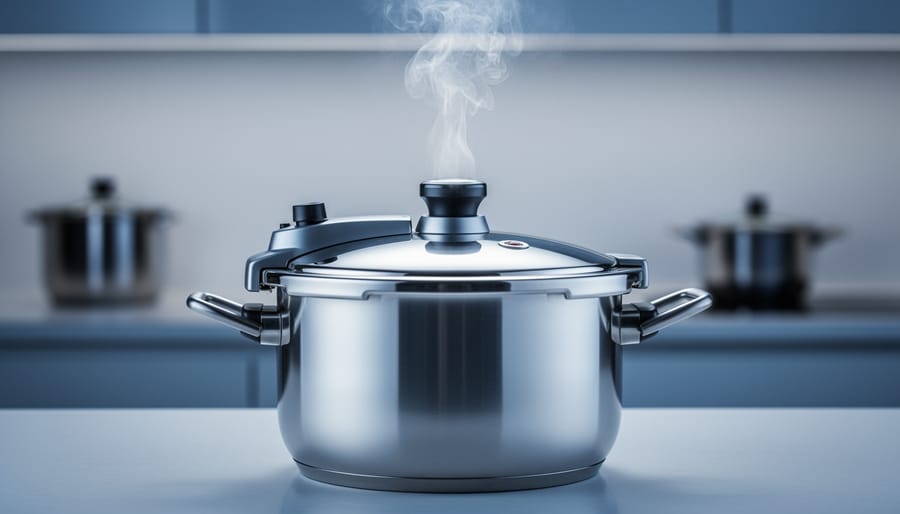
Pressure cooking science explains how sealed vessels use elevated pressure to raise water’s boiling point above 100°C (212°F), dramatically accelerating chemical reactions and physical changes that transform food. When pressure inside a sealed pot reaches approximately 15 psi above atmospheric pressure, water boils at roughly 121°C (250°F), cutting cooking times by up to 70 percent while preserving nutrients that escape through prolonged conventional cooking.
The physics behind this kitchen workhorse traces back to basic thermodynamics. At sea level, atmospheric pressure keeps water’s boiling point fixed at 100°C. Trap steam inside a sealed environment, however, and pressure climbs. Higher pressure forces water molecules to absorb more energy before they can escape as vapor. The result? Superheated liquid water that transfers heat faster and penetrates food more efficiently than boiling or steaming at normal pressure.
This seemingly simple principle unlocks a cascade of chemical transformations. Proteins denature more rapidly. Starches gelatinize in minutes rather than hours. Tough collagen in meat breaks down into gelatin at speeds impossible in a conventional pot. The Maillard reaction, responsible for browning and flavor development, proceeds differently under pressure, while volatile flavor compounds remain trapped in the sealed environment instead of evaporating into your kitchen.
Understanding these mechanisms reveals why pressure cookers have become essential tools in both home kitchens and research laboratories. From tenderizing beans to sterilizing medical instruments, the applications extend far beyond dinner preparation. The science connecting pressure, temperature, and molecular behavior offers insights into fundamental physical chemistry while solving practical problems that have challenged cooks for centuries.
What Pressure Cooking Means: The Physics of Sealed Heat
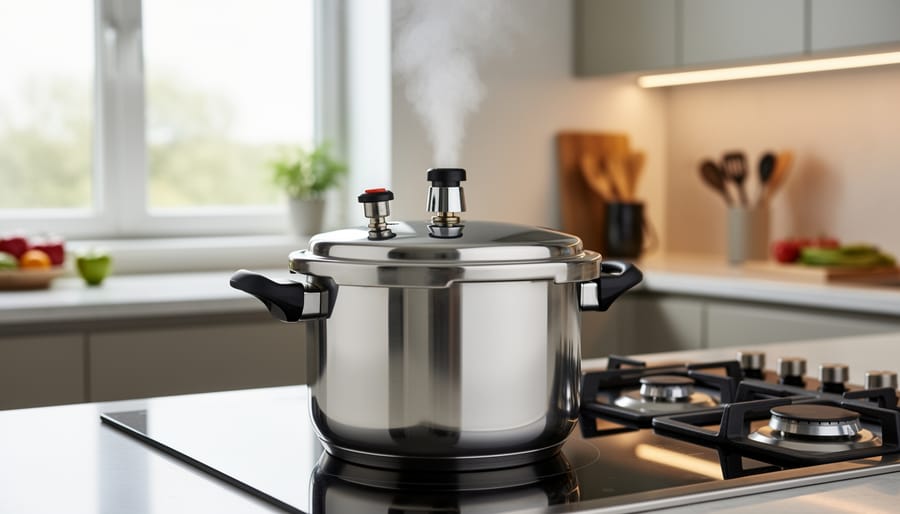
Pressure cooking is a method that traps steam inside a sealed vessel, causing pressure to build until it exceeds normal atmospheric conditions. This elevated pressure forces the boiling point of water higher than its standard 100°C (212°F), which lets food cook at temperatures that would be impossible in an open pot. The science hinges on a straightforward relationship: when you increase pressure on a liquid, you also increase the temperature at which it boils and turns to vapor.
In a conventional pot, water boils at 100°C at sea level because that’s where water molecules have enough energy to escape into the air as steam. Once boiling starts, adding more heat doesn’t raise the temperature further, it just makes water evaporate faster. A pressure cooker changes this dynamic by locking steam inside, preventing it from escaping. As more water turns to steam in the confined space, pressure climbs, and the boiling point shifts upward. Most pressure cookers operate at about 15 psi (pounds per square inch) above atmospheric pressure, which pushes the boiling point to roughly 121°C (250°F).
- Pressure
- The force exerted by steam molecules confined in a sealed space, measured relative to atmospheric pressure. Higher pressure means molecules collide more frequently with surfaces and each other.
- Boiling Point Elevation
- The increase in water’s boiling temperature that occurs when pressure rises above atmospheric levels. This elevation allows cooking at higher temperatures without evaporating all the water.
- Atmospheric Pressure
- The baseline pressure exerted by Earth’s atmosphere at a given altitude, typically 14.7 psi at sea level. Pressure cookers add pressure on top of this baseline.
- Steam Saturation
- A condition where steam contains the maximum amount of water vapor at a given temperature and pressure. Saturated steam transfers heat more efficiently than dry air or open boiling water.
- Sealed Environment
- A cooking chamber with airtight seals that prevents steam from escaping, allowing pressure and temperature to build beyond normal atmospheric conditions.
This combination of sealed heat and elevated pressure creates an environment where chemical reactions speed up, tough fibers break down faster, and cooking times shrink dramatically compared to traditional methods.
The Science Behind How Pressure Cookers Work
Pressure and Boiling Point: The Core Relationship
At sea level, water boils at 100°C (212°F) because that’s the temperature where its vapor pressure equals atmospheric pressure, about 101.3 kilopascals or 14.7 pounds per square inch. When you seal a pot and trap the steam inside, however, pressure builds beyond atmospheric levels. This elevated pressure forces water molecules to remain liquid at temperatures well above the normal boiling point, a fundamental shift governed by the Clausius-Clapeyron relation in thermodynamics.
In a typical pressure cooker operating at 15 psi above atmospheric pressure, water doesn’t boil until it reaches roughly 121°C (250°F). That 21-degree Celsius jump translates directly to faster cooking because chemical reactions, including the breakdown of collagen in meat, the gelatinization of starches, and the softening of plant cell walls, proceed exponentially faster at higher cooking temperatures. A pot roast that needs three hours of conventional braising might finish in 45 minutes under pressure, not because the heat is more intense in a subjective sense, but because the liquid surrounding the food maintains a temperature physically impossible in an open vessel at normal atmospheric conditions.
This pressure-temperature relationship also explains why altitude matters: at higher elevations, atmospheric pressure drops, lowering water’s boiling point and extending cooking times. A pressure cooker compensates by restoring the temperature advantage, making it an essential tool in mountain kitchens where conventional methods falter.
Steam Saturation and Heat Transfer
When water boils in an open pot, steam escapes and carries away heat energy. In a pressure cooker, that steam has nowhere to go. It accumulates, becomes saturated with thermal energy, and creates an environment where heat transfer reaches remarkable levels of effectiveness.
Saturated steam, steam at its maximum water vapor content for a given pressure, is a superior heat transfer medium compared to dry air or even boiling water at standard pressure. At 15 psi above atmospheric pressure, saturated steam reaches approximately 121°C (250°F) and contains significantly more energy per unit volume than air at the same temperature. This dense concentration of thermal energy means that when steam contacts food surfaces, it condenses and releases latent heat, the energy stored during the phase change from liquid to gas. This condensation releases roughly 2,260 joules per gram of steam, flooding food with intense, uniform heat.
The pressurized environment also eliminates air pockets that would otherwise insulate food and slow cooking. Steam molecules, being smaller and more energetic than air molecules under pressure, penetrate food tissues more effectively. This explains why tough cuts of meat break down in 30 minutes rather than three hours, and why dried beans soften without overnight soaking.
From an energy perspective, pressure cooking demonstrates impressive thermal efficiency. Because the sealed system prevents heat loss through steam evaporation, less energy is needed to maintain cooking temperatures. Studies show pressure cookers can use 50-75% less energy than conventional cooking methods for equivalent results, making them one of the most thermodynamically efficient kitchen technologies available.
Safety Mechanisms: Engineering Meets Physics
Modern pressure cookers incorporate multiple safety systems rooted in fundamental physics principles. The primary valve regulates pressure through a spring-loaded mechanism: as steam pressure increases, it pushes against the valve spring until reaching a calibrated threshold (typically 15 psi or 103 kPa above atmospheric pressure). At this point, the valve opens just enough to release excess steam, maintaining equilibrium through negative feedback, a basic control system principle.
Secondary safety features include a gasket release design where excessive pressure forces the rubber seal to deform and vent steam before the vessel fails. This exploits material deformation properties under stress. Many cookers also feature a fusible plug, a low-melting-point metal alloy that liquefies around 150°C, creating a deliberate weak point that releases pressure if all other systems fail.
Locking mechanisms prevent opening under pressure by using the internal pressure itself to hold the lid in place. A simple interlock tab, pushed outward by steam pressure, physically blocks the lid’s rotation until pressure drops near atmospheric levels. These redundant systems demonstrate how engineers apply Pascal’s principle, material science, and mechanical advantage to transform a potentially hazardous pressure vessel into a reliable kitchen appliance.
Types of Pressure Cooking Systems and Their Scientific Differences
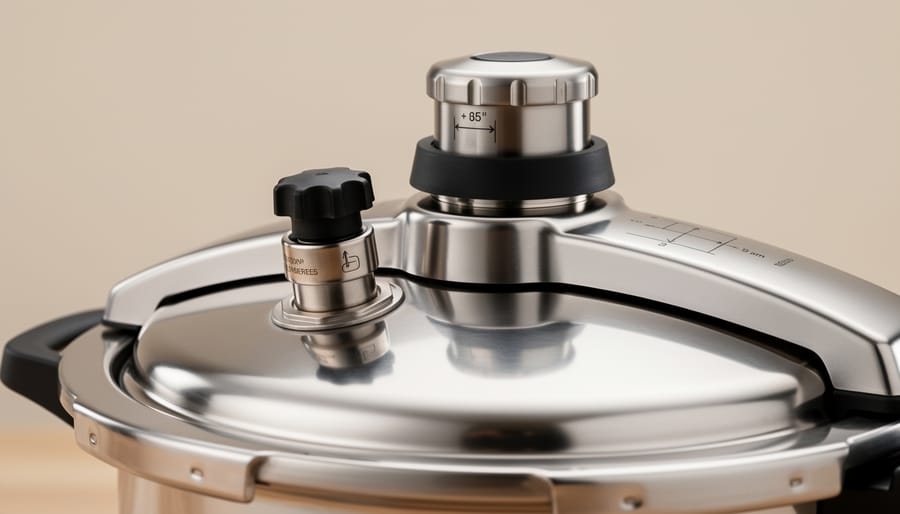
Pressure cookers fall into two primary categories based on their engineering and control mechanisms: stovetop models and electric models. Each type achieves and maintains pressure through distinct physical principles, offering different advantages from a scientific perspective.
Stovetop pressure cookers operate on direct heat transfer from a burner to the vessel. These systems rely on simple thermodynamic feedback: as liquid inside heats, steam generation increases pressure until it reaches a set point (typically 15 psi or about 1 bar above atmospheric pressure). A spring-loaded valve or weighted regulator then releases excess steam to maintain equilibrium. The cook controls pressure indirectly by adjusting the external heat source. This design offers no inherent temperature regulation, the burner doesn’t “know” the internal pressure, so the system depends on mechanical pressure relief alone. Stovetop models typically reach higher maximum pressures and respond quickly to heat adjustments, making them efficient for experienced users who understand the physics at play.
Electric pressure cookers, by contrast, integrate heating elements with electronic sensors and smart control systems that monitor both temperature and pressure. Built-in thermocouples measure internal conditions in real time, and microprocessors adjust heating power to maintain target pressure with precision. This closed-loop feedback system represents a fundamental engineering difference: rather than passively venting excess pressure, electric models actively modulate energy input to prevent over-pressurization. The result is more consistent pressure maintenance and safer operation for beginners, though at the cost of slightly longer preheating times due to lower wattage heating elements compared to stovetop burners.
A third, less common category includes specialized systems like pressure canners (designed for higher pressures around 15 psi for food safety) and autoclave-style cookers used in research settings. These apply the same core physics but engineer the vessels and safety mechanisms for specific temperature-pressure profiles required by their applications. Understanding these design differences helps users choose equipment suited to their needs while appreciating how various engineering approaches solve the same thermodynamic challenge.
How Pressure Cooking Affects Food at the Molecular Level
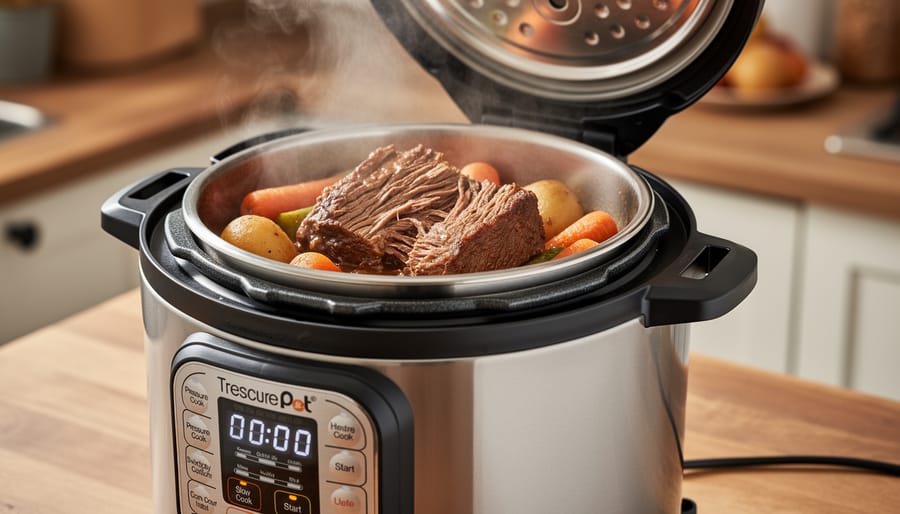
When you seal food in a pressure cooker and bring it up to temperature, you’re not just cooking faster, you’re triggering a cascade of chemical and biological transformations that differ from conventional cooking methods. The combination of elevated temperature (typically 115-121°C at standard pressure settings) and saturated steam environment creates conditions that accelerate or alter molecular processes in proteins, carbohydrates, and plant tissues.
Proteins respond dramatically to pressure cooking conditions. The higher heat causes rapid denaturation, where tightly coiled protein molecules unfold and restructure. In tough cuts of meat, this process is particularly valuable: collagen, the connective tissue that makes certain cuts chewy, breaks down into gelatin much faster under pressure than through traditional braising. What might take three hours at conventional temperatures happens in 45 minutes under pressure, as the elevated heat accelerates hydrolysis, the chemical reaction where water molecules break collagen’s molecular bonds.
Carbohydrates undergo similar transformations. Starch granules in grains, potatoes, and legumes absorb water and swell (a process called gelatinization), but the higher temperature and pressure push this process forward more quickly and completely. The cell walls in beans and lentils break down faster under pressure, which explains why dried legumes that normally require hours of soaking and cooking become tender in 20-30 minutes.
At the molecular level, several key changes occur simultaneously:
- Collagen converts to gelatin at accelerated rates, creating tender, succulent textures in previously tough meat
- Maillard reactions (browning chemistry) proceed differently due to moisture presence, producing distinct flavor compounds compared to dry-heat methods
- Plant cell walls degrade rapidly through pectin breakdown, softening vegetables and legumes efficiently
- Heat-sensitive vitamins (particularly B vitamins and vitamin C) show better retention due to shorter cooking times, despite higher temperatures
- Enzymes that cause browning and nutrient degradation deactivate quickly, preserving color and nutritional content
The pressurized steam environment also affects flavor development. Volatile aromatic compounds that would normally evaporate during conventional cooking remain trapped in the sealed vessel, concentrating flavors in the cooking liquid. However, the wet environment and lack of air circulation prevent surface browning and crisping, which is why foods removed from a pressure cooker have a different flavor profile than roasted or grilled items, they’re intensely flavored but lack caramelized notes.
The absence of oxygen during pressure cooking also matters chemically. Oxidation reactions that typically occur during conventional cooking are minimized, which helps preserve antioxidants in vegetables and prevents certain types of nutrient degradation. This partially explains research findings that pressure cooking can retain more nutrients than boiling or steaming at atmospheric pressure, despite the higher temperatures involved.
Real-World Applications and Scientific Benefits
Understanding the science behind pressure cooking reveals why this method has become indispensable across so many contexts. In home kitchens, the physics principles translate to 70% faster cooking times compared to conventional methods, a difference explained by the elevated temperatures that accelerate chemical reactions and physical breakdown of food structures. Tough cuts of meat that normally require hours of braising become tender in 30-45 minutes because the high-pressure environment speeds protein denaturation and collagen conversion to gelatin.
The energy conservation benefits stem directly from thermodynamics. Because pressure cookers trap steam and maintain higher temperatures in a sealed system, they consume 50-70% less energy than traditional cooking methods. This efficiency matters for both household low-carbon energy goals and commercial operations. The sealed environment also preserves water-soluble vitamins better than boiling, where nutrients leach into discarded cooking liquid. Studies show pressure cooking retains 90-95% of vitamin C in vegetables, compared to 40-75% with conventional boiling, a result of shorter cooking times and minimal water contact.
High-altitude cooking presents a particularly interesting application of pressure cooking science. At elevations above 2,000 meters, water boils at temperatures too low for effective cooking. A pressure cooker solves this problem by artificially raising the boiling point through increased pressure, essentially recreating sea-level cooking conditions regardless of altitude. The principles of water heating science apply here: maintaining liquid water at higher temperatures enables proper starch gelatinization and protein cooking that would otherwise be impossible.
Commercial food processing leverages these same physics principles for sterilization and canning. Industrial autoclaves use pressure-temperature relationships to eliminate bacterial spores at 121°C, achieving sterility impossible at normal atmospheric pressure. This application of pressure cooking science ensures food safety in preserved goods worldwide.
Common Questions About Pressure Cooking Science
The physics and chemistry of pressure cooking raise questions that reveal common misconceptions about how this cooking method actually works. Understanding the scientific answers helps cooks use their pressure cookers more effectively while appreciating the elegant principles at play.
Why does food cook faster in a pressure cooker?
The elevated pressure raises water’s boiling point to approximately 121°C (250°F) instead of the normal 100°C (212°F), and this higher temperature accelerates the chemical reactions that break down food structures. The 20-degree increase translates to cooking times that are roughly one-third of conventional methods.
Can pressure cooking destroy nutrients?
Pressure cooking actually preserves more nutrients than many conventional methods because the shorter cooking time and sealed environment reduce exposure to heat and oxygen. Water-soluble vitamins like vitamin C and B-complex remain more intact compared to prolonged boiling or roasting.
What happens if the pressure gets too high?
Modern pressure cookers incorporate multiple safety mechanisms: a primary pressure regulator that vents excess steam automatically, a backup pressure release valve, and a gasket release system that allows the lid seal to give way before dangerous pressure builds. These engineered failsafes prevent catastrophic failure through redundant pressure relief pathways.
How does altitude affect pressure cooking?
At higher altitudes, lower atmospheric pressure means you start from a lower baseline, so the pressure cooker must work harder to reach the same absolute pressure. Cooking times may need to increase by 5% for every 1,000 feet above sea level because the effective pressure differential between inside and outside the cooker decreases.
These scientific principles explain not just how pressure cookers function, but why certain techniques work better than others. The relationship between pressure, temperature, and molecular changes means that understanding the physics translates directly into better cooking outcomes and safer operation.
Pressure cooking stands as a remarkable demonstration of how fundamental physics and chemistry principles can transform an everyday kitchen task. By manipulating the relationship between pressure and temperature, this method harnesses saturated steam to cook food faster while preserving nutrients and flavors that conventional methods often sacrifice. The science is elegant in its simplicity: seal in steam, raise the pressure, increase the boiling point, and let thermodynamics do the rest.
Understanding these mechanisms does more than satisfy curiosity. It empowers cooks to make informed decisions about timing, ingredient selection, and safety practices. When you grasp why the pressure valve matters or how altitude affects cooking times, you move from following recipes by rote to adapting techniques with confidence.
Current research continues to refine pressure cooking technology, exploring new materials for faster heat transfer, smarter pressure regulation systems, and applications in food preservation and energy-efficient commercial processing. As food scientists map the molecular changes that occur under pressure, we gain deeper insights into optimizing both nutrition and flavor.
The pressure cooker, ultimately, is a physics laboratory on your stovetop, one that proves science and daily life are never far apart.