
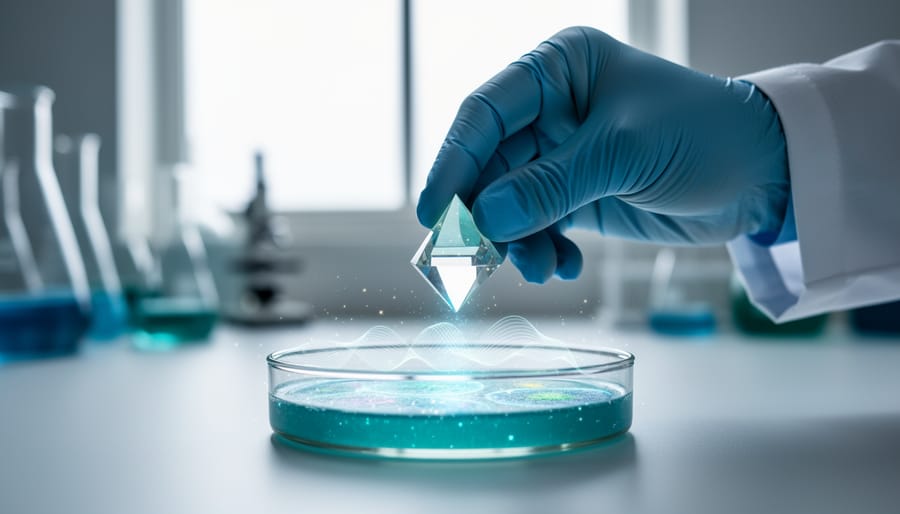
Quantum medicine refers to experimental approaches in healthcare that attempt to apply principles from quantum physics to biological processes, diagnostics, and treatment. At its core, this emerging field explores whether quantum mechanical phenomena like superposition, entanglement, and tunneling play functional roles in living systems and whether these effects can be harnessed for medical purposes.
The concept sits at a controversial intersection of cutting-edge physics and biology. While quantum mechanics governs all matter at the atomic level, the question remains whether these effects survive long enough in warm, wet biological environments to meaningfully influence processes like enzyme function, photosynthesis, or brain activity. Traditional quantum theory, rooted in frameworks like the Copenhagen interpretation suggests that quantum states collapse rapidly when they interact with their surroundings, a process called decoherence.
Recent discoveries have challenged that assumption. Research teams have documented quantum coherence in photosynthetic proteins and suggested quantum tunneling in certain enzymes. These findings have energized scientists to explore whether similar mechanisms could be exploited for medical imaging, drug design, or understanding consciousness itself.
But here’s the critical distinction: quantum medicine today is primarily a research frontier, not a clinical reality. While quantum technologies like MRI scanners already serve medicine, they’re engineering applications of quantum physics rather than biological quantum effects. The field faces skepticism because it also attracts pseudoscientific claims, from unproven quantum healing devices to mystical interpretations disconnected from physics.
This article clarifies what quantum medicine actually encompasses in 2026, which research areas show promise, and where the line between legitimate science and speculation currently stands.
What Quantum Medicine Means for Healthcare
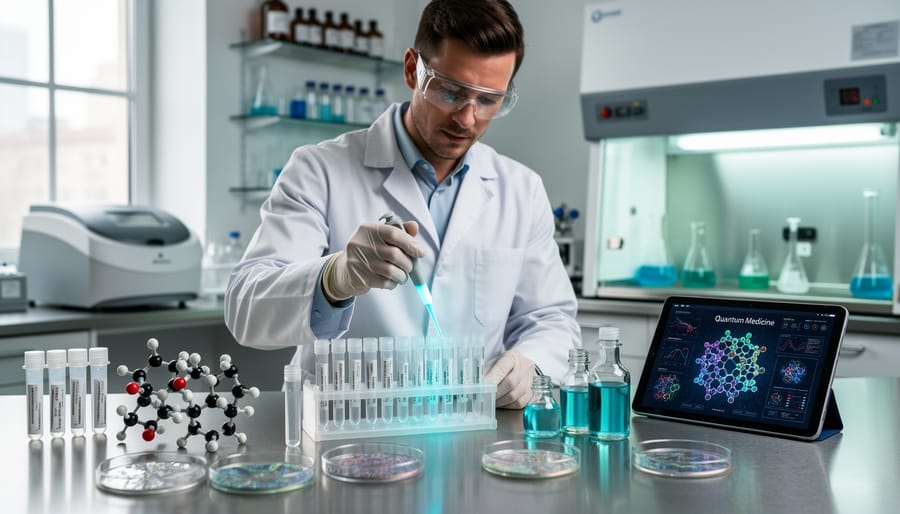
Quantum medicine represents an effort to harness the strange rules that govern matter at its smallest scales, atoms, electrons, photons, and apply them to understanding disease and developing diagnostic tools. At those scales, particles don’t behave like anything we experience in daily life. They can exist in multiple states simultaneously, tunnel through barriers that should be impenetrable, and influence each other across distances. Researchers exploring quantum physics in medicine investigate whether these phenomena play functional roles in living cells and whether we can exploit them for medical purposes.
Traditional medicine operates at the molecular and cellular level using classical physics, the same principles that govern billiard balls and chemical reactions we can see. Quantum medicine asks a different question: what if some biological processes depend on quantum effects that classical models miss? Enzyme reactions might proceed faster than classical chemistry predicts through quantum tunneling. Electrons moving through proteins during cellular respiration might maintain quantum coherence long enough to influence efficiency. These aren’t proven mechanisms in most biological systems, but rather research hypotheses being tested in laboratories worldwide.
The distinction matters because quantum medicine often gets conflated with quantum healing, energy medicine, and other practices that borrow quantum terminology without scientific basis. Legitimate quantum medicine research involves physicists, chemists, and biologists working with sophisticated equipment to measure quantum effects in biological molecules, or engineers designing sensors that exploit quantum properties to detect disease markers. The work happens in physics labs and research hospitals, produces peer-reviewed papers, and proceeds with the same rigor as any other scientific field.
What quantum medicine doesn’t mean is that quantum effects are ready to diagnose or treat patients. The vast majority of research remains at the fundamental science stage, proving quantum effects exist in specific biological contexts, understanding what conditions allow them to persist, and exploring whether they can be measured or manipulated reliably. The gap between laboratory demonstration and clinical application remains wide, with technical challenges around maintaining fragile quantum states in the warm, noisy environment of living tissue.
The Science Behind Quantum Medical Approaches
Quantum Effects in Living Systems
Nature has been experimenting with quantum physics for billions of years, long before physicists began studying these phenomena in laboratories. Scientists have documented quantum effects operating in several biological systems, revealing that life harnesses these mind-bending quantum discoveries to solve practical challenges.
One striking example involves how certain migratory birds navigate across continents. Research suggests these birds detect Earth’s magnetic field through quantum effects in bird compass systems. Specialized proteins in their eyes may exploit quantum entanglement, where pairs of particles remain mysteriously connected, to sense magnetic field directions with remarkable precision.
Plants demonstrate another well-studied quantum phenomenon. During photosynthesis, light energy must travel from where it’s captured to where it’s used for chemistry. This energy transfer operates with nearly 100 percent efficiency, far better than human-made solar cells. Studies indicate this efficiency relies on quantum coherence, where energy simultaneously explores multiple pathways to find the optimal route.
Enzymes, the molecular machines that power biological reactions, may also leverage quantum tunneling. Research into coherence and tunneling in biology shows that particles sometimes “tunnel” through energy barriers they classically couldn’t cross, potentially explaining how certain biochemical reactions proceed at life-compatible speeds.
Understanding these natural quantum processes matters for medicine because biology has already solved problems quantum medicine aims to address: sensing at molecular scales, transferring energy efficiently, and catalyzing precise chemical reactions. If researchers can decode nature’s quantum tricks, they might design medical technologies that work with similar elegance.
From Theory to Medical Technology
Translating quantum phenomena from controlled laboratory conditions into practical medical tools requires overcoming substantial engineering challenges. Researchers must design devices that can harness quantum effects while operating in the messy, warm environment of the human body, conditions that typically destroy the delicate quantum states physicists work so hard to preserve in the lab.
The development path typically begins with proof-of-concept experiments demonstrating that a quantum phenomenon can theoretically improve a medical measurement or process. Scientists then work to engineer systems that maintain quantum properties long enough to be useful, often through sophisticated shielding, cooling, or timing techniques. This might involve creating specialized molecular probes, building ultra-sensitive detectors, or developing new materials that protect quantum states.
Current experimental efforts focus on making these technologies robust enough for real-world use. For instance, researchers are exploring how quantum sensors might detect biomarkers at concentrations too low for conventional methods, or how quantum-enhanced imaging could reveal tissue features invisible to standard techniques. The technical hurdles are significant: devices must become smaller, cheaper, and more reliable while still delivering the quantum advantage they promise.
Most of these technologies remain in early research phases, with years of development needed before they could enter clinical testing.
Research Areas in Quantum Medicine
Quantum Imaging Technologies
Researchers are exploring quantum-enhanced imaging techniques that might overcome the resolution limits of conventional medical scanners. Traditional imaging hits a wall known as the diffraction limit, roughly, you can’t see details smaller than the wavelength of light you’re using. Quantum approaches aim to push past this boundary by exploiting quantum correlations between photons.
One promising direction is quantum super-resolution imaging which uses entangled photon pairs to extract finer spatial information than classical light allows. Another concept, quantum illumination, theoretically improves detection of objects against noisy backgrounds by correlating signal and reference beams at the quantum level. Squeezed light, photons engineered to reduce noise in one measurement dimension at the expense of another, could potentially enhance sensitivity in optical imaging.
These techniques remain largely confined to physics labs. Maintaining the delicate quantum states required for imaging inside the warm, chemically active environment of living tissue presents formidable challenges. Most demonstrations to date involve simplified targets or laboratory conditions far removed from clinical settings. The theoretical advantages are substantial, but translating them into practical diagnostic tools usable on patients requires solving major engineering problems around stability, speed, and cost.
Quantum Sensors for Disease Detection
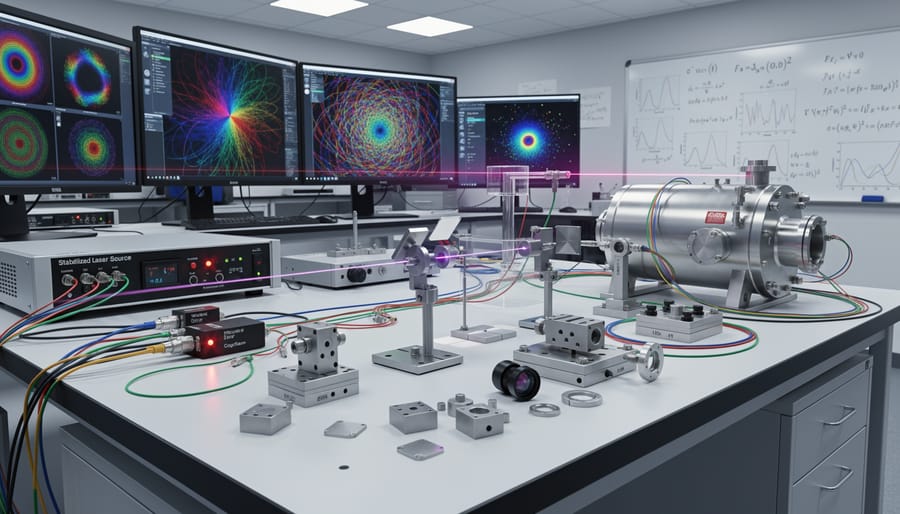
Quantum sensors exploit quantum mechanical effects to achieve measurement sensitivity far beyond what classical detectors can reach. In theory, these devices could detect disease biomarkers, proteins, metabolites, or genetic markers, at concentrations too low for current diagnostic equipment to register, potentially catching diseases at their earliest stages.
One research direction involves nitrogen-vacancy (NV) centers in diamond. These are defects in diamond’s crystal structure where a nitrogen atom sits next to a missing carbon atom, creating a system sensitive to magnetic fields at the nanoscale. Researchers are investigating whether such sensors could detect the weak magnetic signatures of individual molecules associated with disease, though practical medical applications remain distant.
Another approach under study is atomic magnetometry, which uses clouds of atoms to measure extremely subtle magnetic fields. The theoretical advantage lies in detecting changes in cellular magnetic activity that might signal disease processes before symptoms appear.
The core challenge is that quantum states typically require cold, isolated environments to remain stable, while human bodies are warm and chemically chaotic. Current research focuses on whether quantum sensing advantages can be preserved under biological conditions. While laboratory demonstrations show promise, translating these capabilities into reliable clinical tools that work in real patients remains an open question requiring substantial breakthroughs in materials science and engineering.
Quantum Computing in Medical Research
Quantum computing represents one of the most promising, yet still largely theoretical, frontiers in medical research. Unlike classical computers that process information in binary bits, quantum computers use quantum bits (qubits) that can exist in multiple states simultaneously. This quantum superposition, combined with entanglement between qubits, could theoretically solve certain computational problems exponentially faster than today’s most powerful supercomputers.
For drug discovery, this matters because simulating how molecules interact with biological targets is computationally expensive. A classical computer must calculate each possible configuration sequentially. A quantum computer could, in theory, explore many molecular arrangements simultaneously, potentially identifying promising drug candidates in hours rather than months. Researchers are investigating how quantum algorithms might model protein folding, predict drug-receptor binding, and simulate complex biochemical pathways with unprecedented accuracy.
The quantum computing landscape remains in early stages, with existing machines still limited in qubit count and stability. Current quantum computers require near-absolute-zero temperatures and are extremely sensitive to environmental interference. Most pharmaceutical quantum computing research today involves hybrid approaches that combine quantum processors with classical computers to tackle specific sub-problems in molecular simulation.
The gap between theoretical potential and clinical reality remains substantial. While proof-of-concept demonstrations have shown quantum algorithms can model simple molecules, scaling to the complexity of real drug targets, proteins with thousands of atoms, requires quantum computers far more powerful than exist today. This is future research potential, not a tool physicians or drug developers can use now.
Current Applications and Research Status
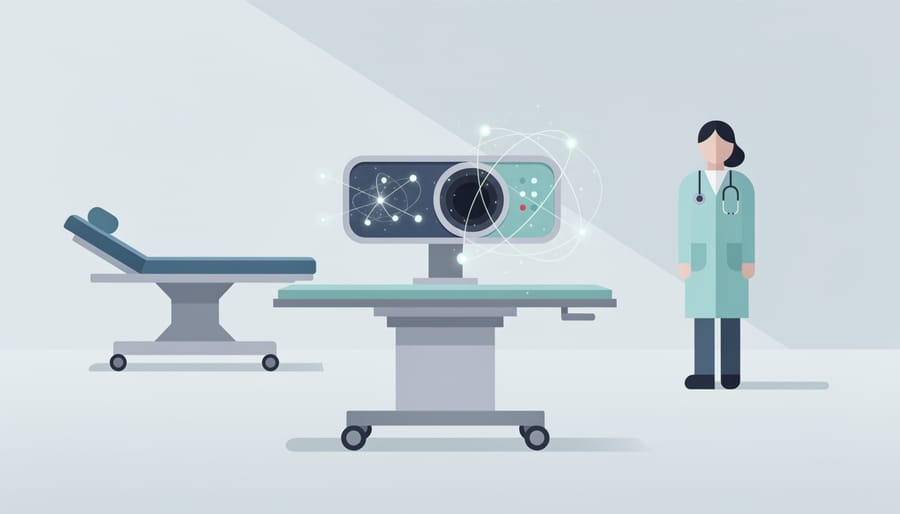
Quantum medicine today exists primarily in university laboratories and specialized research facilities rather than hospitals and clinics. While scientists have demonstrated intriguing quantum effects in controlled experiments, such as maintaining quantum states in specially designed molecules or detecting extremely weak magnetic signals from cells, translating these discoveries into practical medical tools faces substantial hurdles. The technologies that work reliably on laboratory benches often struggle when confronted with the complexity of living tissues and real-world clinical environments.
Most published quantum medicine research focuses on fundamental science: proving that quantum phenomena occur in biological systems or building prototype devices that demonstrate theoretical advantages under ideal conditions. For instance, researchers have created quantum sensors capable of detecting single molecules in laboratory samples, but converting this capability into a device that works inside a human body remains a distant goal. The gap between “proof of concept” and “approved medical device” typically spans decades of development, testing, and refinement.
Current clinical applications of quantum principles remain limited to technologies that don’t require maintaining delicate quantum states in biological environments. MRI machines, for example, exploit nuclear quantum properties but do so in ways that proved manufacturable and reliable decades ago. Newer quantum approaches haven’t yet achieved this transition from research to routine clinical use.
The research community generally views quantum medicine as a long-term investment rather than an imminent revolution. Funding agencies continue supporting basic research into quantum biology and quantum sensor development, recognizing that today’s theoretical work might enable tomorrow’s medical breakthroughs. However, regulatory approval processes, manufacturing challenges, and the need for extensive safety testing mean that even promising laboratory results face a lengthy path before reaching patients.
Challenges and Future Prospects
Quantum medicine faces formidable technical hurdles before it can transition from laboratory curiosity to clinical reality. The most fundamental challenge is environmental decoherence: quantum effects are extraordinarily fragile and typically persist only in near-absolute-zero temperatures or pristine laboratory conditions. Living organisms, by contrast, operate at body temperature in chemically complex, electrically noisy environments where quantum states collapse almost instantly. While researchers continue exploring biological systems where nature has evolved mechanisms to harness quantum effects, deliberately creating and maintaining quantum states for medical purposes in the warm, wet chaos of human tissue remains an unsolved problem.
Scaling represents another major obstacle. Even when quantum effects are demonstrated in controlled laboratory settings, translating these discoveries into devices that can function reliably in clinical environments proves exceptionally difficult. The equipment required to generate and measure quantum states often involves bulky magnetic shielding, cryogenic cooling systems, or laser arrays, technologies far removed from the portability and ease of use demanded by medical practice. Cost compounds this challenge; quantum sensors and computing hardware currently require multi-million-dollar investments and specialized technical expertise to operate and maintain.
Is quantum medicine available to patients now?
No, quantum medicine remains almost entirely in the research phase. The technologies discussed are experimental laboratory projects rather than approved medical treatments or diagnostic tools.
How is quantum medicine different from alternative medicine?
Quantum medicine refers to rigorous scientific research applying quantum physics principles to biology and medicine, pursued at universities and research institutions. This differs entirely from alternative therapies that misappropriate quantum terminology without scientific basis.
When might patients actually benefit from quantum medicine?
Realistic timelines remain uncertain. Most researchers estimate that clinical applications, if they prove viable, are likely decades away, requiring fundamental breakthroughs in maintaining quantum states in biological environments.
What makes quantum medical technologies so difficult to develop?
Quantum states are extremely fragile and collapse rapidly at body temperature or in chemically complex environments. Maintaining these delicate effects long enough to be medically useful remains an unsolved technical challenge.
Regulatory pathways for quantum medical devices also present uncertainty. Health authorities have established frameworks for approving conventional diagnostic and therapeutic technologies, but quantum devices may require entirely new evaluation criteria. Demonstrating safety and efficacy for technologies based on quantum principles could prove more complex than for classical medical devices, potentially lengthening approval timelines even after technical feasibility is established.
Despite these substantial obstacles, ongoing research continues to chip away at fundamental barriers. Breakthroughs would need to occur across multiple fronts simultaneously: discovering or engineering biological molecules that maintain quantum coherence at physiological temperatures, developing compact quantum sensing equipment that functions outside controlled laboratory environments, and demonstrating clear clinical advantages over existing diagnostic and treatment methods that justify the added complexity and cost. The field remains in its infancy, with the gap between research promise and patient care still measured in years if not decades.
Quantum medicine represents an exciting frontier where quantum physics meets medical science, but it’s crucial to keep expectations grounded. While researchers continue exploring how quantum phenomena might enhance disease detection and treatment, this field remains largely in the laboratory stage. The theoretical promise is genuine, quantum effects could theoretically enable unprecedented precision in imaging and sensing, but translating these principles into reliable clinical tools presents formidable challenges.
The path from promising research to patient care is long and uncertain. Maintaining quantum states in biological environments, scaling experimental findings, and navigating regulatory approval all pose significant hurdles. Current quantum medical technologies face years, if not decades, of development before they might reach hospitals and clinics.
What makes quantum medicine worth pursuing isn’t guaranteed breakthroughs, but rather its potential to fundamentally reshape our approach to understanding and treating disease at the molecular level. As research progresses, some avenues will prove more practical than others. The field’s value lies in rigorous investigation of these possibilities, not in overpromising near-term solutions. For now, quantum medicine remains an area of active scientific inquiry rather than established medical practice, with its ultimate clinical impact still to be determined.