
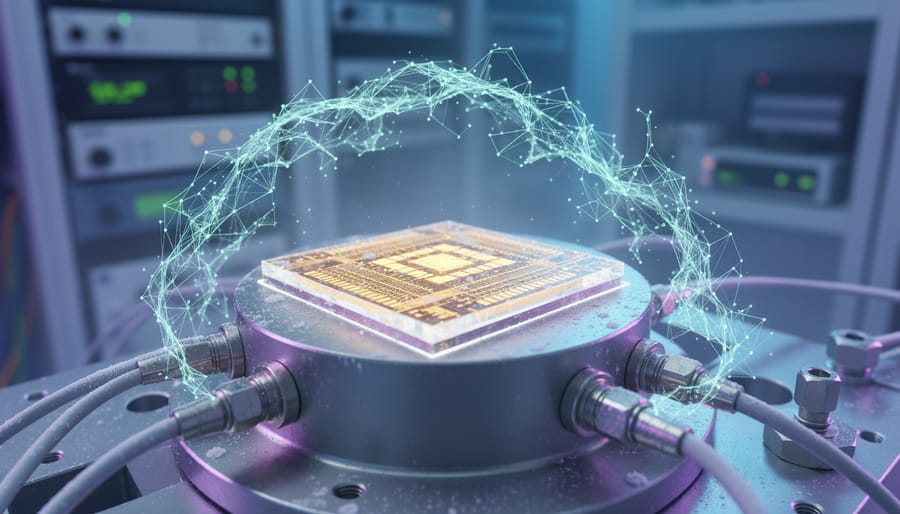
The integration of AI and quantum physics represents two revolutionary technologies working in tandem: artificial intelligence algorithms are accelerating quantum computing development and solving complex quantum problems, while quantum computers promise to supercharge AI capabilities beyond what classical machines can achieve. This bidirectional relationship is reshaping both fields as researchers discover that machine learning can optimize quantum systems and quantum processors can tackle AI calculations that would take conventional computers millennia.
The convergence matters because quantum computers operate fundamentally differently from the devices we use daily. Where classical computers process information as binary bits, quantum systems exploit superposition and entanglement to explore multiple solutions simultaneously. Yet building stable quantum computers remains extraordinarily difficult. Qubits are fragile, error rates are high, and controlling these systems requires solving optimization problems so complex that traditional methods fall short. AI stepped in to bridge this gap, learning to calibrate quantum hardware, correct errors in real time, and even discover new quantum algorithms that human researchers hadn’t conceived.
The relationship flows both ways. Quantum computers could eventually run AI models that explore solution spaces exponentially faster than today’s supercomputers, potentially revolutionizing drug discovery, materials science, and financial modeling. Companies like Google, IBM, and startups such as Rigetti Computing are actively deploying machine learning to improve their quantum processors, while simultaneously developing quantum circuits designed to accelerate neural network training.
“We’re seeing AI become an indispensable tool for making quantum systems practical,” notes Dr. Sarah Chen, a quantum researcher at MIT. “Without machine learning handling calibration and error correction, many of today’s mind-bending quantum discoveries simply wouldn’t be possible at scale.”
This article explores how these technologies enhance each other, the main approaches driving progress, and where real-world applications are already delivering results in 2026.
What AI and Quantum Physics Integration Means
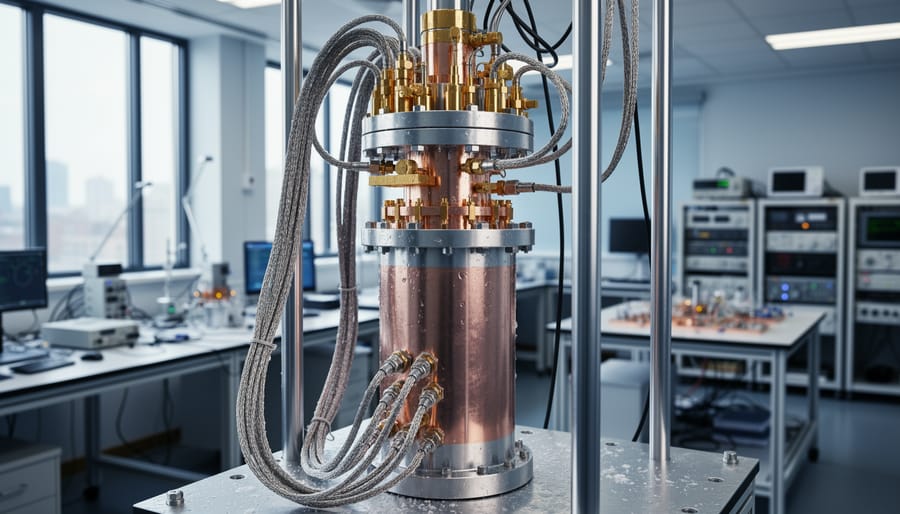
AI and quantum physics integration represents a two-way street of scientific advancement. In one direction, machine learning algorithms are helping physicists solve quantum mechanical problems that were previously intractable, predicting how molecules behave, simulating quantum materials with thousands of interacting particles, and discovering new compounds with specific quantum properties. In the other direction, quantum computers promise to accelerate AI itself by performing certain calculations exponentially faster than classical machines, potentially revolutionizing how we train neural networks and optimize complex systems.
This convergence matters because quantum physics and AI share a fundamental challenge: complexity. Quantum systems grow exponentially harder to simulate as you add particles, a molecule with just 30 electrons requires tracking more quantum states than there are atoms in the universe. Traditional supercomputers hit a wall. AI offers a workaround by learning patterns in quantum data rather than calculating every possibility, compressing vast quantum information into manageable predictions.
The reverse relationship holds equal promise. Quantum computers exploit superposition and entanglement to explore multiple solution paths simultaneously, which could transform how AI handles optimization problems, samples from complex probability distributions, or searches through enormous datasets. A quantum processor might train certain neural networks in hours instead of weeks, or find optimal solutions to logistics puzzles that would take classical algorithms years.
These aren’t separate futures. Researchers are building hybrid systems that blend quantum processors with classical AI, using each technology where it excels. Variational quantum algorithms, for instance, let quantum chips handle specific calculations while classical neural networks manage the optimization loop. This practical middle ground is delivering results today rather than waiting for fault-tolerant quantum computers decades away. The integration creates scientific tools neither field could build alone, opening research directions from designing room-temperature superconductors to modeling protein folding with quantum accuracy.
How the Integration Works
AI Solving Quantum Problems
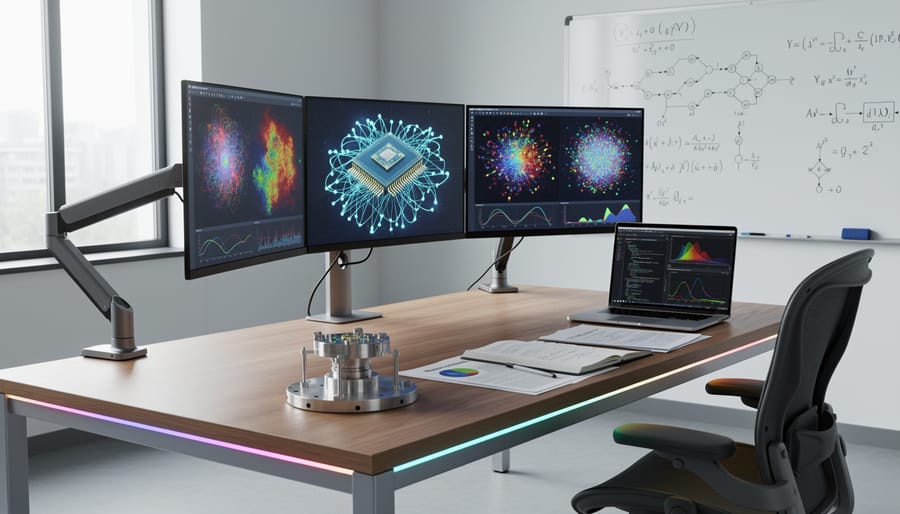
Machine learning has become a powerful accelerator for quantum mechanical calculations that traditionally required weeks of supercomputer time. Neural networks now predict molecular behavior by learning patterns from quantum simulation data, bypassing the need to solve Schrödinger’s equation from scratch for every new molecule. For example, deep learning models trained on databases of molecular structures can forecast binding energies, reaction barriers, and excited states in seconds rather than days, enabling chemists to screen thousands of drug candidates or battery materials rapidly.
Reinforcement learning takes a different approach by optimizing how quantum experiments are conducted. Instead of predicting outcomes, these algorithms learn through trial and error to reinforcement learning discover feedback strategies that stabilize fragile quantum states or improve measurement precision. The technique has proven especially valuable in quantum control, where algorithms adjust laser pulses or magnetic fields in real time to maintain coherence in quantum systems.
Perhaps the most widespread application is accelerating density functional theory calculations, the workhorse method for modeling electron behavior in materials. AI surrogate models reproducing DFT accuracy have cut computational costs by orders of magnitude, making it feasible to simulate larger systems and longer timescales. These neural network potentials learn the relationship between atomic configurations and quantum mechanical forces without explicitly solving the underlying equations each time.
Dr. Cecilia Clementi at the Free University of Berlin notes that “machine learning is not replacing quantum mechanics, it’s learning its language. We’re teaching algorithms to recognize quantum patterns so they can make predictions that would take traditional methods years to compute.” This partnership allows researchers to explore chemical space at unprecedented scale while maintaining quantum-level accuracy.
Quantum Computing Enhancing AI
Quantum computers process information fundamentally differently from classical machines, using quantum bits (qubits) that exist in superposition states and exploit quantum entanglement. This architecture opens specific opportunities for machine learning, though practical quantum advantage remains limited in 2026.
Quantum neural networks represent one promising approach, where quantum circuits replace classical neural network layers. These circuits can encode data in quantum states and perform transformations through quantum gates, potentially processing certain patterns exponentially faster than classical networks. Research teams at IBM and Google have demonstrated proof-of-concept quantum neural networks for image classification and optimization tasks, though current implementations handle only small datasets due to qubit limitations and noise.
Quantum sampling offers more immediate potential. Problems like generating samples from complex probability distributions, which classical computers struggle with, align naturally with quantum mechanics. Quantum annealers and gate-based systems can explore solution spaces more efficiently for specific machine learning tasks, including training restricted Boltzmann machines and generating synthetic data. D-Wave systems have shown advantages in sampling applications, though debates continue about the scope of practical quantum speedup.
Quantum optimization algorithms tackle combinatorial problems that plague classical AI. The Quantum Approximate Optimization Algorithm (QAOA) and variations aim to find optimal solutions in machine learning training, feature selection, and neural architecture search. These algorithms show theoretical promise for problems where classical approaches scale poorly, yet current quantum hardware lacks the qubit count and coherence times for meaningful real-world advantage.
The gap between theoretical quantum advantage and practical deployment remains substantial. Error rates, limited qubit connectivity, and short coherence windows constrain what quantum processors can achieve today, making hybrid quantum-classical approaches the realistic path forward rather than purely quantum AI systems.
Hybrid Quantum-Classical Systems
Today’s quantum processors are impressive in theory but limited in practice, too few qubits, too much noise, and errors that accumulate quickly. That’s why the most successful approach in 2026 pairs quantum hardware with classical AI in hybrid quantum-classical systems. These architectures let each component handle what it does best: quantum circuits explore solution spaces that classical computers can’t reach, while classical algorithms optimize parameters, correct errors, and manage the overall computation.
The flagship method is the variational quantum eigensolver (VQE), which uses a quantum processor to prepare and measure quantum states while a classical optimizer adjusts circuit parameters to minimize energy. VQE targets NISQ computers (noisy intermediate-scale quantum devices) by keeping quantum circuits short and shallow, reducing the chance of errors. A classical machine learning algorithm, often gradient descent or Bayesian optimization, handles the feedback loop, learning which parameter settings produce better results and steering the quantum device toward the answer.
Other hybrid approaches include quantum approximate optimization algorithms (QAOA) for combinatorial problems and quantum neural networks where a quantum circuit acts as a trainable layer inside a classical deep learning model. The division of labor makes sense: quantum hardware tackles the exponentially hard pieces, classical AI does the heavy lifting on optimization and data processing. This practical compromise bypasses the need for error-corrected, fault-tolerant quantum computers that remain years away, delivering useful results on the hardware available now.
Key Components and Approaches

The convergence of AI and quantum physics rests on several distinct technological approaches, each addressing different aspects of the challenge. Understanding these components helps clarify how researchers are actually building bridges between classical machine learning and quantum systems.
At the foundation, quantum machine learning algorithms represent the most direct path toward integration. These algorithms run on quantum processors and exploit quantum phenomena like superposition and entanglement to process information in fundamentally different ways than classical computers. Variational quantum eigensolvers (VQEs) and quantum approximate optimization algorithms (QAOAs) currently lead the field, using quantum circuits with adjustable parameters that classical optimizers tune to solve specific problems. While we have yet to demonstrate clear quantum advantage for most practical machine learning tasks, these algorithms form the experimental testbed for exploring what quantum processors might eventually achieve.
The primary integration approaches being developed and tested include:
- Quantum machine learning algorithms that run natively on quantum processors, including quantum neural networks and quantum kernel methods
- AI-driven quantum error correction systems that use machine learning to identify and compensate for noise in quantum computations
- Neural network quantum state representations that compress and predict complex quantum wavefunctions using deep learning architectures
- Quantum-inspired classical algorithms that borrow mathematical structures from quantum mechanics to enhance conventional computing
- AI for quantum materials discovery, using generative models and reinforcement learning to predict materials with desired quantum properties
Complementing these algorithmic approaches, neural network quantum state representations have emerged as a powerful framework for tackling the exponential complexity of quantum systems. Restricted Boltzmann machines, convolutional neural networks, and transformer architectures can approximate quantum wavefunctions with remarkable efficiency, compressing information about systems with millions of quantum states into tractable models. This approach has proven especially valuable for simulating quantum many-body systems, where traditional methods struggle with computational demands.
Meanwhile, AI-driven quantum error correction addresses one of quantum computing’s most fundamental obstacles. Quantum states are fragile, degrading rapidly through decoherence and operational errors. Machine learning models now decode error syndromes faster and more accurately than classical algorithms, predicting error patterns and adapting correction strategies in real time. Google’s recent demonstrations show neural networks reducing logical error rates in superconducting qubits, a critical step toward fault-tolerant quantum computation.
Interestingly, quantum-inspired classical algorithms prove that the exchange flows both ways. Techniques like tensor networks and quantum annealing simulations run on conventional hardware but apply mathematical insights from quantum mechanics. These methods solve optimization problems in logistics, drug design, and machine learning itself, delivering practical benefits today without requiring actual quantum processors.
Finally, hybrid quantum systems combine the strengths of both paradigms. A classical computer handles preprocessing, optimization, and post-processing while delegating specific subroutines to a quantum co-processor. This architecture matches current hardware capabilities, where quantum processors excel at narrow tasks but lack the scale and stability for end-to-end computation. Research teams at IBM, Microsoft, and academic institutions are refining these hybrid workflows, identifying which problem components genuinely benefit from quantum processing and which remain better suited to classical approaches.
Real-World Applications
Drug Discovery and Materials Science
In pharmaceutical development, AI-enhanced quantum simulations are cutting the time needed to model molecular interactions from years to months. Researchers at MIT and IBM are using machine learning algorithms to predict how drug candidates will bind to protein targets at the quantum level, accounting for electron behavior that classical models miss. One breakthrough came in 2025 when a team at the University of Toronto used neural networks trained on quantum chemistry data to identify a promising tuberculosis treatment candidate, reducing the initial screening phase from 18 months to just three weeks.
Materials science is seeing similarly dramatic advances. Scientists at Stanford are applying AI + quantum in science to design new battery materials with specific quantum properties that could triple energy density. The AI learns from quantum mechanical calculations to predict which atomic arrangements will produce desired electrical characteristics, then guides experimentalists toward the most promising candidates. At Oxford University, researchers used this approach to discover a new class of superconducting materials, with the AI accurately predicting critical transition temperatures based on quantum electron pairing mechanisms. These applications demonstrate how machine learning can navigate the vast chemical space, estimated at 10^60 possible small molecules, by focusing computational resources on compounds most likely to exhibit target quantum behaviors.
Quantum Chemistry and Molecular Modeling
Machine learning models are reshaping how scientists predict molecular behavior by dramatically reducing the computational cost of quantum chemistry calculations. Traditional quantum mechanical methods like coupled cluster theory can take weeks to calculate the energy of a single medium-sized molecule, but neural networks trained on quantum data now produce comparable accuracy in seconds.
Research teams at MIT and the University of Cambridge have developed graph neural networks that learn molecular potential energy surfaces, the quantum mechanical “landscape” that determines how molecules move and react. These models predict reaction pathways and transition states for catalytic processes without running expensive quantum simulations for each configuration. In one 2025 study, researchers used this approach to screen thousands of potential catalysts for converting carbon dioxide into useful chemicals, identifying promising candidates 10,000 times faster than conventional density functional theory.
The implications for energy storage are particularly significant. Battery researchers use machine learning surrogates for quantum calculations to rapidly evaluate electrolyte formulations and electrode materials, predicting ionic conductivity and decomposition voltages from molecular structure. This accelerates the discovery cycle from years to months, helping identify solid-state battery materials that traditional trial-and-error would never reach within practical timescales.
Optimization and Cryptography
Classical AI algorithms already tackle complex optimization problems across industries, from routing delivery trucks to managing investment portfolios. Machine learning methods like genetic algorithms and simulated annealing excel at finding good solutions to problems with millions of variables, where testing every combination is computationally impossible. Financial institutions use reinforcement learning to optimize trading strategies, while logistics companies deploy neural networks to minimize fuel costs and delivery times across global supply chains.
Quantum computing could eventually supercharge these optimization tasks. Quantum annealers, specialized quantum processors designed for optimization, explore multiple solution pathways simultaneously through quantum superposition. D-Wave Systems and other companies are testing these machines on scheduling problems and traffic flow optimization, though current quantum devices remain limited in size and accuracy. Quantum algorithms like QAOA (Quantum Approximate Optimization Algorithm) show theoretical promise for portfolio optimization and resource allocation.
In cybersecurity, the relationship cuts both ways. Quantum computers threaten current encryption methods by potentially cracking RSA and elliptic curve cryptography, prompting development of quantum-resistant algorithms. Meanwhile, AI helps analyze quantum communication networks and detect vulnerabilities in post-quantum cryptographic systems, creating a cat-and-mouse dynamic between quantum threats and AI-powered defenses.
Common Questions About AI-Quantum Integration
The convergence of AI and quantum physics raises practical questions about timelines, accessibility, and real-world readiness. Here are answers to the most common queries from students, researchers, and professionals exploring this field.
Can quantum computers run AI algorithms today?
Yes, but with significant limitations. Current quantum computers can execute small-scale AI experiments and proof-of-concept demonstrations, but they lack the qubit count, error correction, and stability needed for practical advantage over classical systems. Most quantum AI work in 2026 runs on hybrid systems that offload specific subroutines to quantum processors while classical computers handle the bulk of computation.
How close are we to practical quantum-enhanced AI?
Experts estimate we’re five to fifteen years from quantum computers delivering consistent advantages for real-world AI tasks. The quantum computing landscape is expanding rapidly, with more machines coming online each year, but achieving fault-tolerant quantum computers capable of running large AI models remains a major engineering challenge. Near-term applications will likely focus on narrow optimization problems rather than general-purpose machine learning.
Do you need access to a quantum computer to benefit from AI-quantum integration?
No. The more mature side of this integration, using classical AI to solve quantum physics problems, requires only standard machine learning tools and computational resources. Researchers are applying neural networks to quantum chemistry, materials discovery, and quantum state prediction without touching actual quantum hardware.
What are the biggest obstacles to widespread adoption?
Hardware limitations top the list: today’s quantum computers suffer from high error rates, short coherence times, and limited qubit connectivity. Beyond hardware, the field faces a skills gap, as expertise in both quantum physics and machine learning remains rare, and a lack of standardized software frameworks that would make quantum AI development more accessible to non-specialists.
For students and early-career researchers, the good news is that you don’t need to wait for fully fault-tolerant quantum computers to contribute. Classical machine learning applied to quantum problems represents a growing research area with immediate opportunities. Universities and companies offer cloud access to current quantum systems for experimentation, and many valuable contributions come from improving algorithms and theoretical frameworks rather than running experiments on exotic hardware.
Key Terms in AI-Quantum Integration
Understanding the specialized vocabulary of AI-quantum integration helps you follow research developments and grasp what’s actually possible versus what remains theoretical. The field draws terminology from quantum mechanics, computer science, and machine learning, creating a unique interdisciplinary lexicon.
- Quantum Supremacy (Quantum Advantage)
- The point at which a quantum computer can solve a problem faster than any classical computer, regardless of how powerful. The term “quantum advantage” is increasingly preferred as it focuses on practical usefulness rather than theoretical speed alone.
- Qubit
- The quantum equivalent of a classical bit, a qubit can exist in a superposition of both 0 and 1 states simultaneously until measured. The fragility and error rates of qubits represent the primary challenge in building practical quantum computers.
- Quantum Entanglement
- A phenomenon where two or more qubits become correlated in ways that have no classical equivalent, such that measuring one instantly affects the others regardless of distance. This property enables certain quantum algorithms to process information in fundamentally new ways.
- Variational Quantum Algorithm
- A hybrid approach that uses a quantum processor to evaluate certain functions while a classical optimizer adjusts parameters to find optimal solutions. These algorithms work on current noisy quantum hardware and form the basis of most near-term AI-quantum applications.
- Quantum Neural Network
- A machine learning model that runs on quantum hardware, using quantum gates and qubit interactions to process data. Research is exploring whether these networks can learn patterns that classical neural networks cannot efficiently represent.
- Quantum Annealing
- A quantum computing approach designed specifically for optimization problems, where the quantum system naturally evolves toward low-energy states representing optimal solutions. Companies like D-Wave have built quantum annealers for logistics and scheduling applications.
- Density Functional Theory
- A computational quantum chemistry method that predicts the properties of many-electron systems, widely used for materials science and drug design. AI is increasingly used to speed up these calculations or replace them with learned approximations.
- Quantum Error Correction
- Techniques for protecting quantum information from noise and decoherence by encoding a single logical qubit across multiple physical qubits. Achieving fault-tolerant quantum computing at scale depends on practical error correction schemes.
- Decoherence
- The process by which quantum systems lose their quantum properties through interaction with the environment, causing qubits to behave classically. Minimizing decoherence time is essential for maintaining quantum advantage in computations.
- Hamiltonian
- A mathematical operator describing the total energy of a quantum system, central to solving quantum mechanical problems. AI methods are being developed to learn effective Hamiltonians from experimental data or to simulate Hamiltonian evolution more efficiently.
These terms appear frequently in research papers and news about AI-quantum integration. When researchers discuss quantum neural networks or variational algorithms, they’re typically referring to hybrid systems that work on today’s noisy quantum processors rather than future fault-tolerant machines. The vocabulary reflects both the quantum computing hardware limitations we currently face and the creative algorithmic approaches scientists have developed to work within those constraints.
The convergence of AI and quantum physics stands at the frontier of scientific innovation, promising breakthroughs that neither field could achieve alone. While today’s quantum computers remain limited in scale and stability, the rapid progress in both quantum hardware and machine learning algorithms suggests we’re approaching an inflection point. Researchers are already using AI to solve quantum problems that were computationally prohibitive just five years ago, and the first demonstrations of quantum advantage for specific machine learning tasks have moved from theoretical possibility to experimental reality.
Current limitations are real and significant. Quantum computers in 2026 still struggle with noise, decoherence, and scaling beyond a few hundred qubits. Most practical applications rely on hybrid classical-quantum systems rather than pure quantum computing. The hype surrounding quantum AI often outpaces the actual capabilities, and many promised applications remain years or decades from commercial viability. Yet this gap between present reality and future potential creates precisely the kind of challenge that drives scientific progress.
The momentum is undeniable. Universities are launching interdisciplinary quantum information science programs, tech companies are investing billions in quantum research, and the pace of published breakthroughs continues to accelerate. We’re seeing quantum chemistry simulations that would have required supercomputers now running on laptop-scale classical systems powered by machine learning, while quantum processors are beginning to tackle optimization problems beyond classical reach.
For students and early-career researchers, this intersection offers extraordinary opportunities. The field needs people who can bridge quantum physics, computer science, mathematics, and engineering. It needs those who can translate between disciplines and solve problems that don’t fit neatly into traditional academic boundaries. As both AI and quantum technologies mature over the coming decade, the scientists who understand their integration will be positioned to tackle some of humanity’s most pressing challenges, from climate modeling to drug discovery to fundamental questions about the nature of computation itself.