
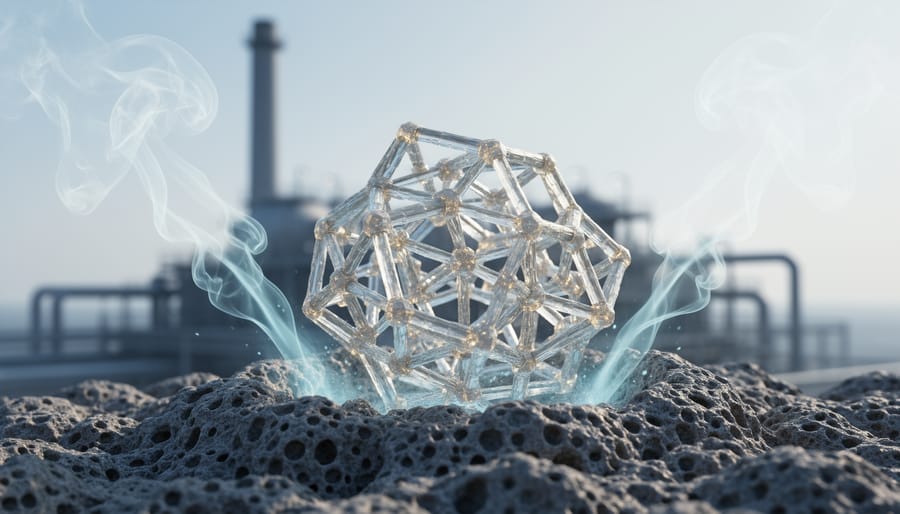
Zeolite carbon capture is a technology that uses porous, crystalline minerals called zeolites to selectively trap carbon dioxide from industrial emissions or directly from the air. These naturally occurring or synthetic materials act like molecular sieves, with microscopic channels that preferentially adsorb CO2 molecules while allowing other gases to pass through. As the scientific consensus continues to emphasize the urgent need to reduce atmospheric carbon, zeolite-based systems have emerged as a promising complement to low-carbon energy sources in the fight against climate change.
What makes zeolites particularly attractive is their tunability. Researchers can engineer the size and chemistry of their pores to optimize CO2 capture efficiency for specific applications, from power plant flue gas to ambient air. Unlike liquid amine solvents, which have dominated industrial carbon capture for decades, zeolites can be regenerated at lower temperatures, potentially reducing the energy penalty that has long plagued carbon capture economics.
The technology has moved beyond laboratory curiosity. Pilot facilities in 2026 are testing zeolite systems at coal-fired power plants and cement factories, two of the most challenging emission sources to decarbonize. Dr. Maria Chen, a materials scientist at Pacific Northwest National Laboratory, notes that “we’re seeing capture costs drop as manufacturing scales up and new zeolite formulations enter the market.”
This article explores how zeolite carbon capture works at the molecular level, examines the different types of zeolites being deployed, and evaluates where this approach fits in the broader toolkit of climate solutions.
What Zeolite Carbon Capture Means
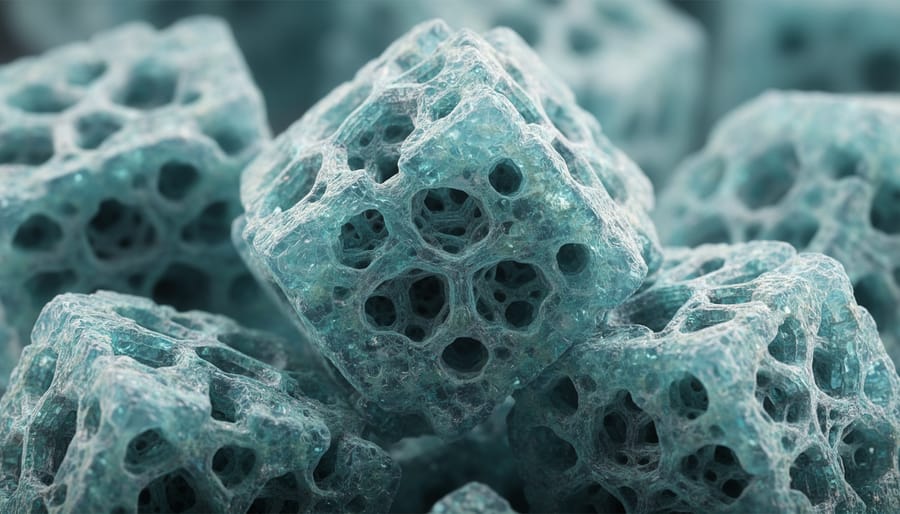
Zeolite carbon capture is a technology that uses naturally occurring or synthetic minerals called zeolites to selectively trap and remove carbon dioxide from gas streams or ambient air. These materials work as molecular filters, pulling CO2 molecules out of industrial emissions or the atmosphere and holding them until they can be released under controlled conditions for permanent storage or conversion into useful products.
Zeolites are microporous aluminosilicate minerals with crystalline, cage-like structures riddled with uniform channels and cavities at the molecular scale. Think of them as microscopic sponges with precisely sized pores, typically measuring 3 to 10 angstroms in diameter. This pore architecture gives zeolites their remarkable ability to discriminate between different gas molecules based on size and chemical affinity. The framework consists of silicon and aluminum atoms bonded to oxygen, creating a negatively charged lattice that attracts positively charged ions and polar molecules like CO2.
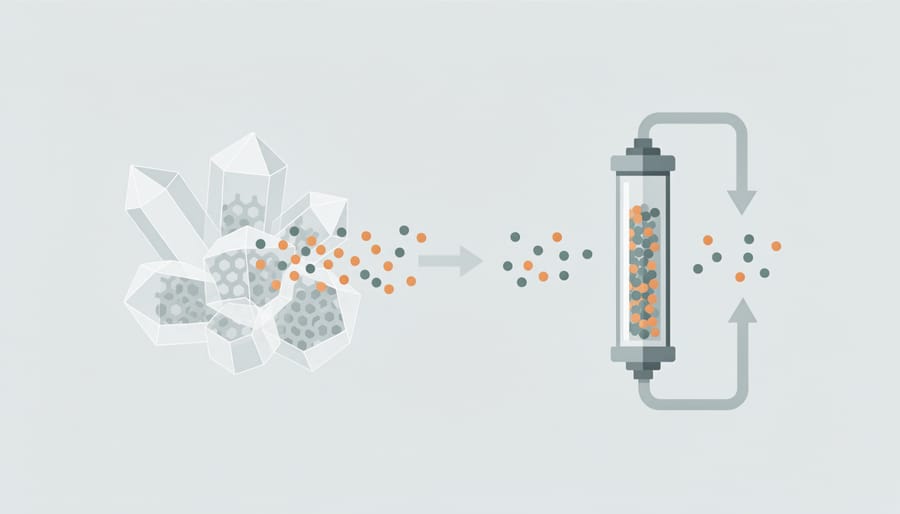
When gas containing carbon dioxide flows through zeolite material, CO2 molecules enter the pores and become trapped through a process called molecular sieve adsorption in zeolites. The molecules stick to the pore walls via weak electrostatic forces rather than chemical bonding, which means they can be released later by changing temperature or pressure. This reversibility makes zeolites reusable for thousands of cycles.
- Zeolite Structure
- A three-dimensional crystalline framework of silicon, aluminum, and oxygen atoms forming uniform micropores and channels that act as molecular-scale filters.
- Adsorption vs. Absorption
- Adsorption means molecules stick to a surface, while absorption means they’re taken into the bulk material. Zeolites use adsorption, holding CO2 on pore walls rather than dissolving it.
- Selective Binding
- The ability of zeolite pores to preferentially capture certain molecules based on size, shape, and polarity, allowing CO2 separation from nitrogen, oxygen, and other gases.
- Pore Size
- The diameter of channels and cavities within the zeolite structure, measured in angstroms (10⁻¹⁰ meters), which determines which molecules can enter and be captured.
- Cation Exchange Capacity
- The zeolite framework’s ability to host and exchange metal ions, which can be tuned to enhance CO2 attraction and binding strength for improved capture performance.
Zeolite carbon capture finds application in two main scenarios. In point-source capture, zeolites filter concentrated CO2 from industrial exhaust streams at cement plants, steel mills, or power stations where emissions exit through a stack. In direct air capture, these materials extract CO2 from ambient air where concentrations hover around 420 parts per million, requiring materials with especially high selectivity and affinity for CO2 over the far more abundant nitrogen and oxygen.
How Zeolite Carbon Capture Works
The Role of AI in Optimizing Zeolite Performance
Machine learning has transformed how researchers identify and optimize zeolites for carbon capture. Traditional trial-and-error methods once required months of lab work to test a handful of zeolite candidates. Today, AI optimization enables scientists to computationally screen thousands of zeolite structures in days, predicting which frameworks will exhibit the strongest CO2 binding affinity before synthesizing a single sample.
Machine learning for CO2 binding analyzes crystallographic databases containing over 200,000 possible zeolite structures, evaluating pore geometry, chemical composition, and surface properties to rank candidates by their predicted capture performance. Algorithms trained on quantum mechanical calculations can forecast how different zeolites will behave under varying temperature and pressure conditions, pinpointing optimal operational parameters without running expensive pilot tests.
Beyond screening existing materials, AI now designs entirely novel zeolite frameworks with enhanced selectivity for CO2 over nitrogen and water vapor. Dr. Sarah Chen at MIT’s Carbon Sequestration Lab explains: “We’re using generative models to propose zeolite structures that don’t exist in nature or current databases. The AI suggests atomic arrangements we wouldn’t have imagined, and several have shown 40% better CO2 uptake in simulations.” These AI-discovered materials are now moving into synthesis and real-world testing, potentially accelerating the path to commercial deployment by five to seven years.
Types of Zeolites Used in Carbon Capture
Zeolites fall into two broad categories: natural minerals mined from volcanic deposits and synthetic versions manufactured in laboratories or industrial facilities. Natural zeolites like clinoptilolite are abundant and inexpensive, making them attractive for large-scale deployment where cost matters more than peak performance. However, they typically offer lower CO2 capacity and less precise pore structures than their synthetic counterparts. Synthetic zeolites, engineered to exact specifications, deliver superior selectivity and adsorption capacity but come at a higher price point that can challenge commercial viability.
Among the workhorse synthetic zeolites, 13X (a type of faujasite) stands out for industrial point-source capture. Its large pore openings, roughly 10 angstroms across, accommodate CO2 molecules while maintaining good selectivity against nitrogen and other flue gas components. Power plants and cement factories often favor 13X for its balance of capacity, regeneration efficiency, and proven track record in pressure swing adsorption systems.
ZSM-5, with its medium-pore structure and high silica-to-alumina ratio, excels in separating CO2 from gas streams containing water vapor. Its hydrophobic character means it doesn’t compete as aggressively with moisture for adsorption sites, a persistent problem in humid industrial exhaust. The trade-off is lower absolute CO2 uptake compared to 13X, making ZSM-5 better suited for selective capture applications where purity matters more than total volume.
Chabazite, particularly the SSZ-13 variant, has gained attention for direct air capture because its small pore windows, around 3.8 angstroms, strongly favor CO2 over other atmospheric gases. This selectivity comes at a cost: chabazite requires more energy to regenerate and remains expensive to produce at scale.
Emerging engineered zeolites push performance boundaries further. Researchers are embedding metal ions like copper or sodium into frameworks to enhance CO2 binding strength, and designing hierarchical pore structures that combine fast gas diffusion with high adsorption capacity. These next-generation materials promise lower regeneration temperatures and longer operational lifetimes, though most remain in the pilot stage as of 2026. The durability question looms large; repeated adsorption cycles can degrade crystal structures, especially in the presence of water and acidic gases, making long-term stability testing crucial before commercial deployment.
Where Zeolite Carbon Capture Is Being Used
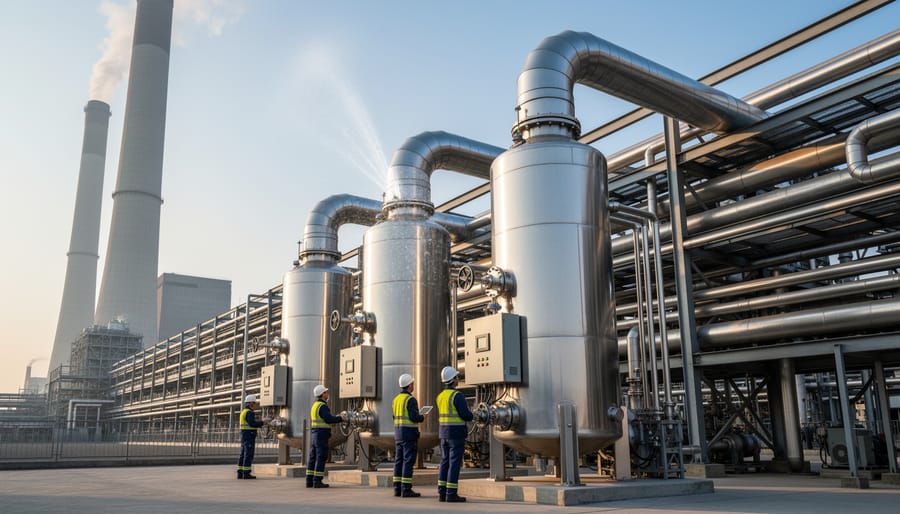
Zeolite-based carbon capture has moved beyond laboratory experiments into operational deployments across multiple sectors. The technology proves particularly valuable in point-source capture, where concentrated CO2 streams from industrial processes can be intercepted before entering the atmosphere.
Cement and steel plants represent the largest current deployments. LafargeHolcim operates a zeolite capture system at its Retznei plant in Austria, processing flue gases from cement kilns where CO2 concentrations reach 20-30%. The system uses synthetic 13X zeolite beds that capture roughly 80 tonnes of CO2 daily, which is then compressed and transported for permanent geological storage. Similar installations are running at steel manufacturing facilities in South Korea and Japan, where zeolites handle exhaust streams from blast furnaces.
Coal and natural gas power stations have integrated zeolite systems as retrofit solutions. A 50-megawatt pilot at the Mountaineer Power Plant in West Virginia has operated since 2024, using chabazite-based modules that withstand the water vapor and sulfur compounds present in power plant exhaust. The captured CO2 feeds into enhanced oil recovery operations, creating a revenue stream that offsets operational costs.
Direct air capture facilities increasingly rely on zeolite contactors for ambient CO2 removal. Climeworks runs a modular zeolite DAC array in Iceland that processes 4,000 tonnes annually, partnering with Reykjavik University to optimize regeneration cycles. Carbon Engineering’s British Columbia facility uses engineered zeolites in combination with hydroxide solutions, achieving capture costs below $200 per tonne for the first time in 2025.
The technology extends into several emerging application sectors:
- Heavy industry: Ammonia production, ethanol distillation, and hydrogen generation facilities
- Power generation: Coal, natural gas, and biomass combustion exhaust treatment
- Direct air capture: Standalone facilities removing CO2 from ambient air
- Transportation fuels: Synthetic fuel production using captured carbon as feedstock
- Building materials: Carbon-negative concrete curing and mineralization processes
- Agricultural CO2 recycling: Greenhouse enrichment and vertical farming systems
Carbon-negative concrete production represents one of the fastest-growing applications. CarbonCure Technologies has equipped over 500 concrete plants with zeolite capture units that inject recovered CO2 into fresh concrete during mixing, where it permanently mineralizes as calcium carbonate while improving compressive strength.
Synthetic fuel pathways increasingly incorporate zeolite capture. Prometheus Fuels in California combines DAC using zeolite contactors with electrolysis and Fischer-Tropsch synthesis to produce drop-in gasoline and jet fuel, closing the carbon loop for transportation. The company collaborates with Stanford University researchers who are engineering zeolites with dual functionality: capturing CO2 and catalyzing its conversion to methanol in a single material.
Academic partnerships drive innovation across these deployments. MIT’s zeolite research group works with industrial partners to field-test novel frameworks, while ETH Zurich operates test beds that evaluate zeolite performance under real exhaust conditions rather than idealized laboratory settings.
Advantages and Challenges of Zeolite-Based Systems
Zeolite-based carbon capture systems offer several compelling advantages that make them attractive for industrial deployment. Their high selectivity for CO2 over other gases means they can target carbon dioxide molecules precisely, even in mixed gas streams from power plants or cement factories. This selectivity stems from the zeolite’s uniform pore structure, which acts like a molecular sieve. Unlike liquid amine scrubbing systems that require substantial thermal energy to release captured CO2, zeolites typically need lower regeneration temperatures, reducing operational costs and energy penalties. Many zeolite frameworks demonstrate exceptional durability, maintaining their capture capacity across thousands of adsorption-desorption cycles without significant degradation. This regenerability makes them economically viable for long-term installations.
However, zeolite systems face meaningful challenges that researchers are actively addressing. The cost of high-performance synthetic zeolites remains substantial compared to natural variants, which typically lack the optimized pore structures needed for maximum efficiency. “We’re seeing promising climate progress through materials innovation, but scaling up production of designer zeolites while driving down costs is our immediate frontier,” explains Dr. Maria Chen, a materials scientist at Stanford’s carbon capture laboratory. Water vapor presents another complication, competing with CO2 for adsorption sites in humid flue gas environments and reducing capture efficiency. The energy required for regeneration, while lower than amine systems, still represents a significant operational expense that affects the overall carbon footprint of the process. Infrastructure development also poses hurdles, as widespread adoption requires purpose-built facilities and integration with existing industrial systems, demanding substantial capital investment and engineering expertise.
Common Questions About Zeolite Carbon Capture
How much CO2 can zeolites capture per cycle?
Zeolite capacity varies by framework type and operating conditions, but high-performance synthetic zeolites like 13X typically capture 3-5 mmol CO2 per gram of material under optimal conditions. Capacity decreases at lower CO2 concentrations, such as in direct air capture applications where atmospheric CO2 is only 420 ppm.
How many regeneration cycles can zeolites withstand before replacement?
Well-designed zeolite systems can undergo thousands of adsorption-desorption cycles with minimal degradation. Industrial-grade zeolites maintain 90% or more of their initial capacity after 5,000 cycles, though performance depends on regeneration temperature, moisture exposure, and contaminant levels in the gas stream.
Are natural zeolites sufficient, or do we need synthetic variants?
While natural zeolites offer lower upfront costs, synthetic zeolites deliver superior selectivity, uniform pore structures, and higher CO2 capacity. Most commercial carbon capture systems rely on engineered zeolites tailored for specific applications, though natural zeolites find niche uses where cost constraints outweigh performance requirements.
What happens to the CO2 after zeolites capture it?
Captured CO2 can be permanently stored in geological formations, mineralized into stable carbonates, or converted into valuable products like synthetic fuels and chemicals. Some companies are exploring integration with carbon markets to monetize captured carbon through credit trading.
Cost comparisons show zeolite systems generally require lower energy for regeneration than amine scrubbing, potentially reducing operating expenses by 15-30% in point-source applications. However, synthetic zeolite production remains capital-intensive, and humid environments present a persistent challenge since water vapor competes with CO2 for adsorption sites, reducing capture efficiency until moisture is removed or water-resistant zeolite variants are deployed.
Zeolite carbon capture stands at a critical juncture where proven materials science meets cutting-edge artificial intelligence. The microporous structures that have served industry for decades are now being optimized through machine learning algorithms that can evaluate thousands of zeolite configurations in hours rather than years. This convergence accelerates the path from laboratory discovery to commercial deployment, addressing the urgent need for scalable carbon sequestration solutions.
The technology has moved beyond theoretical promise. Pilot facilities are capturing CO2 from industrial sources today, and direct air capture installations using zeolite-based systems continue to expand. As synthetic zeolite production costs decline and AI-driven optimization refines operational efficiency, these systems become increasingly competitive with alternative capture methods. The ability to regenerate zeolites across hundreds of cycles, combined with their selectivity for CO2 in mixed gas streams, positions them as a durable component of carbon management infrastructure.
Meeting ambitious climate targets requires deploying multiple carbon capture approaches simultaneously. Zeolite systems, enhanced by computational design and supported by growing research partnerships between universities and industry, will likely play an expanding role. Current commercial scale-up efforts focus on reducing energy requirements for regeneration and improving performance in humid conditions. As these challenges yield to ongoing innovation, zeolite carbon capture offers a tangible pathway toward reducing atmospheric CO2 concentrations while supporting industrial decarbonization across sectors from cement to power generation.